Accounting Currency
An accounting currency—also known as a reporting or presentation currency—is the monetary denomination in which a business, fund, or trading account records transactions, maintains ledgers, and publishes financial statements.
In international business, corporate finance, and retail trading, the accounting currency—frequently termed the presentation or reporting currency—is the official monetary unit used to maintain financial ledgers, compute taxable income, and compile balance sheets.
For retail forex traders, the accounting currency represents the primary denomination of their trading account (most commonly USD, EUR, or GBP) against which all margin deposits, equity balances, realized profits, and floating drawdowns are settled, regardless of the exotic currency pairs traded on the terminal.
Functional Currency vs. Presentation (Accounting) Currency
In corporate accounting governed by International Financial Reporting Standards (IFRS / IAS 21) and U.S. GAAP (ASC 830), financial authorities draw a strict legal distinction between a company’s operational currency and its reporting currency:
| Accounting Classification | Definition | Determinant Criteria | Example |
|---|---|---|---|
| Functional Currency | The currency of the primary economic environment in which an entity operates | Currency that predominantly influences sales prices, labor costs, and operational financing | An automobile manufacturing plant located in Wolfsburg, Germany operates in Euros (EUR) |
| Presentation (Accounting) Currency | The currency in which the parent group consolidates and publishes its financial statements | Decided by corporate board of directors and regulatory listing exchange | A European subsidiary consolidating its balance sheet into an American parent company in U.S. Dollars (USD) |
Foreign Currency Translation Mechanics
When a multinational corporation consolidates global subsidiaries into a single presentation currency:
- Assets and Liabilities: Translated into the accounting currency at the closing spot exchange rate on the balance sheet date.
- Revenues and Expenses: Translated at the weighted-average exchange rate across the reporting quarter or year.
- Cumulative Translation Adjustment (CTA): Discrepancies resulting from fluctuating exchange rates are booked into a separate reserve under equity known as Other Comprehensive Income (OCI), rather than flowing through net income.
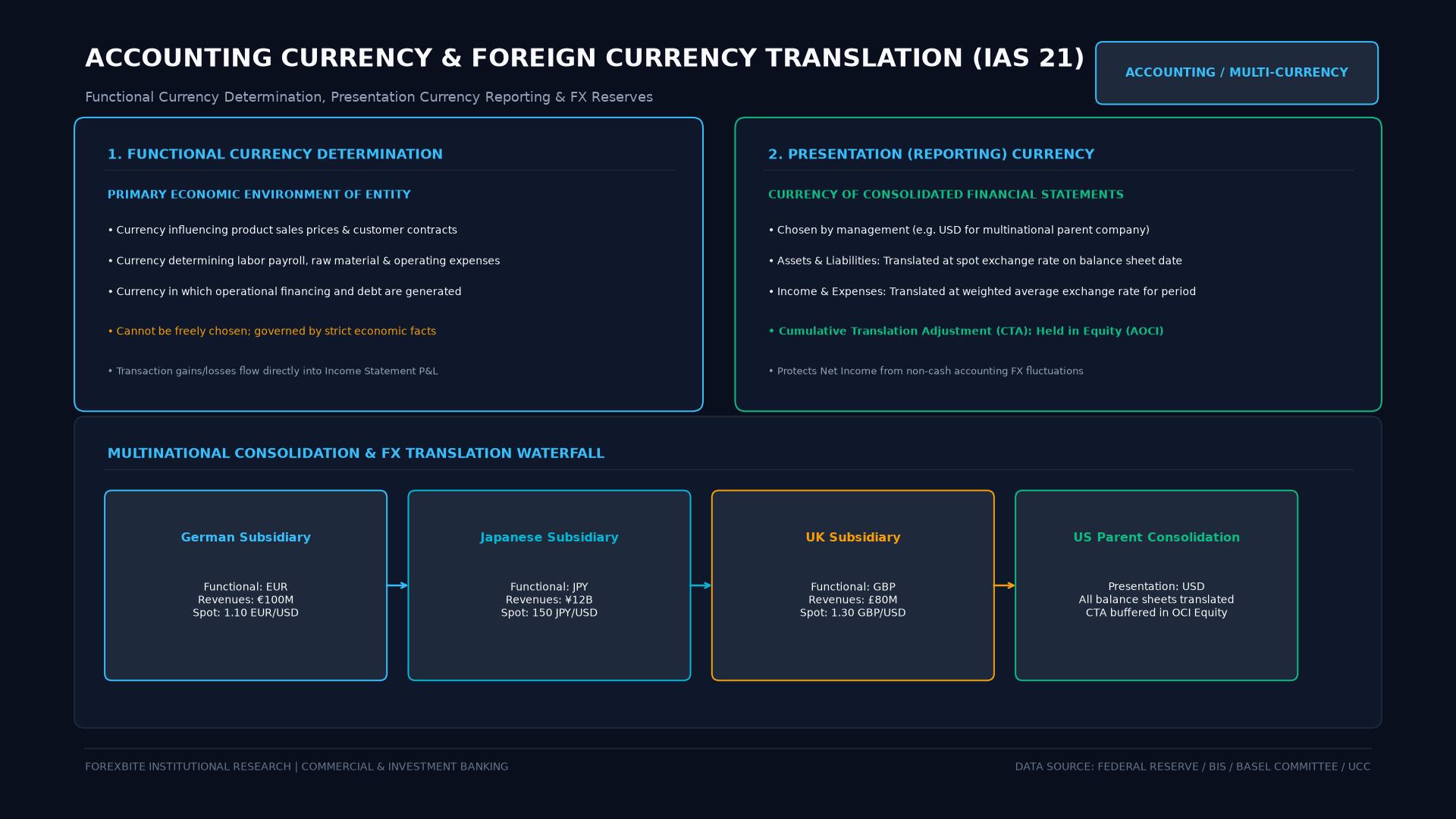 Figure: Multinational accounting currency hierarchy under IAS 21 and ASC 830, mapping local operational cash flows, functional currency determination, and presentation translation reserves.
Accounting Currencies in Retail Forex Trading
When an individual opens a brokerage account, they must choose an accounting currency (typically USD, EUR, GBP, or JPY):
- Collateral Base: Account deposits, cash withdrawals, and available margin are measured strictly in this chosen unit.
- Cross-Currency Conversion: A trader with a USD-denominated accounting currency can freely execute trades in pairs that contain no U.S. dollars at all—such as EUR/GBP, AUD/NZD, or CHF/JPY.
- Automated Settlement Flow:
- If you trade EUR/GBP, your profit or loss is natively generated in British Pounds (the quote currency).
- At the moment the trade closes, the broker’s risk engine automatically executes an internal spot transaction, converting the pound profit or loss into U.S. dollars at the prevailing GBP/USD spot exchange rate.
- Some retail brokerages apply a small currency conversion fee (typically 0.1% to 0.5%) for trades settled in currencies other than the account’s baseline accounting currency.
Practical Example: Corporate FX Translation Risk
Consider an American multinational technology firm with a major subsidiary in the United Kingdom:
- Subsidiary Performance: In 2021, the UK subsidiary generates a healthy profit of £20,000,000 GBP. The average GBP/USD exchange rate during the fiscal year is 1.3800.
- Consolidated USD Revenue: $$£20,000,000 \times 1.3800 = \mathbf{$27,600,000 \text{ USD}}$$
- The Macro Shock: In 2022, geopolitical turmoil and inflation cause the British pound to collapse. The UK subsidiary again generates an identical profit of £20,000,000 GBP in local terms. However, the average exchange rate falls to 1.1800.
- Consolidated USD Revenue: $$£20,000,000 \times 1.1800 = \mathbf{$23,600,000 \text{ USD}}$$
- The Financial Result: Even though the subsidiary maintained steady local revenue and profit, the parent firm suffers a $4,000,000 USD revenue drop on its consolidated quarterly income statement solely due to translation exposure against its domestic accounting currency.
Key Takeaways
- Financial Benchmark: The accounting currency is the official monetary denomination used to record ledgers and report financial statements.
- Functional vs. Reporting: Functional currency reflects daily operations, while presentation currency is used for consolidated financial reporting.
- Retail Margin Foundation: Account balance, free margin, and leverage buffers are locked to the trader’s chosen deposit accounting currency.
- Automatic P&L Conversion: Trading pairs outside the accounting currency requires real-time automated conversion of quote-currency profits and losses.
- Translation Exposure: Fluctuations between foreign operational currencies and corporate reporting currencies generate substantial non-operational balance-sheet volatility.
Frequently Asked Questions
Which accounting currency is best for a retail forex trader?
For the majority of global traders, the U.S. Dollar (USD) is the most practical accounting currency. Because the USD is involved in over 85% of all foreign exchange transactions, holding a USD account minimizes cross-currency conversion fees and simplifies pip value calculations ($10 per lot on major pairs).
What is the difference between transaction risk and translation risk?
Transaction risk occurs when a company has actual future cash flows or invoices committed in a foreign currency that change value before settlement. Translation risk (accounting risk) is purely a balance-sheet phenomenon where an asset or subsidiary denominated in a foreign currency must be revalued into the parent firm’s reporting currency for quarterly statements.
Can a retail trader change their account accounting currency?
Most retail brokers do not allow you to change the base accounting currency of an existing active account once opened. However, brokers routinely allow clients to open multiple sub-accounts within their portal denominated in different currencies (e.g., maintaining one USD account and one EUR account).
Ready to trade forex?
Open a free demo account with a regulated broker. Practice with virtual funds before risking real money.