Unrealized Profit and Loss
Unrealized profit and loss—often termed floating P&L—is the theoretical gain or loss generated by an open trading position based on current real-time market prices, which remains variable until the position is officially liquidated.
Unrealized Profit and Loss—frequently referred to in trading terminals as floating P&L or “paper profit/loss”—represents the immediate financial return of open market positions calculated continuously against live market quotes. Because the underlying position has not been closed, these gains or losses remain variable, fluctuating tick-by-tick with every shift in the exchange rate.
While an unrealized gain or loss does not alter the cash balance of a trading account until the position is closed, it directly dictates account equity, available free margin, and the distance to automated margin liquidation.
Mathematical Calculation of Floating P&L
In foreign exchange trading, unrealized profit and loss is calculated based on whether a position is long or short, evaluated against the current liquidation price:
1. Long Position (Bought Currency)
When long, the position must be closed by selling at the current Bid price:
$$\text{Unrealized P/L}_{\text{Long}} = (\text{Current Bid Price} - \text{Entry Price}) \times \text{Contract Size} \times \text{Lot Count}$$
2. Short Position (Sold Currency)
When short, the position must be closed by buying back at the current Ask price:
$$\text{Unrealized P/L}_{\text{Short}} = (\text{Entry Price} - \text{Current Ask Price}) \times \text{Contract Size} \times \text{Lot Count}$$
$$\text{Conversion to Account Currency} = \text{P/L in Quote Currency} \times \text{Exchange Rate to Deposit Currency}$$
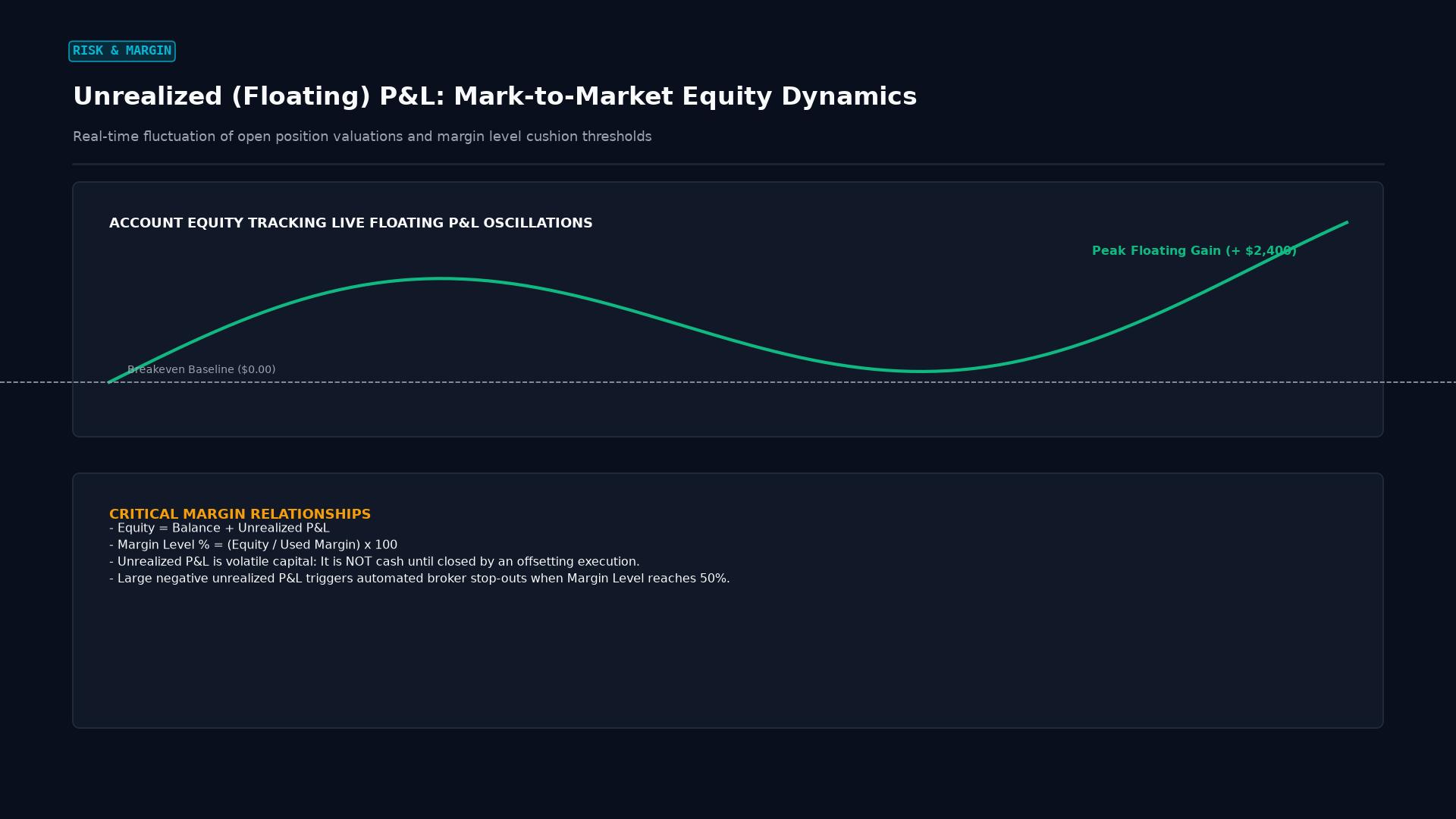 Figure: Mark-to-market equity curve: real-time floating profit and loss tracking, account equity adjustments, and margin call liquidation buffers.
Balance vs. Equity: The Core Distinction
Understanding the difference between cash balance and real-time equity is fundamental to avoiding capital destruction:
| Account Metric | Definition | Impacted by Open Trades? | Primary Purpose |
|---|---|---|---|
| Balance | Realized cash funds resulting from closed historical trades and net deposits/withdrawals | No — Remains completely static while trades are open | Accounting ledger; historical baseline |
| Floating P&L | Aggregate sum of all unrealized profits and losses across all open tickets | Yes — Fluctuates continuously with every market tick | Real-time performance measurement |
| Equity | The true immediate cash liquidation value of the account ($\text{Balance} + \text{Floating P/L}$) | Yes — Dictates the trader’s actual net worth | Risk management, margin level, stop-out safety buffer |
The Role of Unrealized P&L in Margin Health
Many retail traders fall into the dangerous psychological trap of ignoring floating losses, believing that “it’s not a real loss until I close the trade.” In institutional risk management, this premise is completely false.
The broker’s automated risk engine tracks Equity, not Balance, to assess margin safety:
$$\text{Free Margin} = \text{Equity} - \text{Used Margin}$$
$$\text{Margin Level (%)} = \left(\frac{\text{Equity}}{\text{Used Margin}}\right) \times 100$$
As floating unrealized losses expand:
- Free Margin Erodes: Usable capital shrinks, preventing the trader from opening new hedging positions.
- Margin Call Warning (100%): When floating losses cause total equity to equal used margin, free margin hits $0.
- Automated Stop-Out (50% or 20%): If the market continues moving against the position, the broker’s risk engine forcibly closes the largest losing trades at prevailing market prices, instantly transforming paper losses into catastrophic realized losses.
Practical Example: Floating Drawdown on EUR/USD
Consider a retail trading account with the following parameters:
- Account Balance: $10,000
- Broker Leverage: 1:100 (1% margin requirement)
- Trade: Long 2.0 standard lots of EUR/USD ($200,000 base value) at 1.0900
- Used Margin Locked: $2,180
The Adverse Market Move
Following a hawkish U.S. economic release, EUR/USD tumbles 150 pips from 1.0900 down to 1.0750.
Account Impact Analysis
- Each pip on 2.0 standard lots equals $20.00.
- A 150-pip decline generates an unrealized floating loss of: $$150 \text{ pips} \times $20.00 = -$3,000.00$$
- Current Account Metrics:
- Balance: Displays as $10,000.00 (unchanged on the terminal).
- Unrealized P&L: Displays as -$3,000.00 (glowing red).
- Actual Equity: $$10,000 - $3,000 = \mathbf{$7,000.00}$.
- Free Margin: $$7,000 - $2,180 = \mathbf{$4,820.00}$.
- Margin Level: $($7,000 / $2,180) \times 100 = \mathbf{321.1%}$.
If the trader manually closes the position at 1.0750, the unrealized loss becomes realized: the cash balance drops to $7,000, and the locked margin of $2,180 is returned to free cash.
Key Takeaways
- Temporary Paper Values: Unrealized P&L represents the live floating value of active trades that remains unfinalized until closed.
- Equity is King: Account equity—the true economic value of the account—is determined by adding unrealized P&L directly to cash balance.
- Bid/Ask Liquidation: Long positions are marked against the current Bid price; short positions are marked against the current Ask price.
- Margin Pressure: Growing floating losses devour free margin and can trigger automated forced liquidations (stop-outs) regardless of cash balance.
- Psychological Trap: Hope is not a strategy; refusing to cut floating losses often leads to catastrophic margin liquidation.
Frequently Asked Questions
Is unrealized profit subject to taxation?
In most international jurisdictions, capital gains taxes apply only to realized profits finalized during the taxable calendar year. However, certain jurisdictions or specialized derivative tax structures (such as Section 1256 contracts in the United States) may require year-end mark-to-market accounting. Consult a local certified tax professional for specific tax regulations.
Can I withdraw unrealized profits from my trading account?
No. Brokers permit cash withdrawals only from available Free Margin or realized settled balance. Because unrealized profits can evaporate in seconds if market prices reverse, they cannot be transferred to a bank account until the trade is closed and settled.
What happens to floating P&L during high-impact news releases?
During volatile news events, bid-ask spreads expand sharply. Because long positions are valued at the Bid and short positions at the Ask, a sudden spread blowout will instantly cause floating P&L to show a sudden temporary dip, even before actual price direction is established.
Ready to trade forex?
Open a free demo account with a regulated broker. Practice with virtual funds before risking real money.