Quote Currency
The quote currency—frequently called the counter currency or term currency—is the second currency listed in a forex currency pair, representing the amount required to purchase one unit of the base currency.
In foreign exchange trading, every transaction involves the simultaneous purchase of one currency and the sale of another. Because currencies are traded in standardized pairs, exchange rates are expressed as a ratio between two distinct assets: the base currency (the first currency listed) and the quote currency (the second currency listed, also termed the counter currency).
The quote currency serves as the price unit for the pair. It tells a trader exactly how many units of the quote currency are needed to buy a single unit of the base currency, while dictating how pip values, profit and loss calculations, and overnight financing swaps are priced in retail accounts.
The Base and Quote Currency Equation
Every currency quotation follows a universal fractional structure:
$$\text{Currency Pair} = \frac{\text{Base Currency}}{\text{Quote Currency}}$$
$$\text{Price Quote} = \text{Amount of Quote Currency to buy 1 Base Unit}$$
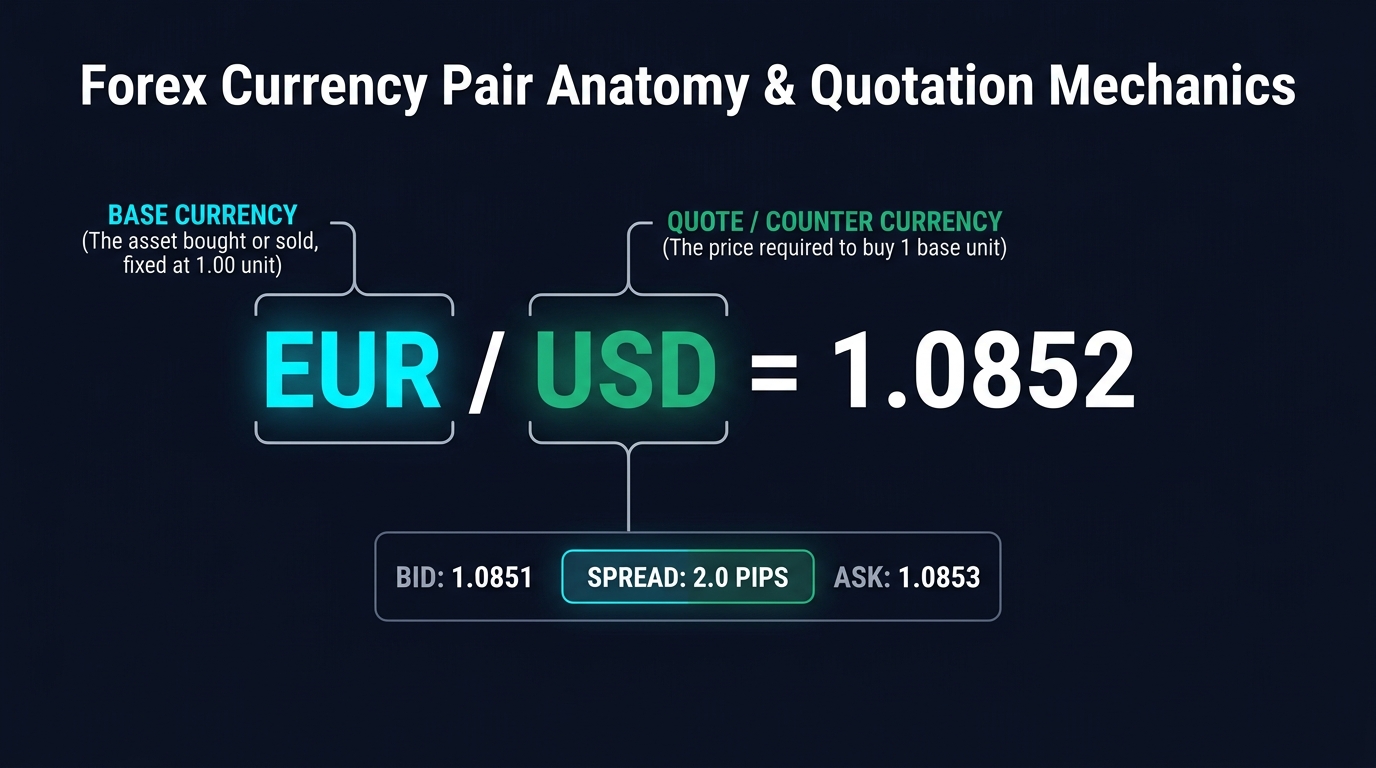
Consider the global benchmark quotation EUR/USD = 1.0850:
- Base Currency: Euro (EUR) represents a fixed single unit ($1.00$ EUR).
- Quote Currency: U.S. Dollar (USD) represents the variable price ($1.0850$ USD).
- Interpretation: It takes exactly $1.0850 U.S. dollars to buy 1.00 euro.
Reading Market Direction
- When the Exchange Rate Rises (e.g., to 1.0920): The base currency has strengthened (appreciated), while the quote currency has weakened (depreciated). It now requires more U.S. dollars to purchase one euro.
- When the Exchange Rate Falls (e.g., to 1.0780): The base currency has weakened, while the quote currency has strengthened. It now requires fewer U.S. dollars to purchase one euro.
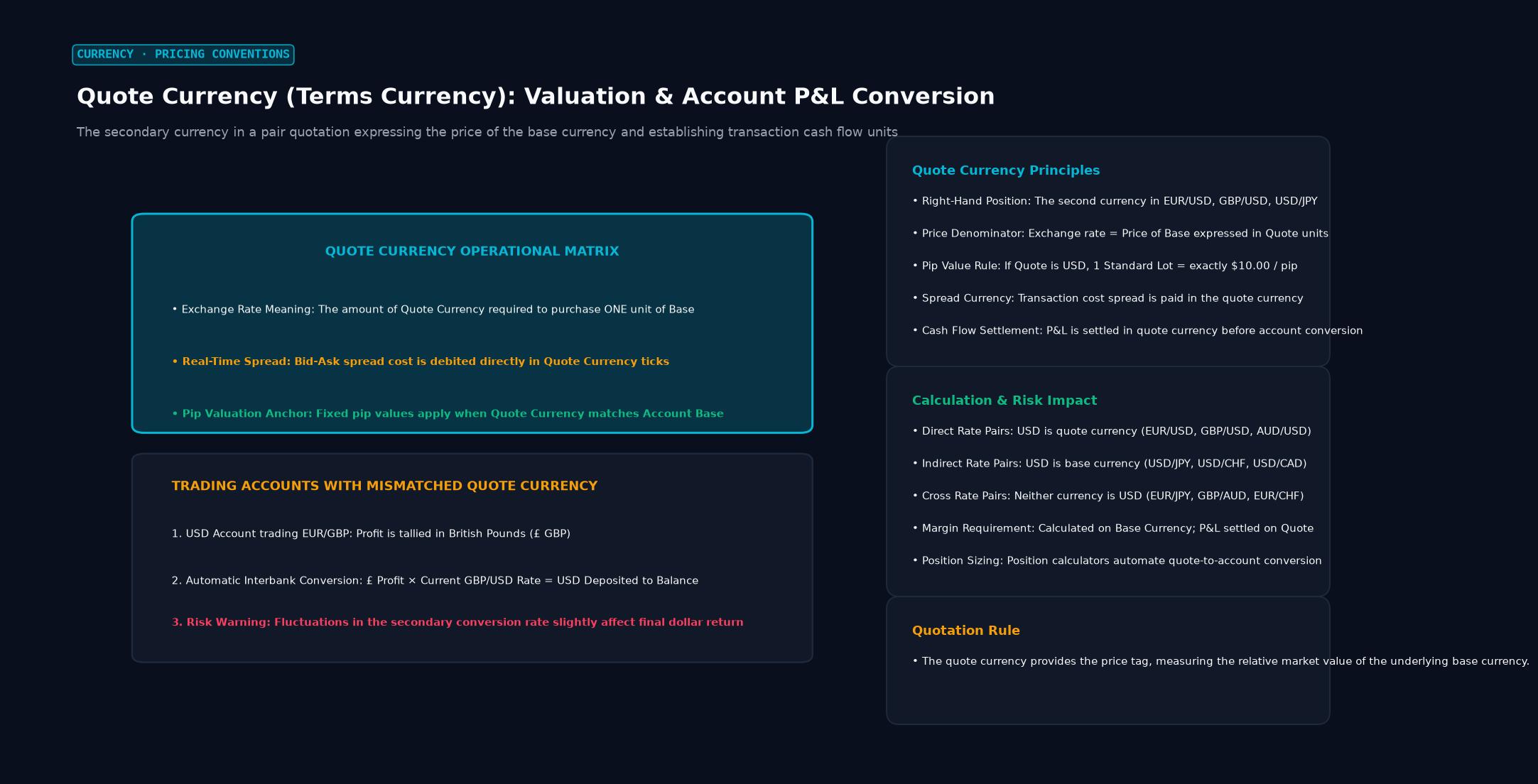 Figure: The secondary currency in a pair quotation expressing the price of the base currency and establishing transaction cash flow units
The Crucial Role in Calculating Pip Value
A foundational principle in currency trading is that pip values are always denominated in the quote currency:
$$\text{Pip Value (in Quote Currency)} = \text{Contract Size} \times \text{Pip Decimal Value}$$
For a standard lot ($100,000 units of base currency):
| Currency Pair | Base Currency | Quote Currency | Pip Calculation | Pip Value in Quote Currency | Approximate USD Equivalent |
|---|---|---|---|---|---|
| EUR/USD | EUR | USD | $100,000 \times 0.0001$ | $10.00 USD | $10.00 |
| EUR/GBP | EUR | GBP | $100,000 \times 0.0001$ | £10.00 GBP | ~$12.70 (at GBP/USD = 1.27) |
| USD/CHF | USD | CHF | $100,000 \times 0.0001$ | 10.00 CHF | ~$11.20 (at USD/CHF = 0.89) |
| USD/JPY | USD | JPY | $100,000 \times 0.01$ | 1,000 JPY | ~$6.50 (at USD/JPY = 154.00) |
| AUD/CAD | AUD | CAD | $100,000 \times 0.0001$ | 10.00 CAD | ~$7.30 (at USD/CAD = 1.37) |
Because pip values originate in the quote currency, trading a pair where the quote currency is not your account deposit currency requires an automated conversion. If you hold a USD-denominated account and trade EUR/GBP, each pip gained or lost is calculated in British pounds and instantly converted into U.S. dollars at the prevailing GBP/USD spot exchange rate.
Quote Currencies and Trading P&L
When an order closes, the gross profit or loss is finalized in the quote currency:
$$\text{Gross Profit / Loss} = (\text{Close Price} - \text{Open Price}) \times \text{Lot Size} \times \text{Contract Units}$$
Practical Example on USD/JPY:
- A trader opens a long position of 1.0 standard lot ($100,000) on USD/JPY at 154.00.
- The trade is closed at 155.50 (+150 pips).
- The gross profit generated is: $$(155.50 - 154.00) \times 100,000 = \mathbf{150,000 \text{ JPY}}$$
- The broker automatically converts those 150,000 yen into U.S. dollars at the current closing price (155.50): $$\frac{150,000 \text{ JPY}}{155.50} = \mathbf{$964.63 \text{ USD}}$$
Key Takeaways
- The Price Denominator: The quote currency is the second currency in a pair, specifying the price of one unit of the base currency.
- Pip Denomination: Every pip gained or lost on a trade is natively priced in the quote currency.
- Inverse Valuation: An increasing exchange rate signals quote currency depreciation; a decreasing exchange rate signals quote currency appreciation.
- Automated Account Conversion: If your deposit currency differs from the quote currency, your broker automatically converts realized profits or losses at prevailing spot rates.
- Primary Global Quotes: The U.S. dollar, Japanese yen, euro, and British pound are the most common quote currencies in the interbank market.
Frequently Asked Questions
What happens when the U.S. dollar is the base currency vs. the quote currency?
When the USD is the quote currency (e.g., EUR/USD, GBP/USD, AUD/USD), pip values are fixed at exactly $10.00 per standard lot. When the USD is the base currency (e.g., USD/JPY, USD/CHF, USD/CAD), the pip value fluctuates in dollar terms based on the current exchange rate.
What is another name for the quote currency?
The quote currency is commonly referred to in financial literature and banking as the counter currency or the term currency.
Why do some currency pairs always place EUR or GBP first?
Foreign exchange market conventions establish a rigid priority order for quoting currencies. The Euro (EUR), British Pound (GBP), Australian Dollar (AUD), and New Zealand Dollar (NZD) almost always act as the base currency when paired against the U.S. Dollar or Japanese Yen due to historical Commonwealth conventions and European Central Bank standards.
Ready to trade forex?
Open a free demo account with a regulated broker. Practice with virtual funds before risking real money.