Base Currency
The base currency is the first currency listed in a forex currency pair. It is the currency being bought or sold, and its value is always quoted in terms of the second currency (the quote currency). In EUR/USD, the euro is the base currency — the pair tells you how many US dollars (quote currency) are needed to purchase one euro.
The Building Block of Every Forex Trade
Every forex transaction involves two currencies. The base currency is the one you’re measuring and trading — the “unit” in the exchange. The quote currency is the measuring stick — how many units of it you need to buy one unit of the base.
EUR/USD at 1.0852 means: one euro (base currency) costs 1.0852 US dollars (quote currency).
GBP/USD at 1.2740 means: one British pound (base currency) costs 1.2740 US dollars.
USD/JPY at 149.80 means: one US dollar (base currency) costs 149.80 Japanese yen.
Note that in USD/JPY, the dollar is the base — which is why this pair rises when the dollar strengthens (each dollar buys more yen), while EUR/USD falls when the dollar strengthens (fewer dollars are needed to buy a euro, so EUR/USD goes down).
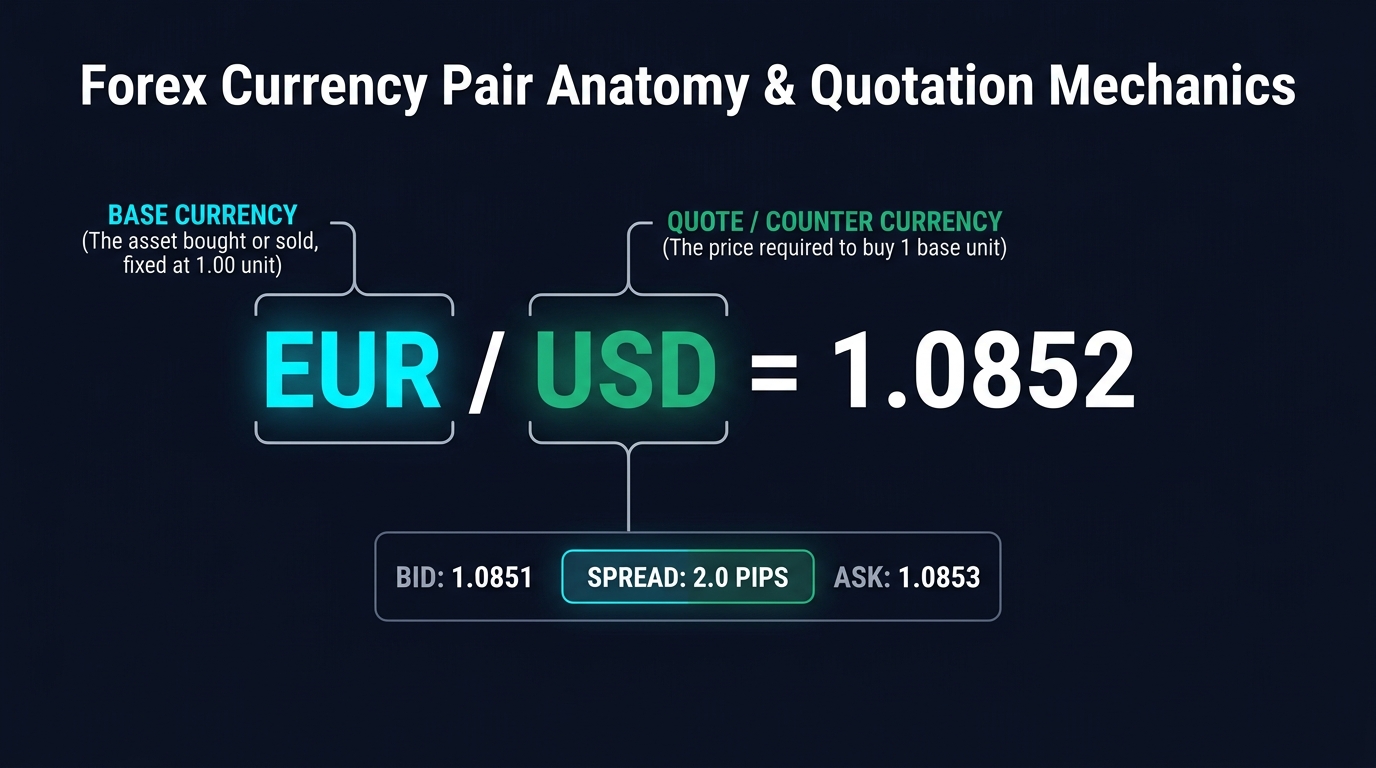
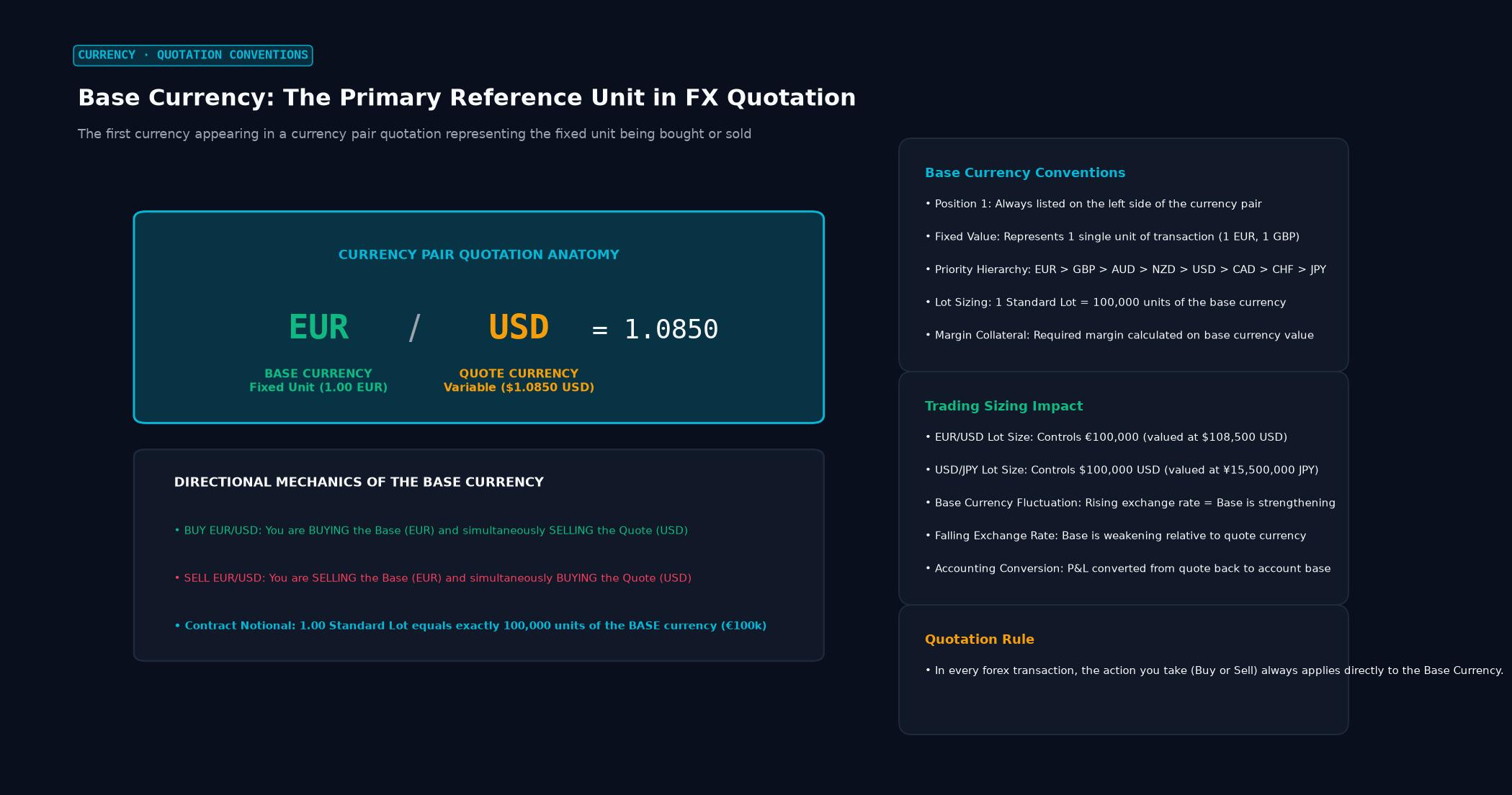 Figure: The first currency appearing in a currency pair quotation representing the fixed unit being bought or sold
Why the Convention Exists
The ordering of currencies in a pair follows an established international convention, not an arbitrary choice. The typical hierarchy:
- EUR (always first when paired with any other currency)
- GBP
- AUD
- NZD
- USD (base when paired with CHF, CAD, JPY, and others)
- CAD
- CHF
- JPY (usually the quote currency in pairs)
This ordering was established by the International Organization for Standardization (ISO 4217) and the interbank market convention. Knowing the hierarchy prevents confusion: EUR always comes before USD in EUR/USD, never USD/EUR — even though US-centric traders might intuitively prefer USD first.
Practical Impact: Profit and Loss Calculation
The base currency determines how you calculate profit and loss, and whether pip values are constant or variable.
For pairs where USD is the quote currency (EUR/USD, GBP/USD, AUD/USD): Pip value is straightforward: for a standard lot (100,000 units of base currency), each pip = $10. Moving 50 pips in your favor = $500 profit.
For pairs where USD is the base currency (USD/JPY, USD/CHF, USD/CAD): Pip value varies because the profit is calculated in the quote currency (yen, francs, Canadian dollars) and must be converted back to USD. On USD/JPY at 150.00, one standard lot pip = ¥1,000 ÷ 150.00 = approximately $6.67.
This is why your trading platform calculates P&L automatically — the math differs by pair. Understanding why it differs (because of which currency is the base) prevents surprises when comparing trade outcomes across different pairs.
Base Currency and Directional Bias
When you go long (buy) a currency pair, you are buying the base currency and selling the quote currency. When you go short (sell) a pair, you are selling the base currency and buying the quote currency.
This means:
- Going long EUR/USD = bullish on EUR, bearish on USD
- Going short EUR/USD = bearish on EUR, bullish on USD
- Going long USD/JPY = bullish on USD, bearish on JPY
- Going short USD/JPY = bearish on USD, bullish on JPY
Having multiple positions open simultaneously may create inadvertent correlated exposure. Long EUR/USD and short USD/JPY are both USD-bearish positions. Long AUD/USD and short NZD/USD creates a mixed exposure where you’re long AUD relative to NZD. Understanding which currency is the base in each pair helps you map your total portfolio exposure clearly.
Key Takeaways
- The base currency is the first currency in a pair — its value is expressed in units of the quote currency
- EUR/USD: euro is base (how many dollars per euro); USD/JPY: dollar is base (how many yen per dollar)
- Currency ordering follows ISO 4217 convention — EUR first, then GBP, AUD, NZD, USD, etc.
- Pip value calculation differs depending on whether USD is the base or quote currency
- Long = buy base, sell quote; Short = sell base, buy quote
FAQ
Why is EUR always listed first in EUR/USD? By international convention, the euro has the highest precedence in currency pair ordering — it’s always the base currency when paired with any other currency. This convention ensures every broker, platform, and market participant uses the same pair direction, preventing confusion when quotes are compared.
What happens if I accidentally trade the wrong direction because I confused base and quote? This is a real beginner mistake. If you meant to buy euros and instead bought dollars (went short EUR/USD instead of long), you’ve opened the exact opposite of your intended position. Always verify: which currency are you bullish on? Is it the first (base) or second (quote)? Then ensure your position direction aligns.
Ready to trade forex?
Open a free demo account with a regulated broker. Practice with virtual funds before risking real money.