Adjusted Book Value
Adjusted Book Value is an equity valuation method that recalculates a company's assets and liabilities to reflect current fair market values rather than historical accounting balance sheet values, establishing true net asset worth.
What Is Adjusted Book Value?
In corporate finance, equity valuation, and mergers and acquisitions (M&A), Adjusted Book Value (also referred to as Adjusted Net Asset Value or Net Asset Value - NAV) is an asset-based valuation methodology that recalculates a company’s balance sheet accounts to reflect their current fair market value rather than their historical accounting cost.
Under standard accounting frameworks (US GAAP and IFRS), balance sheets are constructed around historical purchase prices. Over time, this creates severe accounting distortions: commercial real estate purchased thirty years ago remains recorded at its original price minus decades of accumulated depreciation, even if the land’s market value has increased tenfold. Conversely, manufacturing machinery may sit on the books at an inflated value despite becoming technologically obsolete.
Adjusted book value eliminates these historical accounting artifacts by marking every asset and liability up or down to what it would realistically fetch or cost in an orderly, arm’s-length commercial transaction today.
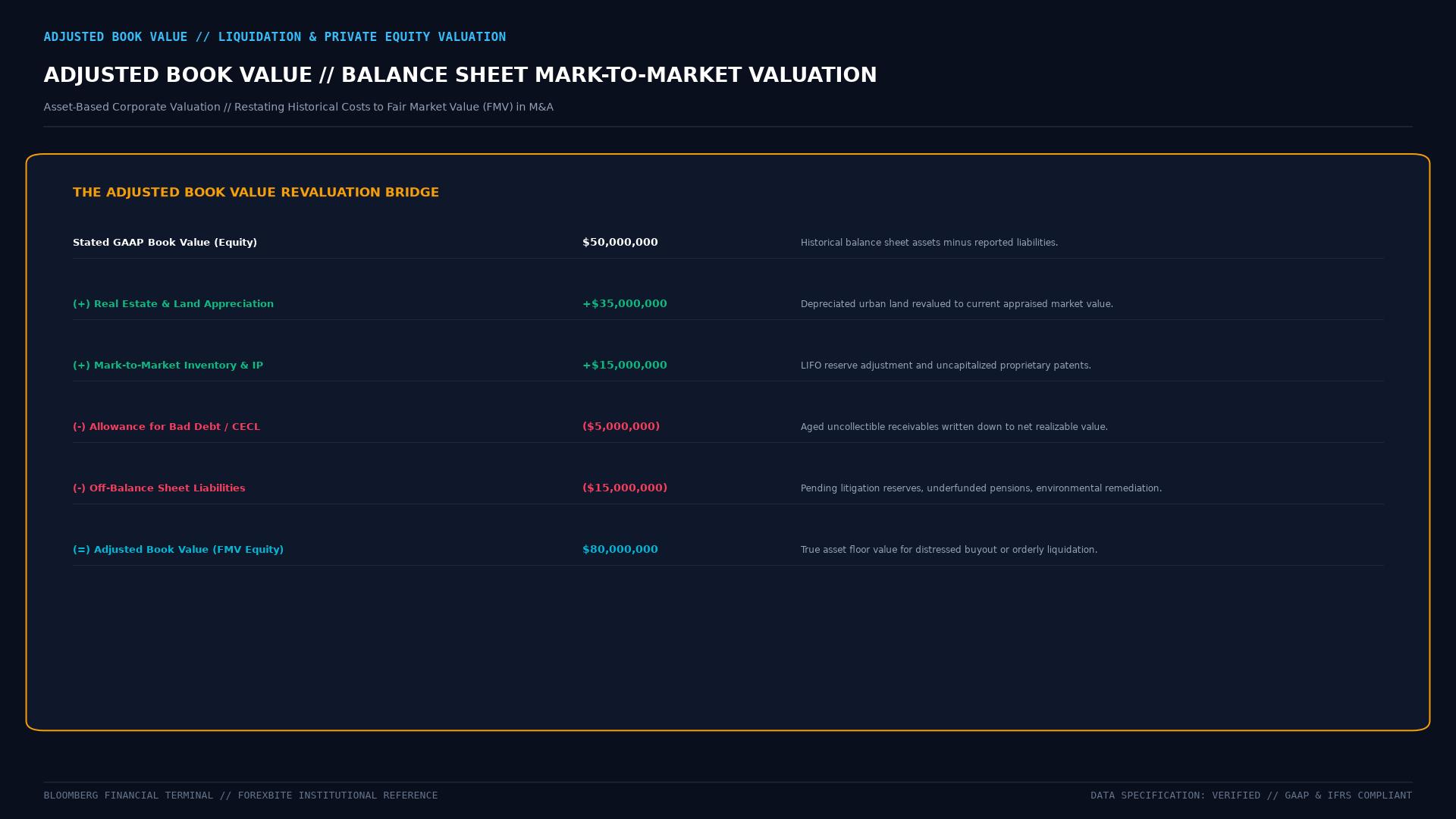 Figure: Balance sheet asset-revaluation waterfall calculating Adjusted Book Value by restating historical book assets and liabilities to fair market values, intangibles recognition, and liquidation discounting.
Technical Mechanics: The Adjustment Process
Valuation analysts and private equity professionals execute an adjusted book value audit by inspecting four major balance sheet domains:
1. Tangible Real Estate and Fixed Assets
- Land and Buildings: Appraisers conduct independent real estate valuations. Properties carried at nominal depreciated historical cost are written up to prevailing regional market prices.
- Machinery and Equipment: Industrial engineers inspect equipment to establish Orderly Liquidation Value (OLV) or Fair Market Value in Continued Use, discounting outdated machinery.
2. Working Capital Haircuts
- Accounts Receivable: Receivables aging reports are audited. Stale invoices past 90 days or balances owed by insolvent clients are discounted or written off completely.
- Inventory Net Realizable Value (NRV): Obsolete parts, damaged finished goods, and work-in-progress inventory are marked down to expected liquidating value.
3. Off-Balance Sheet and Intangible Assets
- Under GAAP, internally developed software, registered trademarks, customer contracts, and patents are expensed as R&D, leaving zero carrying value on the balance sheet. In an adjusted book value calculation, analysts assign explicit fair market values to these productive intellectual property assets.
4. Unrecorded and Contingent Liabilities
- Analysts add off-balance sheet obligations, including underfunded employee pension liabilities, contingent environmental remediation obligations, pending product liability lawsuits, and deferred executive compensation packages.
The Valuation Formula
Adjusted Book Value = Fair Market Value of All Assets - Fair Market Value of All LiabilitiesTo calculate Adjusted Book Value Per Share (ABVPS):
ABVPS = Adjusted Book Value / Total Diluted Shares OutstandingComparative Matrix: Adjusted Book Value vs. Standard Book Value vs. DCF
| Valuation Metric | Adjusted Book Value | Standard Accounting Book Value | Discounted Cash Flow (DCF) |
|---|---|---|---|
| Foundation | Current market appraisal of net assets | Historical purchase cost minus depreciation | Future projected operating cash flows |
| Handling of Growth | Ignores future revenue/earning growth | Ignores future revenue/earning growth | Directly models multi-year revenue growth |
| Best Applied To | Asset-heavy firms, holding companies, distress | Basic financial screening ratios | High-growth software, service businesses |
| Intangibles | Appraises unrecorded IP and patents | Excludes internally developed IP | Captures IP value through high margins |
| Liquidation Floor | Provides realistic floor valuation in buyout | Misleading floor due to depreciation rules | Irrelevant during rapid liquidation |
Real-World Case Study: Commercial Real Estate Holding Company Buyout
In 2023, an activist hedge fund acquired a controlling 28% stake in an aging Midwestern industrial warehousing firm trading at $42.00 per share with an accounting book value of $35.00 per share ($105 million total equity across 3.0 million shares). Public markets viewed the firm as a low-margin operator due to stagnant rental income.
The hedge fund conducted an Adjusted Book Value audit:
- Real Estate Appraisal: The company held 14 distribution logistics hubs acquired between 1975 and 1990 carried on the balance sheet at a depreciated net book value of $48 million. Modern commercial appraisal valued the land and buildings at $210 million due to highway expansion and urban infill demand.
- Liabilities: Total corporate debt stood at $45 million, with $5 million in unrecorded environmental maintenance liabilities.
- Net Adjusted Valuation:
Adjusted Book Value = $210M (Real Estate) + $15M (Cash & Receivables) - $50M (Total Liabilities) = $175 million
Adjusted Book Value Per Share = $175,000,000 / 3,000,000 shares = $58.33 per share
The hedge fund launched a proxy contest, replaced executive management, and sold four non-core logistics centers for $68 million. The proceeds were deployed to pay down debt and fund a $15.00 per share special cash dividend, unlocking the unrecognized adjusted book value for shareholders.
Frequently Asked Questions (FAQ)
When is Adjusted Book Value the preferred valuation method?
Adjusted book value is preferred when valuing asset-heavy enterprises, such as real estate investment trusts (REITs), commercial banks, insurance companies, natural resource exploration firms, holding companies, and distressed companies facing potential bankruptcy liquidation.
Why is Adjusted Book Value ineffective for technology and SaaS companies?
Technology, software, and consumer brand companies derive 80% to 95% of their enterprise value from intangible elements like brand loyalty, network effects, recurring subscription models, and future software scalability. Asset-based models capture only physical computers and office furniture, vastly undervaluing high-earning tech companies.
What is the difference between Adjusted Book Value and Liquidation Value?
Adjusted Book Value assumes that assets are appraised under an orderly transaction timeframe between willing buyers and sellers. Liquidation Value assumes a distressed forced-sale scenario where assets must be sold within a short window (e.g., 30 to 90 days), resulting in steep auction discounts.
Ready to trade forex?
Open a free demo account with a regulated broker. Practice with virtual funds before risking real money.