Accumulated Earnings Tax
The Accumulated Earnings Tax is a statutory 20% penalty tax imposed under US tax law (IRC Section 531) on corporations that retain profits beyond the reasonable needs of the business to prevent individual shareholders from avoiding dividend taxes.
What Is the Accumulated Earnings Tax?
The Accumulated Earnings Tax (AET) is a statutory federal penalty tax codified under Sections 531 through 537 of the United States Internal Revenue Code (IRC). It is assessed against corporations that accumulate retained earnings beyond the reasonable and verifiable operating needs of the business, rather than distributing those surplus profits to shareholders as taxable dividends.
The policy rationale behind the tax targets a specific tax avoidance strategy utilized by closely held private C-corporations. If corporate tax rates are significantly lower than individual marginal income tax rates, high-net-worth controlling shareholders might instruct management to hoard cash inside the corporate balance sheet indefinitely.
By retaining corporate profits rather than declaring dividends, shareholders avoid paying the top marginal tax rate on qualified dividends (20% plus the 3.8% Net Investment Income Tax). The Accumulated Earnings Tax imposes an additional flat 20% penalty tax directly on top of regular corporate income taxes to eliminate the financial incentive for improper earnings retention.
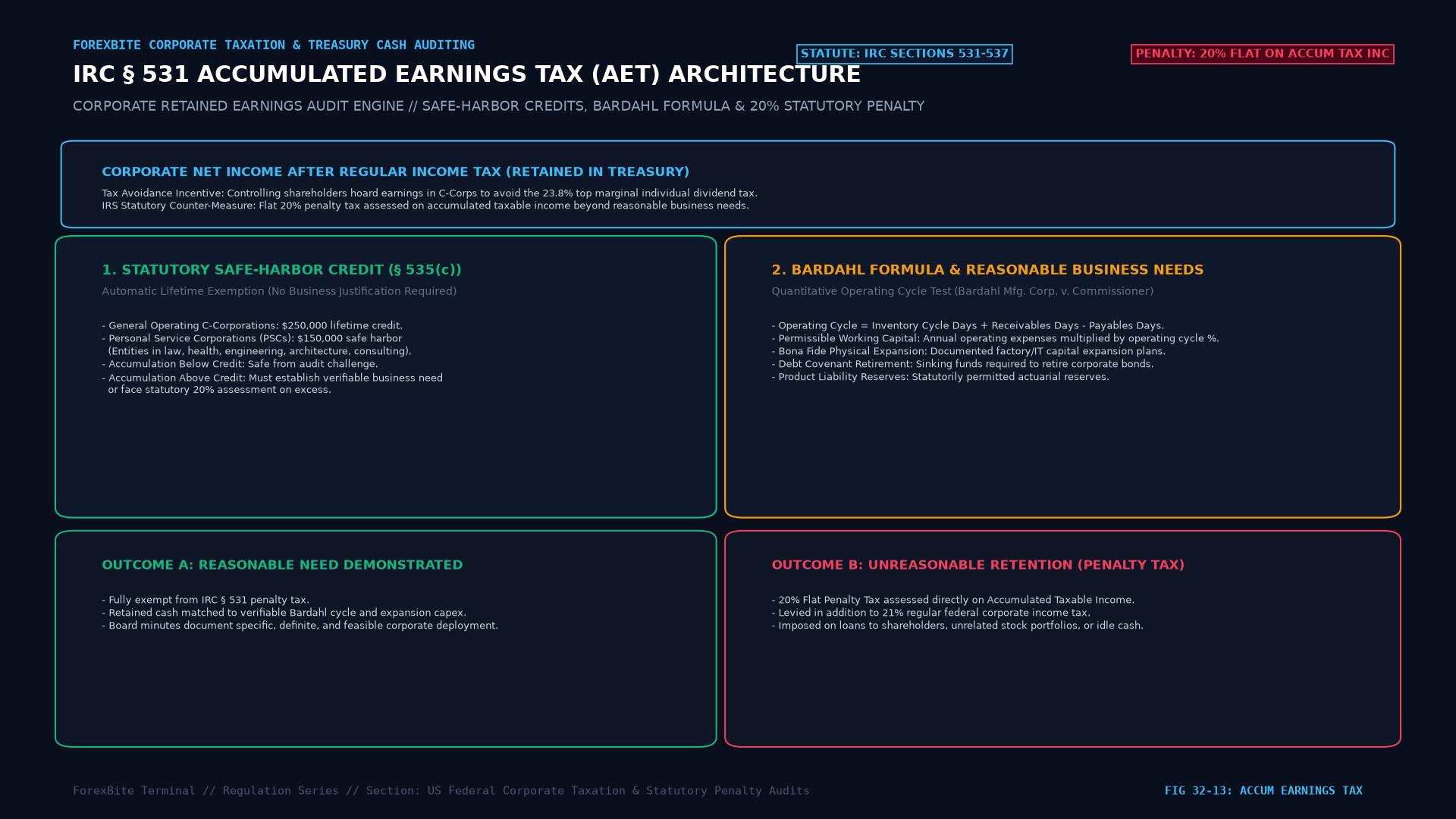 Figure: The statutory audit framework of the Accumulated Earnings Tax (AET), showing safe-harbor credits, Bardahl Formula operating cycle analysis, and the 20% penalty tax.
Technical Mechanics & The Bardahl Formula
To defend retained earnings against an IRS audit assessment, corporations must prove that cash reserves correspond to the reasonable anticipated needs of the business:
1. Statutory Minimum Credit
Under IRC § 535(c), every corporate taxpayer receives a cumulative lifetime safe-harbor credit:
- General Operating Corporations: Permitted to accumulate up to $250,000 in retained earnings with zero requirement to justify the business purpose.
- Personal Service Corporations (PSCs): Entities performing services in fields like health, law, engineering, accounting, or architecture are limited to a safe harbor of $150,000.
2. The Bardahl Working Capital Formula
Established in the landmark tax court decision Bardahl Manufacturing Corp. v. Commissioner (1965), corporate treasurers utilize a mathematical model to calculate the exact working capital required to fund one complete operating cycle:
Operating Cycle % = Inventory Cycle % + Accounts Receivable Cycle % - Accounts Payable Cycle %
Working Capital Need = Operating Cycle % × (Cost of Goods Sold + Annual Operating Expenses)
Where:
- Inventory Cycle:
Average Inventory / Annual Cost of Goods Sold - Receivables Cycle:
Average Accounts Receivable / Annual Net Sales - Payables Cycle:
Average Accounts Payable / Annual Operating Expenses
Retained cash held up to this calculated working capital dollar amount is legally shielded from the penalty tax.
3. Permissible Business Justifications
Beyond routine working capital, the IRS permits corporations to accumulate cash for:
- Concrete, specific, and documented plans for plant expansion, equipment acquisition, or technology modernizations.
- Sinking funds established to retire corporate bond debt or long-term bank notes.
- Documented reserves for self-insured business liabilities, product warranties, or pending litigation defenses.
Comparative Matrix: Accumulated Earnings Tax vs. Personal Holding Company Tax
| Parameter | Accumulated Earnings Tax (IRC § 531) | Personal Holding Company Tax (IRC § 541) |
|---|---|---|
| Tax Rate | 20% on accumulated taxable income | 20% on undistributed personal holding company income |
| Trigger Mechanism | Subjective intent to avoid shareholder dividend tax | Objective mathematical tests (stock ownership & passive income) |
| Filing Requirement | Assessed through IRS audit; no self-reporting return | Self-reported on Schedule PH (Form 1120) |
| Applicability | Operating C-corporations with active business lines | Shell or investment entities generating passive income |
| Safe Harbor | $250,000 ($150,000 for PSCs) | None; applies immediately if mathematical tests trigger |
Real-World Case Study: Machine Tool Manufacturer Defense
In 2023, a privately held precision machine tool manufacturer with $18 million in annual revenue underwent an IRS examination. The company had accumulated $4.5 million in cash reserves while distributing zero dividends to its two family shareholders over five years. The examining agent proposed assessing the 20% Accumulated Earnings Tax on $3.8 million in excess cash, representing a $760,000 penalty.
The corporation’s tax advisory team mounted a defense using the Bardahl formula and corporate minutes:
- Operating Cycle Calculation: Demonstrated that its complex aerospace supply chains required an operating cycle of 124 days, justifying an immediate working capital buffer of $2.2 million.
- Capital Expenditure Commitment: Provided formal board minutes, architectural blueprints, and non-refundable equipment deposit slips for a planned $1.8 million facility expansion scheduled for 2024.
- Debt Sinking Fund: Proved a contractual requirement under a senior bank loan requiring a $500,000 cash escrow reserve.
Total justified cash needs ($4.5 million) matched total balance sheet cash. The IRS appeals division dropped the assessment in full, illustrating the necessity of contemporaneous board documentation when retaining corporate capital.
Frequently Asked Questions (FAQ)
Does the Accumulated Earnings Tax apply to S-Corporations or LLCs?
No. The tax applies exclusively to C-Corporations. S-Corporations, partnerships, and limited liability companies (LLCs) are pass-through tax entities where net earnings flow through and are taxed directly to individual owners each year, rendering corporate tax deferral impossible.
Can a publicly traded corporation be hit with the Accumulated Earnings Tax?
While the statute legally applies to any corporation not specifically exempt, the IRS rarely audits public corporations for AET because widespread public shareholding dilutes the motivation to hoard cash for the benefit of a few individual controlling owners. The vast majority of assessments target closely held, family-owned C-corporations.
How can a corporation quickly eliminate an impending AET assessment?
A corporation facing an audit can declare a consent dividend or execute a deficiency dividend under IRC § 547 / § 565. This mechanism treats a distribution as taxable income to shareholders for the tax year in question, immediately wiping out the accumulated taxable income base and abating the 20% penalty.
Ready to trade forex?
Open a free demo account with a regulated broker. Practice with virtual funds before risking real money.