Accumulated Earnings
Accumulated Earnings, universally recognized as Retained Earnings on corporate balance sheets, represents the cumulative net profits retained by a corporation since inception after distributing all dividends to shareholders.
What Are Accumulated Earnings?
Accumulated Earnings (commonly referred to in corporate accounting as Retained Earnings) represents the cumulative percentage of net income that a business retains internally over its entire operating history rather than paying out as dividends to shareholders.
Reported within the Shareholders’ Equity section of the corporate balance sheet, accumulated earnings reflects the organic capital self-generated by the enterprise. When a company earns an accounting profit on its income statement, corporate leadership faces a capital allocation decision: distribute those earnings to equity holders via cash dividends or reinvest that capital into future enterprise expansion.
The funds that remain inside the firm are transferred into accumulated earnings, providing internal financing for capital expenditures, research and development, inventory accumulation, debt retirement, and strategic corporate acquisitions without diluting existing stockholders through new share issuances.
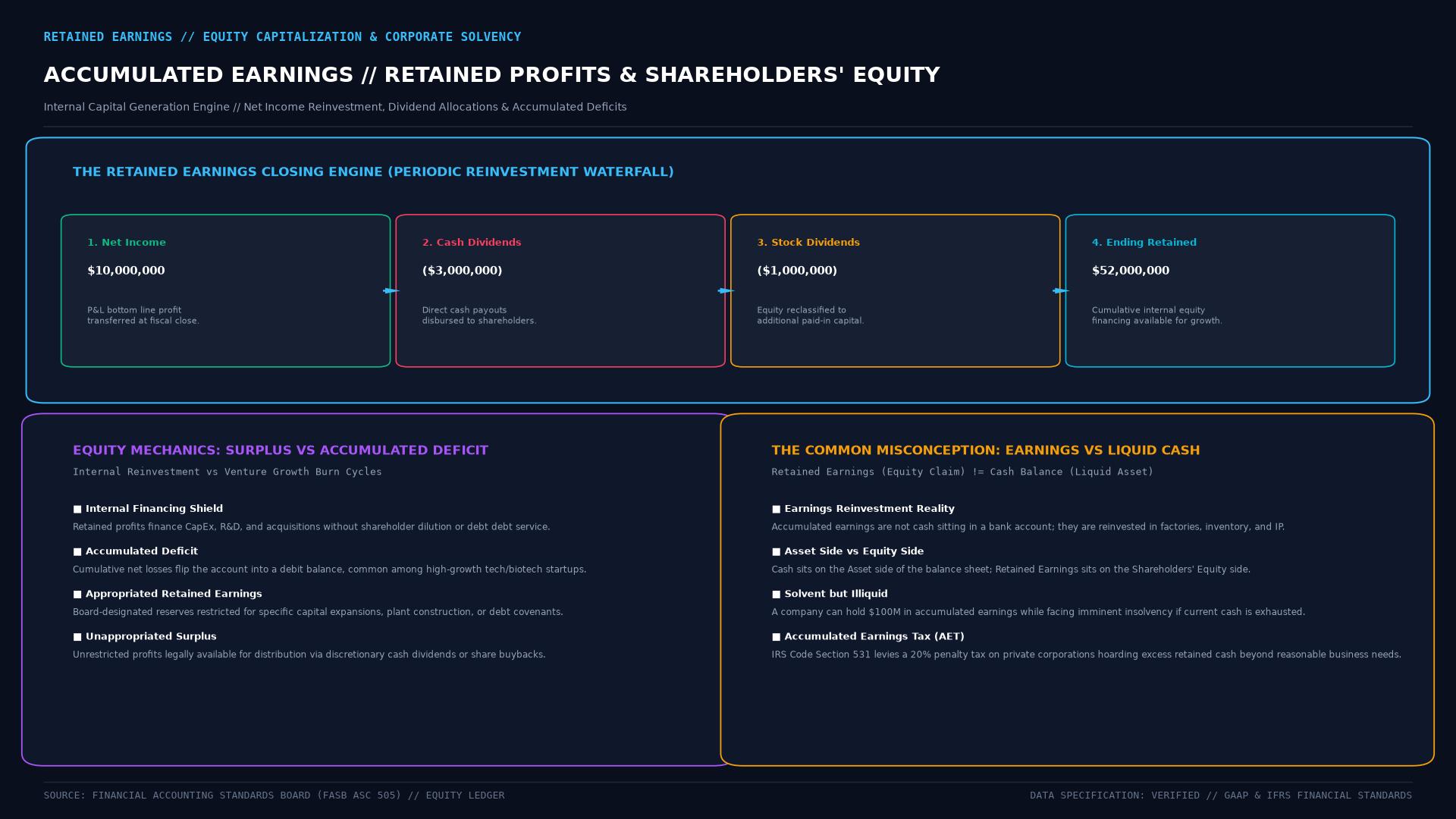 Figure: The Accumulated Earnings (Retained Earnings) periodic closing engine, showing net income transfer from the P&L, dividend distribution deductions, internal financing vs accumulated deficits, and the distinction between accounting equity and liquid cash balances.
Technical Mechanics & Core Equation
Corporate accountants calculate accumulated earnings at the end of each reporting period using a standardized closing formula:
Ending Retained Earnings = Beginning Retained Earnings + Net Income (or - Net Loss) - Cash Dividends - Stock Dividends1. The Treatment of Net Losses and Accumulated Deficit
If a corporation experiences recurring operating losses that exceed its historical profits, the retained earnings account flips into a debit balance. On the balance sheet, this negative figure is formally labeled an Accumulated Deficit. High-growth venture-backed technology companies and biotechnology startups frequently report tens or hundreds of millions in accumulated deficits during their initial development phases.
2. Appropriated vs. Unappropriated Retained Earnings
Boards of directors occasionally establish internal restrictions on accumulated profits:
- Appropriated Retained Earnings: Funds formally set aside by board resolution for specific capital programs, such as building a new manufacturing plant, financing pending environmental remediation, or satisfying bond indenture covenants. These funds cannot be distributed as dividends.
- Unappropriated Retained Earnings: The unencumbered surplus capital legally available for discretionary dividend payouts or open-market share repurchase authorizations.
Accumulated Earnings vs. Cash: The Common Misconception
A widespread misconception among retail investors is the belief that accumulated earnings represents a liquid pool of cash sitting in a bank vault:
- Cash is an Asset: Cash is recorded on the asset side of the balance sheet and represents actual liquid bank deposits.
- Retained Earnings is Equity: Accumulated earnings sits on the liabilities and equity side of the balance sheet. It is an accounting record of the cumulative historical profits reinvested into the business.
A corporation may report $500 million in accumulated earnings while holding only $10 million in liquid cash, because those cumulative historical profits were deployed over the years into physical factories, inventory, equipment, patents, and working capital.
Comparative Matrix: Accumulated Earnings vs. Paid-in Capital vs. Treasury Stock
| Equity Component | Source of Capital | Balance Sheet Role | Impact of Net Income |
|---|---|---|---|
| Accumulated Earnings | Organic cumulative operational profits minus dividends | Tracks self-generated earnings reinvested | Increases with profit; decreases with loss |
| Additional Paid-in Capital (APIC) | External capital contributed by investors buying shares | Tracks equity funding received above par value | Zero impact from ongoing corporate profit |
| Treasury Stock | Shares repurchased from public markets | Contra-equity account reducing total equity | Zero impact from ongoing corporate profit |
| Common Stock Par Value | Legal nominal face value of authorized shares | Legal capital floor required by state charters | Zero impact from ongoing corporate profit |
Fundamental Valuation: The Warren Buffett Reinvestment Test
In value investing and fundamental equity analysis, legendary investor Warren Buffett popularized the $1 Retained Test to evaluate whether corporate management allocates accumulated earnings effectively:
Value Creation = Increase in Market Capitalization over 5-10 Years / Cumulative Retained Earnings over PeriodIf an enterprise retains $1.00 of shareholder profit, it should generate at least $1.00 in incremental long-term market capitalization. If a company retains $100 million in earnings over a decade but its market capitalization expands by only $40 million, management is destroying shareholder value through sub-optimal capital allocation, and the funds would have been better deployed as cash dividends directly to investors.
Frequently Asked Questions (FAQ)
Can a company pay dividends if it has an accumulated deficit?
Under standard corporate law in most US jurisdictions (such as Delaware corporate law) and international jurisdictions, companies are subject to capital impairment rules. A firm cannot declare cash dividends if its net assets are less than its stated capital, meaning a company with an accumulated deficit generally cannot pay dividends unless it qualifies under specific “nimble dividend” rules (permitting dividends out of current-year net profits despite past deficits).
How do stock splits affect accumulated earnings?
A standard stock split (such as a 2-for-1 split) changes only the number of outstanding shares and the per-share par value; it has zero mathematical effect on accumulated earnings. In contrast, a stock dividend requires an internal accounting transfer from retained earnings into common stock and additional paid-in capital.
Why do mature corporations exhibit high accumulated earnings?
Established corporations with durable competitive advantages (such as consumer staples, healthcare, and industrial blue-chips) generate reliable profits over decades. Even while paying generous annual dividends, retaining 30% to 50% of annual net income compounds their accumulated earnings into billions of dollars over time.
Ready to trade forex?
Open a free demo account with a regulated broker. Practice with virtual funds before risking real money.