Fundamental Analysis
Fundamental analysis is the method of evaluating a currency's value by examining the macroeconomic factors that drive its supply and demand — interest rates, inflation, GDP growth, employment data, and monetary policy decisions. It answers the question: why is this currency moving, and where is it likely to move next based on the underlying economy?
The Foundation of Currency Valuation
Technical analysts study price charts. Fundamental analysts study economies. Both are trying to answer the same question — which direction is this currency heading — but they approach it from completely different angles and on completely different timescales.
Fundamental analysis works on the premise that currencies are ultimately valued by the relative health and trajectory of their underlying economies. A country with strong growth, rising interest rates, low inflation, and a current account surplus is generally a good place to hold capital — and capital flows toward favorable conditions, driving currency demand. The opposite is equally true: a country facing stagflation, currency controls, and political instability will see its currency depreciate as capital flees.
Over weeks and months, fundamentals tend to win. Price may deviate from fundamental fair value in the short term — technical trading, sentiment shifts, and speculative positioning can push currencies to extremes — but gravity eventually pulls price back toward the economic reality.
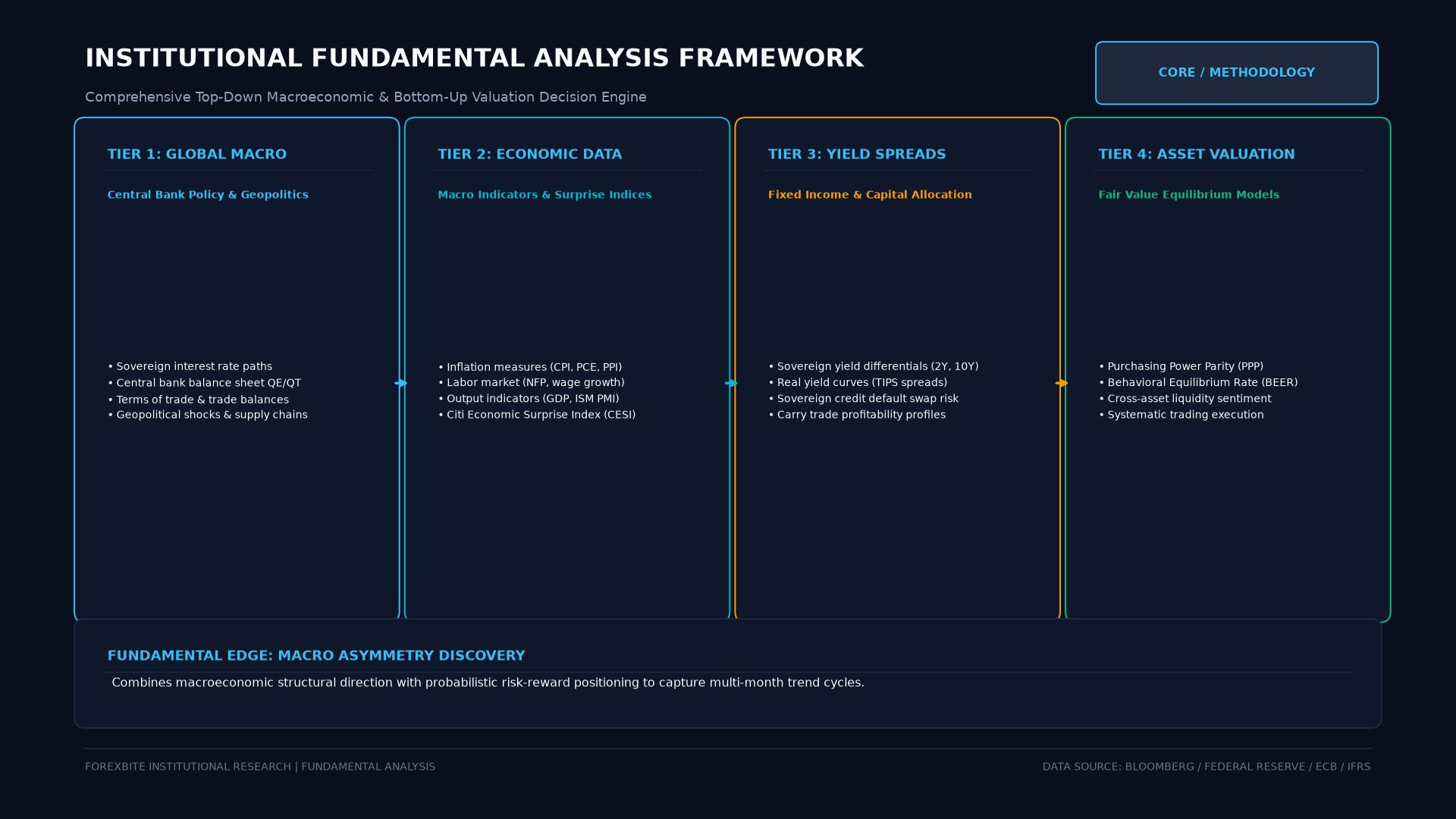 Figure: Comprehensive fundamental analysis pipeline integrating global macroeconomic regimes, economic indicator surprises, sovereign yield curves, and asset valuation models to derive asymmetric market positioning.
The Core Drivers of Currency Value
Interest rates: The single most powerful driver of currency demand in the short-to-medium term. When a central bank raises interest rates, its currency typically strengthens because higher yields attract foreign capital chasing better returns. The carry trade is built entirely on this mechanism.
Inflation: Price stability is a core mandate of most central banks. High inflation erodes purchasing power — a currency’s real value falls as prices rise. If inflation runs persistently above target, the central bank is expected to raise rates to control it, which can paradoxically strengthen the currency short-term (rate expectations) while signaling economic stress longer-term.
GDP growth: Gross Domestic Product measures the total output of an economy. Strong GDP growth signals economic health — companies earn more, employment rises, tax revenue increases. Currency markets respond positively to GDP beats vs. expectations.
Employment: Non-Farm Payrolls (US), Claimant Count (UK), and equivalent labor market reports are among the highest-impact data releases in forex. Employment is a proxy for consumer spending power and, importantly, for future inflationary pressure — tight labor markets historically precede wage inflation.
Current account balance: A country running a current account surplus (exporting more than it imports) is a net earner of foreign currency, which must be converted back to the domestic currency — creating structural demand. Persistent deficits work in reverse.
Monetary policy: Central bank decisions on interest rates and quantitative easing/tightening are the most market-moving events in forex. The ECB, Fed, BOJ, BOE, RBA, and SNB conduct scheduled meetings multiple times per year. Traders don’t just react to actual decisions — they position ahead of meetings based on forward guidance and data-driven expectations.
How to Apply Fundamental Analysis
Economic calendar: Every serious fundamental trader tracks scheduled data releases: CPI, GDP, employment reports, PMI surveys, central bank meetings, and press conferences. The economic calendar is the fundamental trader’s charting tool.
Relative performance: The key insight in forex fundamental analysis is not absolute economic strength but relative strength. EUR/USD is driven by the relative health of the Eurozone economy versus the US economy — if both are growing, the stronger growth story wins. EUR/GBP is driven by UK economic performance relative to the Eurozone.
Interest rate differentials: Monitor where central bank rates stand relative to each other, and more importantly, where market expectations have them heading. Currency pairs often move in anticipation of rate decisions months before they occur. A currency can strengthen on expectations of a rate hike even before the hike actually happens.
Surprise effect: Markets price in expected outcomes. A US jobs report of +200,000 when consensus was +200,000 is neutral — already priced in. The same number vs. a consensus of +250,000 is bearish for the dollar. Understanding what’s priced in is as important as knowing the actual data.
Fundamental vs. Technical Analysis: Not a Competition
Many traders operate as if these are opposing philosophies requiring a choice. In practice, the most complete analytical framework combines both.
Fundamentals establish the bias: which direction does the macroeconomic picture favor over the next weeks or months? Technicals provide the timing: where exactly on the chart is the optimal entry for that directionally-biased trade, with the best risk-reward ratio?
A trader with a bullish GBP/USD fundamental thesis who waits for a technical pullback to key support before entering gets better entries and tighter stops than one who simply buys the currency at any price based on the macro case alone.
Key Takeaways
- Fundamental analysis evaluates currencies through economic data, interest rates, inflation, and monetary policy
- Interest rate differentials and central bank policy are the most powerful short-to-medium term drivers
- Relative economic performance between two countries drives currency pairs, not absolute strength
- The “surprise” — actual data vs. consensus expectations — is what moves markets, not the data itself
- Fundamentals establish directional bias; technicals optimize entry timing and risk management
FAQ
How long does it take for fundamental factors to affect currency prices? It varies. Interest rate changes and major economic surprises can move markets within seconds of release. Longer-term trends driven by persistent current account deficits or structural economic divergence can take months or years to fully play out. Most fundamental traders focus on a 1–4 week trade horizon for medium-term setups.
Do I need to understand economics to trade fundamentally? Not at an academic level. You need to understand the direction of key variables — is inflation rising or falling? Are rate hikes priced in or unexpected? Is growth accelerating or decelerating? The relationship between these variables and currency direction is more directional logic than economic theory.
Ready to trade forex?
Open a free demo account with a regulated broker. Practice with virtual funds before risking real money.