Accumulation Period
The Accumulation Period is the capital growth phase in a retirement annuity or investment portfolio during which an investor builds wealth through contributions and compound returns prior to annuitization or withdrawal.
What Is the Accumulation Period?
In retirement planning, wealth management, and insurance contracts, the Accumulation Period (often referred to as the savings phase or pay-in phase) represents the multi-year timeframe during which an investor deposits capital into a deferred annuity, pension fund, or investment portfolio to build wealth.
During this period, the contract holder makes lump-sum or scheduled periodic contributions. These funds are allocated across diverse investment sub-accounts (such as equity index funds, corporate bond funds, or guaranteed interest accounts), where they compound on a tax-deferred basis.
The accumulation period stands in direct structural contrast to the Annuitization (Payout) Phase, which begins when the investor ceases contributing and transitions the contract into guaranteed lifetime monthly income distributions or systematic withdrawals.
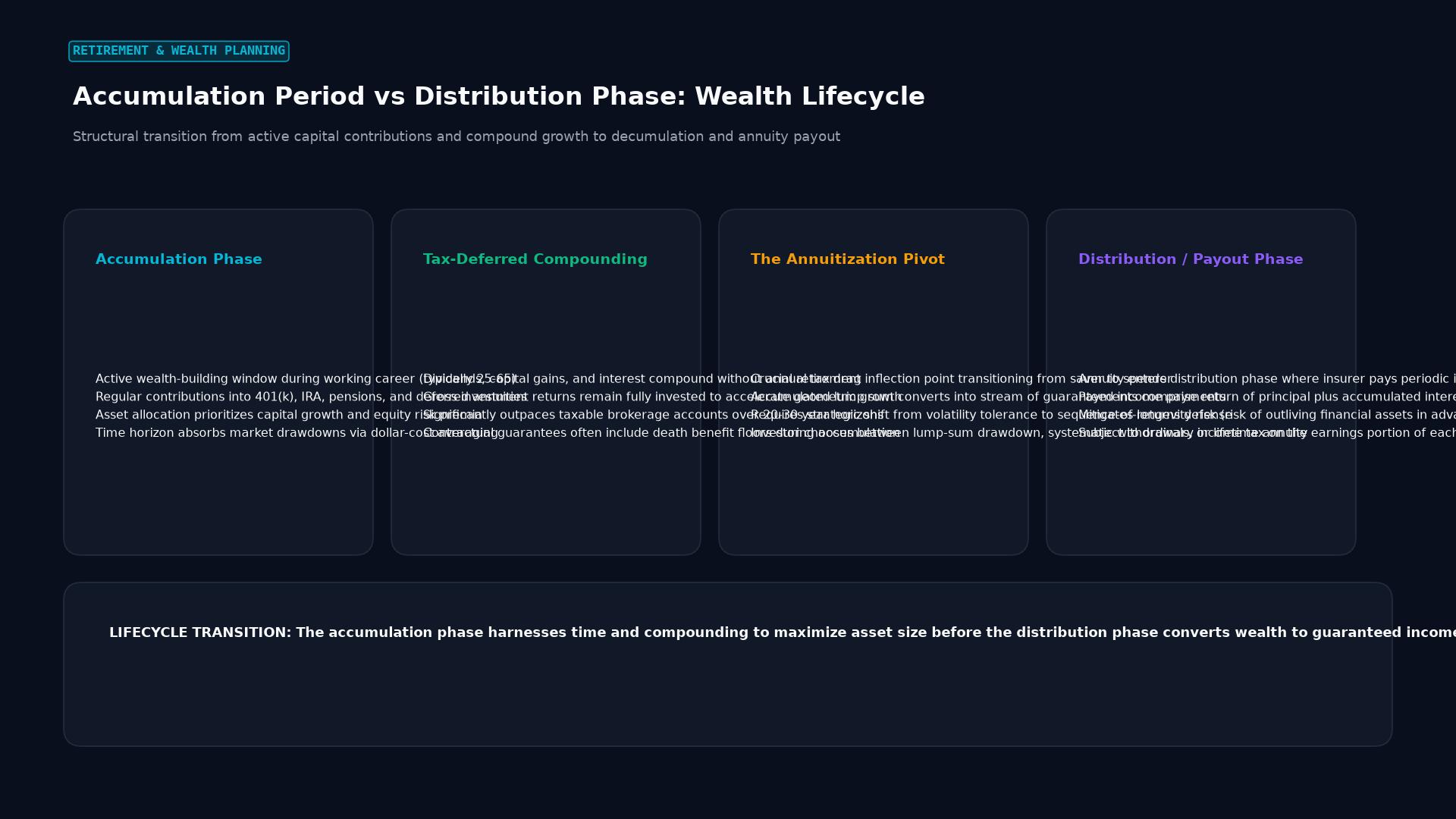 Figure: Structural transition from active capital contributions and compound growth to decumulation and annuity payout
Technical Mechanics: Valuation and Sub-Account Management
During the accumulation period of a variable annuity or modern pension vehicle, account value is calculated using dynamic unit accounting:
1. Purchase of Accumulation Units
When an investor deposits capital during the accumulation phase, the money purchases Accumulation Units in designated investment sub-accounts:
Number of Units Purchased = Net Deposit / Current Accumulation Unit Value (AUV)Where the Net Deposit represents gross contributed capital minus applicable state premium taxes or upfront sales charges. The Accumulation Unit Value fluctuates daily, reflecting the mark-to-market performance of underlying stocks and bonds minus ongoing insurance mortality and expense (M&E) risk fees.
2. Tax Deferral Advantages
The core financial engine driving the accumulation period is tax deferral:
- In standard taxable brokerage accounts, annual capital gain distributions, stock dividends, and bond interest payments trigger immediate tax liabilities, reducing the capital base that compounds into subsequent years.
- Within an annuity accumulation wrapper, all capital gains, dividends, and interest compound 100% tax-free until withdrawal, dramatically accelerating the exponential curve of total wealth accumulation.
3. Surrender Charges and Liquidity Restrictions
To protect insurance companies that incur substantial upfront underwriting and broker commission costs, annuities impose surrender charges if an investor withdraws capital early during the accumulation phase:
- Typical Schedule: A descending scale (e.g., 7% in Year 1, 6% in Year 2, descending to 0% after Year 7).
- Free Withdrawal Corridor: Most contracts permit penalty-free withdrawals of up to 10% of total account value annually during the accumulation period.
- Tax Penalties: Under US tax law (IRC Section 72(q)), withdrawals of earnings taken prior to age 59½ face a 10% federal IRS tax penalty on top of ordinary income taxes.
Technical Analysis Parallel: Wyckoff Market Accumulation Phase
In financial trading and market technical analysis, the term Accumulation Phase possesses an alternative, highly influential definition established by pioneer market analyst Richard Wyckoff:
- Smart Money Positioning: Following an extended downtrend, institutional investors systematically absorb floating share supply within a tight horizontal trading range.
- Volume Signatures: Volume diminishes as retail selling dries up, characterized by “springs” (false breakdowns below support) followed by an eventual high-volume breakout into a markup trend.
Comparative Matrix: Accumulation Phase vs. Distribution Phase
| Parameter | Accumulation Period | Distribution / Annuitization Phase |
|---|---|---|
| Primary Financial Goal | Capital growth, wealth accumulation, tax shelter | Predictable cash flow, capital preservation, longevity protection |
| Cash Direction | Capital flows INTO the contract | Capital flows OUT OF the contract to investor |
| Accounting Measure | Accumulation Units (value tracks sub-accounts) | Annuity Units (value determines monthly paycheck) |
| Liquidity Access | Flexible (subject to surrender fee schedules) | Irreversible once annuitized into lifetime payments |
| Death Benefit | Guarantee of initial principal return to heirs | Ceases upon death unless period-certain option selected |
Real-World Case Study: 25-Year Tax-Deferred Growth Comparison
In 2000, an investor contributed $10,000 annually ($250,000 total principal over 25 years) into two parallel retirement vehicles: a standard taxable investment account and a tax-deferred variable annuity accumulation wrapper. Both accounts tracked a diversified 60/40 global index portfolio generating an average annualized pre-tax gross return of 7.5% (including 2.0% annual dividend yield and 5.5% capital growth).
Assuming a 28% blended annual tax drag on dividends and realized annual rebalancing gains in the taxable account:
- Taxable Portfolio Outcome: After 25 years of annual tax drag, the taxable portfolio grew to $542,000.
- Variable Annuity Accumulation Phase: Shielded from annual tax drag (net of a 0.75% annual annuity insurance wrap fee), the accumulation portfolio expanded to $684,000.
By utilizing the tax-sheltered accumulation period, the investor entered retirement with an extra $142,000 in total investable capital, enabling significantly higher lifetime monthly income payments upon initiating distributions.
Frequently Asked Questions (FAQ)
Can an investor extend the accumulation period beyond original retirement plans?
Yes. Annuity contracts specify a maximum annuitization age (typically between age 85 and 95). Until reaching that contract ceiling, the investor can defer distributions indefinitely, allowing investments to continue compounding.
What happens if the contract owner dies during the accumulation period?
If the owner dies during the accumulation phase, the contract does not forfeit capital. The designated beneficiaries receive the full current account value or a guaranteed minimum death benefit (such as the total cumulative principal invested minus previous withdrawals), bypassing lengthy probate proceedings.
Is the accumulation period identical to a 401(k) vesting period?
No. An accumulation period refers to the entire multi-decade timespan of saving and compounding capital. A vesting period is a short corporate HR timeframe (typically 1 to 4 years) required for an employee to gain full legal ownership of employer-matching contributions.
Ready to trade forex?
Open a free demo account with a regulated broker. Practice with virtual funds before risking real money.