Accumulation Bond
An Accumulation Bond is a fixed-income instrument that reinvests and compounds interest payments directly into the principal balance rather than disbursing cash coupons, returning the accumulated sum upon maturity.
What Is an Accumulation Bond?
An Accumulation Bond (often termed a capital growth bond or compound interest bond) is a debt security engineered to maximize compound wealth expansion rather than providing current cash income.
In conventional fixed-income markets, bonds distribute periodic cash payments, typically semi-annually or annually, directly to the bondholder’s brokerage account. While this design appeals to retirees seeking living expenses, it forces long-term wealth builders to manually reinvest small, fragmented coupon checks, often incurring transaction fees, bid-ask spreads, and coupon reinvestment risk.
An accumulation bond solves this friction by retaining all earned coupon interest within the bond structure. With each passing compounding cycle, the earned interest is credited to the principal base, allowing subsequent interest calculations to compound exponentially against an ever-expanding capital base until final maturity or voluntary redemption.
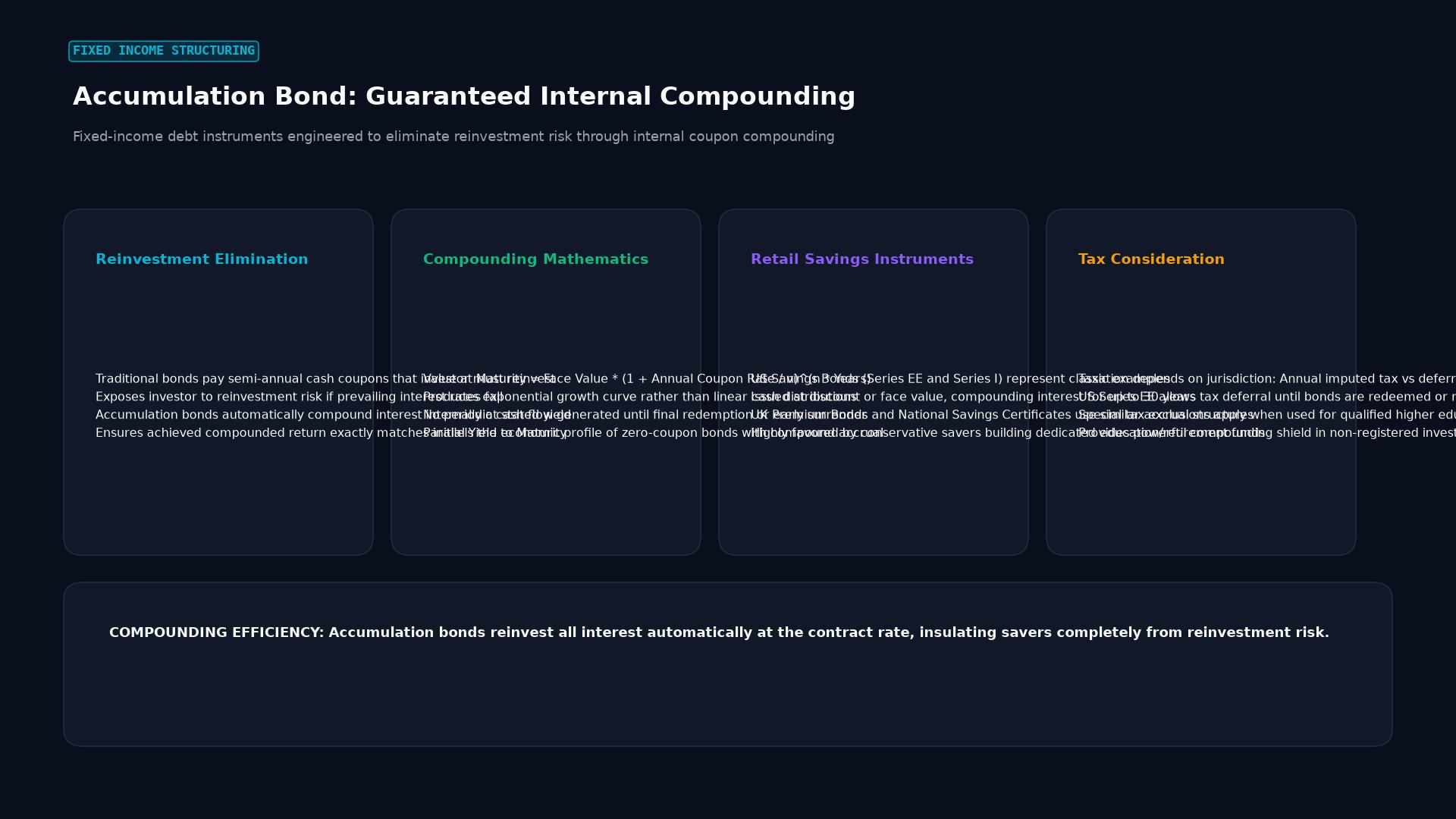 Figure: Fixed-income debt instruments engineered to eliminate reinvestment risk through internal coupon compounding
Technical Mechanics & Compound Valuation
The terminal payout of an accumulation bond is governed by the universal compound interest equation:
Maturity Value = Principal × [1 + (Nominal Interest Rate / m)]^(m × n)Where:
- Principal: Initial purchase price of the bond.
- Nominal Interest Rate: Stated annual contractual coupon rate.
- m: Compounding frequency per year (1 for annual, 2 for semi-annual, 12 for monthly).
- n: Total number of years until maturity.
1. Reinvestment Risk Elimination
The central structural advantage of an accumulation bond is the total elimination of reinvestment risk. When interest rates drop in secondary debt markets, investors holding traditional bonds are forced to reinvest their incoming cash coupons at lower prevailing yields. An accumulation bond guarantees the contractual compounding rate across its entire multi-year lifecycle, regardless of central bank interest rate cuts.
2. Tax Timing and Phantom Income
In taxable investment accounts, government tax authorities (such as the US IRS or UK HMRC) frequently treat accumulated interest as taxable income in the calendar year it compounds, even though the investor receives zero liquid cash until maturity. Consequently, institutional wealth managers predominantly place accumulation bonds within tax-exempt trusts, individual retirement accounts (IRAs), 401(k) plans, or tax-advantaged savings wrappers like UK ISAs.
Comparative Matrix: Accumulation Bond vs. Income Bond vs. Zero-Coupon Bond
| Feature | Accumulation Bond | Income (Distribution) Bond | Traditional Zero-Coupon Bond |
|---|---|---|---|
| Purchase Price | Issued at Par ($1,000) | Issued at Par ($1,000) | Issued at Deep Discount (e.g., $580) |
| Cash Coupons | Zero interim cash; compounded | Periodic cash checks (semi-annual) | Zero cash; zero contractual coupon |
| Principal Growth | Principal balance expands visibly | Principal balance remains static | Static nominal par ($1,000 face) |
| Cash Outflow | Full compounded sum at maturity | Initial par returned at maturity | Face par returned at maturity |
| Investor Goal | Long-term capital growth / retirement | Immediate cash flow / living expenses | Targeted liability matching / defeasance |
Real-World Case Study: Sovereign Savings Accumulation Certificates
A prominent international example of accumulation bond architecture is the National Savings and Investments (NS&I) Index-Linked Savings Certificate program in the United Kingdom, alongside US Treasury Series EE and Series I Savings Bonds.
In 2022, an individual investor allocated $10,000 into a 20-year US Treasury Series EE Bond offering guaranteed doubling of capital if held to year 20 (reflecting an effective 3.53% compound annual growth rate). Rather than receiving $350 in annual checks, the bond’s redemption value tracked an accumulation schedule:
- By Year 10, the bond’s cash surrender value accreted to $14,140.
- By Year 20, the Treasury’s statutory guarantee matured, delivering a tax-deferred lump-sum redemption of $20,000.
By avoiding annual tax reporting and eliminating all management fees and reinvestment frictions, the accumulation structure delivered frictionless capital compounding for the investor’s retirement fund.
Frequently Asked Questions (FAQ)
Can an accumulation bond be redeemed before maturity?
Most retail and government accumulation bonds permit early surrender after an initial lockout period (typically one year), though early redemption during the first three to five years may incur a small interest penalty (such as forfeiting the last three months of accrued interest).
What is the difference between an accumulation bond and an accumulation unit?
An accumulation bond is a fixed-income debt instrument issued by a government or corporation that compounds interest on a debt obligation. An accumulation unit is an equity-linked accounting measure used in variable annuities and mutual funds that tracks the proportional value of fund shares during the investment phase.
How do rising interest rates affect existing accumulation bonds?
If market interest rates rise significantly after an accumulation bond is purchased, the investor faces opportunity cost risk. Because their capital is compounding at the original fixed contractual rate, they miss the opportunity to earn higher market yields unless the instrument is redeemable and can be rolled over into higher-yielding debt.
Ready to trade forex?
Open a free demo account with a regulated broker. Practice with virtual funds before risking real money.