Accumulation Unit
An Accumulation Unit is an accounting measure that quantifies an investor's proportional ownership in a variable annuity sub-account during the accumulation phase, functioning like mutual fund shares.
What Is an Accumulation Unit?
An Accumulation Unit is a specialized financial accounting unit that represents an investor’s proportional share of ownership in an underlying investment sub-account of a variable annuity or segregated life insurance fund during the accumulation (savings) phase.
When an individual deposits money into a variable annuity, the capital is not held as static cash. Instead, the contract owner directs those funds into specific sub-accounts that track underlying portfolios of equities, government bonds, or money market instruments.
Because the underlying assets fluctuate in market value daily, the insurance company cannot track the account solely in static dollar increments. Instead, it divides each sub-account into discrete units. An accumulation unit functions almost identically to a share of a mutual fund: its unit price rises and falls based on the investment performance of the underlying asset portfolio, minus applicable insurance mortality and operational fees.
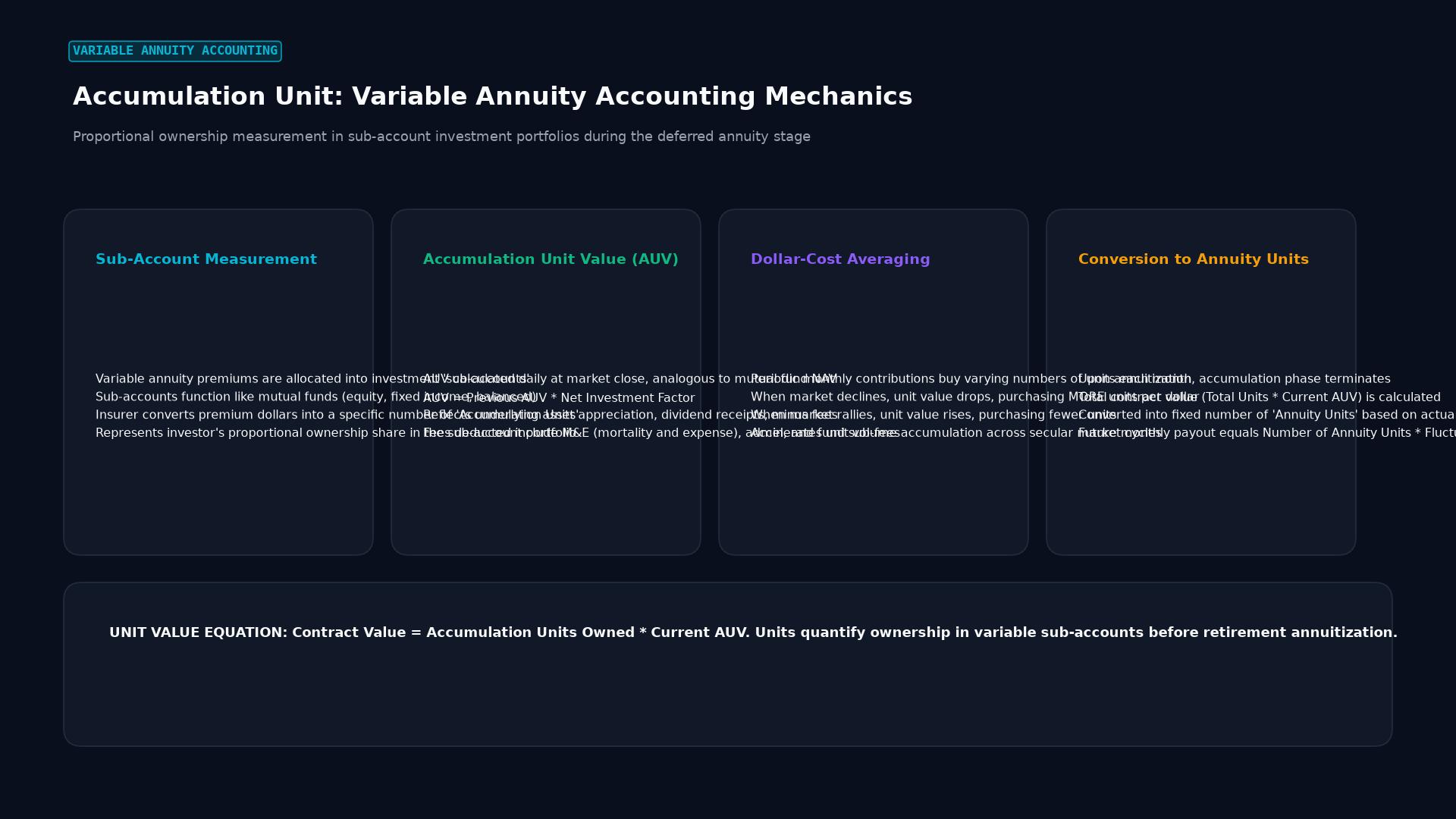 Figure: Proportional ownership measurement in sub-account investment portfolios during the deferred annuity stage
Technical Mechanics: Calculating Accumulation Unit Value (AUV)
The price of an accumulation unit is termed the Accumulation Unit Value (AUV). Unlike mutual funds that publish Net Asset Value (NAV) once per trading day based purely on portfolio holdings, an AUV incorporates specific insurance overhead deductions through the Net Investment Factor (NIF):
1. The Daily Pricing Equation
AUV_Today = AUV_Yesterday × Net Investment Factor2. The Net Investment Factor (NIF) Formula
The Net Investment Factor measures the net performance of the sub-account from the close of the preceding business day to the close of the current valuation day:
NIF = (Net Asset Value of Underlying Fund + Dividends/Gains - Daily Separate Account Charges) / Prior NAVWhere Daily Separate Account Charges reflect the annualized insurance costs divided by 365, including:
- Mortality and Expense (M&E) Risk Charges: Compensates the insurer for longevity guarantees and death benefit promises (typically 0.90% to 1.40% annually).
- Administrative & Recordkeeping Fees: Covers customer servicing and statements (0.15% to 0.30% annually).
- Underlying Portfolio Management Expense Ratio: Asset management fees paid to mutual fund sub-advisors (0.40% to 1.00% annually).
Because these fractional insurance fees are deducted every business day from the Net Investment Factor, the growth curve of an Accumulation Unit runs slightly below the gross raw return of the underlying stock index.
The Transition: Accumulation Units to Annuity Units
When an investor reaches retirement and chooses to convert the contract into guaranteed periodic lifetime distributions (a process called annuitization), accumulation units cease to exist:
- Terminal Account Valuation: The total number of accumulation units across all sub-accounts is multiplied by their current AUVs to establish the gross contract value (e.g., 20,000 units × $25.00 AUV = $500,000).
- Actuarial Conversion: The insurance actuary applies an annuity purchase factor based on the annuitant’s age, gender, assumed interest rate (AIR, typically 3.0% to 4.0%), and mortality tables.
- Annuity Units Created: The total dollar value is converted into a permanent fixed number of Annuity Units. From that day forward, the retiree’s monthly check equals their fixed number of annuity units multiplied by the fluctuating monthly Annuity Unit Value.
Comparative Matrix: Accumulation Unit vs. Mutual Fund Share vs. Annuity Unit
| Feature | Accumulation Unit | Mutual Fund Share (NAV) | Annuity Unit |
|---|---|---|---|
| Context | Variable annuity accumulation phase | Retail mutual fund / ETF holding | Variable annuity payout (distribution) phase |
| Pricing Term | Accumulation Unit Value (AUV) | Net Asset Value (NAV) | Annuity Unit Value (Annuity UV) |
| Fee Deduction | Sub-account fees + M&E insurance fees | Pure investment management expense ratio | Ongoing post-annuitization insurance fees |
| Tax Reporting | Zero annual tax (100% tax-deferred) | Annual 1099-DIV for dividends and capital gains | Payouts taxed as ordinary income via exclusion ratio |
| Unit Balance | Increases with every new cash deposit | Increases with every new share purchase | Fixed number of units for lifetime |
Real-World Case Study: Dollar-Cost Averaging Accumulation Units
Between 2022 and 2024, a corporate professional contributed $1,000 monthly into an equity index sub-account of a variable annuity. During 2022, market volatility caused the Accumulation Unit Value to fluctuate:
- In March 2022, when the AUV was $40.00, the $1,000 deposit purchased 25.0 units.
- In October 2022, amid a market pullback, the AUV dropped to $25.00; the $1,000 deposit purchased 40.0 units.
- By December 2024, the market recovered, pushing the AUV to $50.00.
Because the investor purchased more units when prices were depressed (dollar-cost averaging), their accumulated unit balance reached 850 units with an average purchase cost of $32.40 per unit. At the $50.00 AUV, the portfolio stood at $42,500 on total cash contributions of $27,540, illustrating how accumulating discrete units capitalizes on market drawdowns.
Frequently Asked Questions (FAQ)
Can an investor reallocate accumulation units between sub-accounts without paying taxes?
Yes. One of the primary advantages of variable annuities is the ability to transfer accumulation units from an equity sub-account to a bond or money market sub-account tax-free. Unlike retail brokerage accounts where selling appreciated stock triggers capital gains taxes, reallocating sub-account units triggers zero tax consequences.
How often are Accumulation Unit Values calculated?
AUVs are calculated at the close of every business day that the New York Stock Exchange (NYSE) is open, typically around 4:00 PM Eastern Time, reflecting the updated market close prices of underlying securities.
Do cash dividends increase the number of accumulation units owned?
Generally, no. In most variable annuity sub-accounts, underlying stock dividends and interest distributions do not purchase extra units. Instead, the dividends are reinvested directly into the fund assets, which increases the daily Net Investment Factor and raises the per-unit value (AUV) of existing units.
Ready to trade forex?
Open a free demo account with a regulated broker. Practice with virtual funds before risking real money.