Advance Retail Sale
Advance Retail Sales is a monthly macroeconomic indicator released by the US Census Bureau measuring total consumer spending across retail stores, serving as a primary driver of GDP forecasts and foreign exchange volatility.
What Is the Advance Retail Sales Report?
The Advance Monthly Sales for Retail and Food Services (universally referred to in financial media and forex trading as the Advance Retail Sales Report) is a high-impact macroeconomic data release published monthly by the United States Census Bureau, a division of the Department of Commerce.
Released around the middle of each month at 8:30 AM Eastern Time (approximately two weeks after the conclusion of the reference month), the report provides the earliest official estimate of total dollar sales across US brick-and-mortar retail stores, online e-commerce platforms, dining establishments, and beverage venues.
Because consumer spending accounts for approximately 68% to 70% of total United States Gross Domestic Product (GDP), and retail sales represent roughly one-third of that consumer expenditure, the Advance Retail Sales report functions as the financial market’s primary pulse check on consumer confidence, household purchasing power, and broad economic momentum.
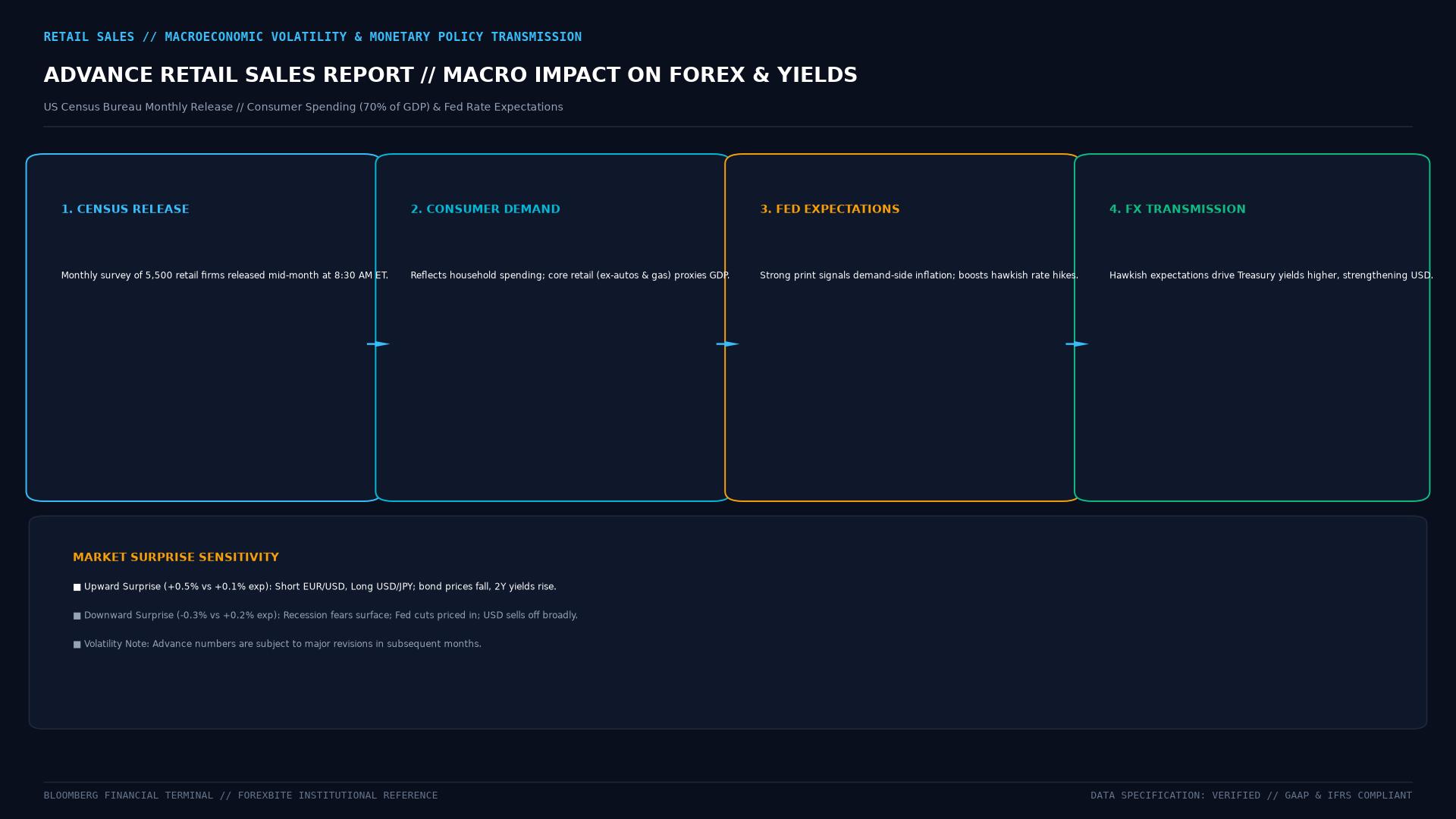 Figure: Advance Retail Sales release architecture and macroeconomic transmission showing Headline vs Core (control group) metrics, real GDP impacts, central bank policy expectations, and foreign exchange market reactions.
Technical Mechanics: Headline vs. Core Retail Sales
Institutional trading desks dissect the monthly release across four distinct analytical layers:
1. Headline Retail Sales (Total Sales)
The headline figure tracks the total dollar volume of all retail and food service sales, expressed as a month-over-month (MoM) and year-over-year (YoY) percentage change. While prominent in mainstream headlines, the headline metric is heavily distorted by two volatile components:
- Automotive Sales: Motor vehicles represent roughly 20% of the index. Supply-chain delivery delays or seasonal fleet buying create volatile swings that do not reflect organic consumer spending.
- Gasoline Stations: Dollar receipts at gas stations fluctuate based on global crude oil prices rather than changes in actual consumer fuel demand.
2. Retail Sales ex-Autos (Core Retail Sales)
Excludes motor vehicle and parts dealers from the calculation, providing a clearer reading on general merchandise, electronics, and apparel spending.
3. Retail Sales ex-Autos & Gas (Super-Core)
Strips out both automotive dealers and gasoline filling stations, isolating non-energy consumer discretionary spending.
4. The Retail Control Group
The Control Group (often termed “Core-Core”) strips out automobiles, gasoline stations, building materials, and food services. The control group feeds directly into the Bureau of Economic Analysis (BEA) model to calculate Personal Consumption Expenditures (PCE) for official quarterly GDP reports.
Forex Market Impact: Trading the Retail Sales Release
Currency markets exhibit immediate, violent volatility upon the release of the Advance Retail Sales report at 8:30 AM ET:
Scenario A: Stronger-than-Expected Data (Hawkish USD Shock)
- Macro Trigger: Retail sales print significantly above Bloomberg/Reuters consensus forecasts (e.g., +0.9% actual vs. +0.3% expected).
- Market Reaction: Signals resilient consumer demand that could fuel demand-pull inflation. Bond traders sell Treasury debt, driving nominal US Treasury yields higher.
- Forex Trajectory: The US Dollar appreciates rapidly across major currency pairs. The EUR/USD and GBP/USD drop by 30 to 70 pips within minutes, while USD/JPY surges higher on widening interest rate differentials.
Scenario B: Weaker-than-Expected Data (Dovish USD Sell-off)
- Macro Trigger: Retail sales contract or miss expectations sharply (e.g., -0.4% actual vs. +0.1% expected).
- Market Reaction: Rekindles economic slowdown or stagflation fears, prompting traders to price in aggressive Federal Reserve interest rate cuts.
- Forex Trajectory: US Dollar weakens broadly; gold (XAU/USD) rallies as yields retreat.
Comparative Matrix: US Retail Sales vs. CPI vs. Non-Farm Payrolls
| Economic Release | Issuing Agency | Frequency & Timing | Primary Focus | Forex Volatility Tier |
|---|---|---|---|---|
| Advance Retail Sales | US Census Bureau | Monthly (~15th, 8:30 AM ET) | Consumer spending volume & retail demand | Tier-1 (High Volatility) |
| Consumer Price Index (CPI) | Bureau of Labor Statistics | Monthly (~12th, 8:30 AM ET) | Consumer price inflation & purchasing power | Tier-1 (Extreme Volatility) |
| Non-Farm Payrolls (NFP) | Bureau of Labor Statistics | Monthly (First Friday, 8:30 AM) | Labor employment & wage inflation | Tier-1 (Maximum Volatility) |
| Consumer Confidence | The Conference Board | Monthly (Last Tuesday, 10:00 AM) | Consumer sentiment & future outlook | Tier-2 (Moderate Volatility) |
Real-World Case Study: Retail Sales Surprise and EUR/USD Reversal
On Thursday, August 15, 2024, the US Census Bureau released the July Advance Retail Sales report amid pervasive market anxiety that the US economy was slipping into an imminent recession following a weak July jobs report.
Consensus forecasts projected modest retail sales growth of +0.3% MoM:
- The Data Print: Advance Retail Sales surged by +1.0% MoM, the strongest monthly advance in 18 months, driven by electronics (+1.6%) and grocery stores (+1.0%). The Retail Control Group expanded by +0.3%.
- Immediate Yield Shock: The 10-year US Treasury yield jumped 14 basis points from 3.82% to 3.96% within twenty minutes, as bond traders immediately slashed expectations of a 50-basis-point emergency rate cut by the Federal Reserve.
- Forex Price Action: The EUR/USD plummeted from 1.1015 down to 1.0950 (a rapid 65-pip intraday drop), while the USD/JPY soared from 147.20 to 149.30 (+210 pips). The report single-handedly dispelled immediate recession fears and restored fundamental demand for the US Dollar.
Frequently Asked Questions (FAQ)
Why is the report titled “Advance” Retail Sales?
The report is designated “Advance” because it is an initial preliminary estimate based on an early sample survey of approximately 5,500 retail and food service firms. The Census Bureau publishes comprehensive revisions in subsequent months as additional accounting survey data is submitted.
Does the Retail Sales report adjust for inflation?
No. The Advance Retail Sales report measures nominal dollar sales, not real sales adjusted for inflation. If retail sales expand by 0.5% in a month where consumer price inflation (CPI) rose by 0.6%, real physical goods consumption actually contracted, a distinction critical for macro forex analysts.
Are services included in the Retail Sales report?
No. Aside from dining and drinking places (food services), the report measures strictly physical merchandise. It excludes healthcare, legal services, air travel, housing rent, and software subscriptions, which make up the larger remaining share of total US consumer spending.
Ready to trade forex?
Open a free demo account with a regulated broker. Practice with virtual funds before risking real money.