Advance
An Advance in trading refers to an upward price movement in a security or currency pair, while in banking it denotes a short-term disbursement of credit or loan capital prior to final settlement.
What Is an Advance in Financial Markets?
In financial terminology, the word Advance operates across two foundational pillars of market operations:
- Market Price Action & Breadth: In securities trading and foreign exchange, an advance describes an upward price move in an individual currency pair, equity, or commodity during a trading session. On an exchange-wide level, “advances” refer to the total aggregate number of stocks closing higher on the day, serving as the basis for macro Market Breadth indicators like the Advance-Decline Line (A/D Line).
- Commercial Banking & Credit Facilities: In lending and trade finance, an advance is a disbursement of funds (such as a cash advance, bank advance, or working capital drawdown) transferred to a borrower before formal long-term financing is finalized or before underlying receivables are collected.
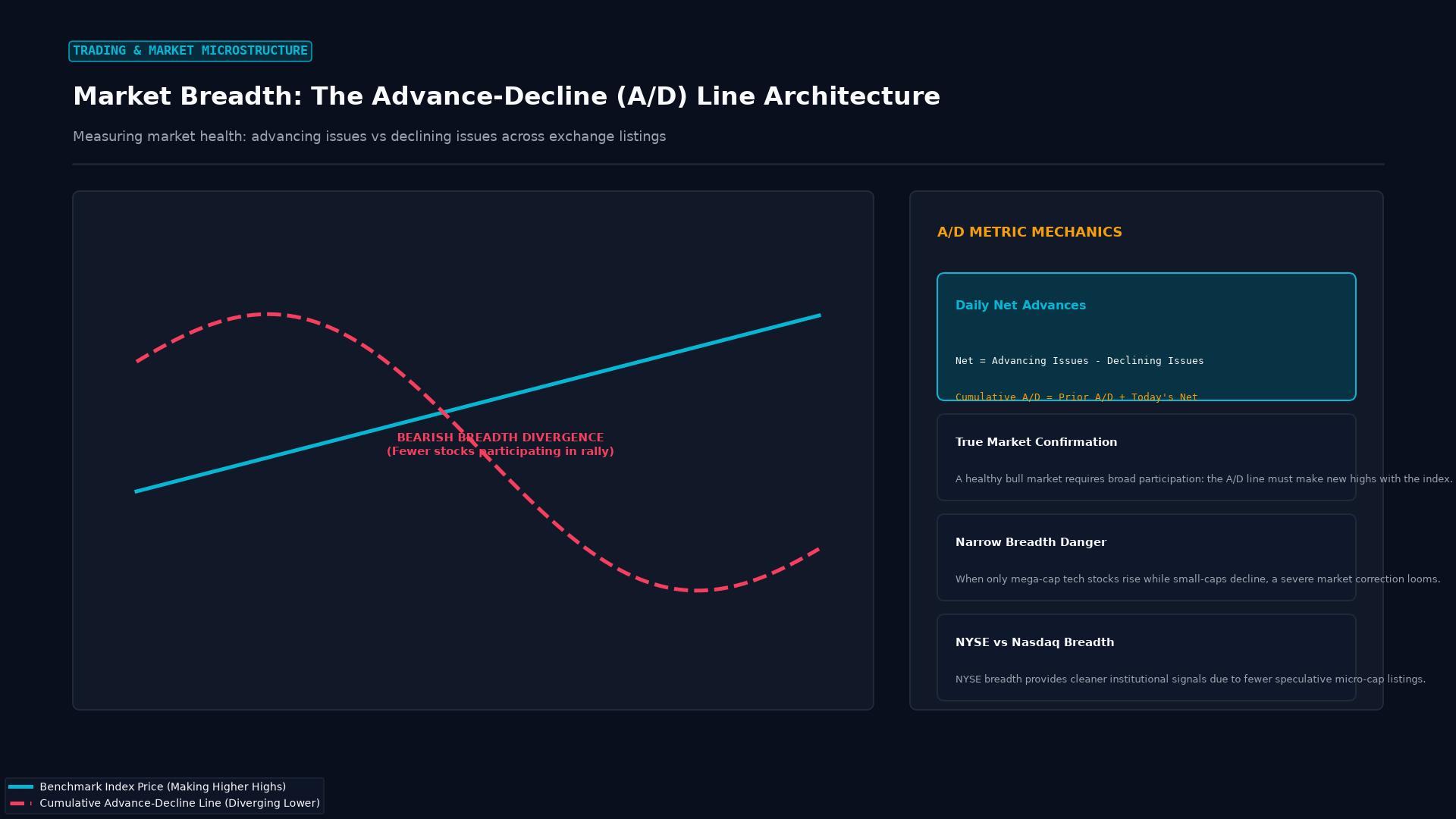 Figure: Exchange market breadth mechanics: calculating daily net advances and cumulative Advance-Decline line divergence to gauge institutional participation behind benchmark index rallies.
Technical Mechanics: Market Breadth and the Advance-Decline Line
In technical analysis and equity index trading, evaluating whether market advances are genuine or artificial requires analyzing internal market participation:
1. The Advance-Decline (A/D) Net Ratio
At the close of each trading day, exchanges (such as the NYSE or Nasdaq) calculate:
Net Advances = Number of Advancing Stocks - Number of Declining StocksA day where 2,200 stocks rise and 800 stocks decline produces a net advance of +1,400, signaling broad, healthy market buying participation across the economy.
2. Breadth Divergence (The Warning Signal)
- Healthy Market Advance: The headline equity index (such as the S&P 500) climbs to new all-time highs while the cumulative Advance-Decline Line simultaneously reaches new highs. This confirms that thousands of small, mid, and large-cap companies are advancing in tandem.
- Bearish Breadth Divergence: The market index pushes higher, but the Advance-Decline Line declines. This indicates that a small handful of mega-cap technology stocks are driving the index upward while the vast majority of ordinary companies are falling, signaling an impending structural market correction.
Technical Mechanics: Commercial Banking Advances
In commercial lending and corporate treasury, an advance functions as a flexible, pre-authorized credit disbursement:
1. Advances Under Revolving Credit Lines
Unlike a term loan where the borrower takes the entire lump-sum balance on day one and pays interest on the full amount, a revolving line of credit allows a business to request incremental advances:
- The borrower requests an advance of $75,000 to cover weekly inventory restocking.
- The bank wires the funds, increasing the loan balance from $100,000 to $175,000.
- Daily interest accrues strictly on the active advanced balance, minimizing corporate interest expense.
2. Banker’s Advances in Trade Finance
In international import-export commerce, banks issue pre-shipment and post-shipment advances to exporters against confirmed letters of credit, allowing manufacturers to purchase raw materials and pay labor before overseas buyers settle invoices.
Comparative Matrix: Market Advance vs. Banking Advance
| Dimension | Market Price Advance | Commercial Credit Advance |
|---|---|---|
| Primary Domain | Secondary exchange trading & technical analysis | Commercial banking and debt financing |
| Opposite Concept | Price Decline / Market Sell-off | Loan Repayment / Principal Amortization |
| Key Indicator | Advance-Decline Ratio / Breadth Line | Utilization Rate (% of facility advanced) |
| Duration | Intraday, daily, or multi-week trend phase | Short-to-medium term revolving credit |
| Risk Focus | Volatility, bull traps, liquidity exhaustion | Borrower credit default, collateral haircuts |
Real-World Case Study: Detecting the 2021 Index Breadth Divergence
Throughout the autumn of 2021, the US equity market displayed a classic technical warning involving market advances:
- The Index Appearance: Between September and November 2021, the headline S&P 500 index repeatedly broke out to new all-time highs, advancing past 4,700 points.
- The Advance-Decline Reality: Quantitative analysts tracking the NYSE Advance-Decline Line discovered that the cumulative A/D line peaked in June 2021 and had been steadily deteriorating for five months. By November, declining stocks outnumbered advancing stocks on 65% of trading days.
- The Divergence Outcome: Mega-cap giants (Apple, Microsoft, Alphabet) were advancing, masking the fact that hundreds of industrial, retail, and biotech stocks were already trapped in 20% to 40% drawdowns.
- The Resolution: Within weeks, the mega-cap stocks succumbed to selling pressure, triggering the brutal 2022 bear market and vindicating the predictive value of advance-decline breadth analysis.
Frequently Asked Questions (FAQ)
What does “advances leading declines” mean in morning market commentary?
When financial media reports that “advancers lead decliners by a 2-to-1 margin,” it means twice as many individual stocks have increased in price during the trading session as those that have fallen, confirming broad buying interest across the market.
What is a cash advance on a credit card?
A cash advance is a short-term loan extended by a credit card issuer allowing cardholders to withdraw physical cash from an ATM. Unlike standard retail purchases, cash advances carry high upfront fees (typically 3% to 5%) and accrue interest immediately at elevated APRs with zero grace period.
How does an Advance-Decline Oscillator differ from the cumulative A/D Line?
The cumulative A/D Line is a running historical total that trends upward or downward over years. An Advance-Decline Oscillator (such as the McClellan Oscillator) applies moving average formulas to daily net advances to measure short-term overbought and oversold conditions within a bounded oscillator range.
Ready to trade forex?
Open a free demo account with a regulated broker. Practice with virtual funds before risking real money.