Advance Rate
The Advance Rate is the maximum percentage of an asset's appraised collateral value that a commercial lender or broker agrees to extend as credit, establishing the borrowing limit for loans and margin facilities.
What Is an Advance Rate?
In commercial lending, asset-based finance, structured credit, and prime brokerage, the Advance Rate represents the maximum percentage of an asset’s appraised value that a financial institution will extend as credit to a borrower.
When a corporation applies for a collateralized loan or revolving credit line, the lender does not lend 100% of the collateral’s face value. Doing so would expose the lender to immediate principal losses if the borrower defaulted and collateral values dropped in secondary markets.
To create a protective equity buffer, the lender applies an advance rate (such as 85% against eligible accounts receivable or 50% against warehouse inventory). The remaining unfinanced percentage (e.g., 15% or 50%) is known as the collateral haircut, providing a safety cushion that absorbs price volatility, default liquidation expenses, and asset deterioration.
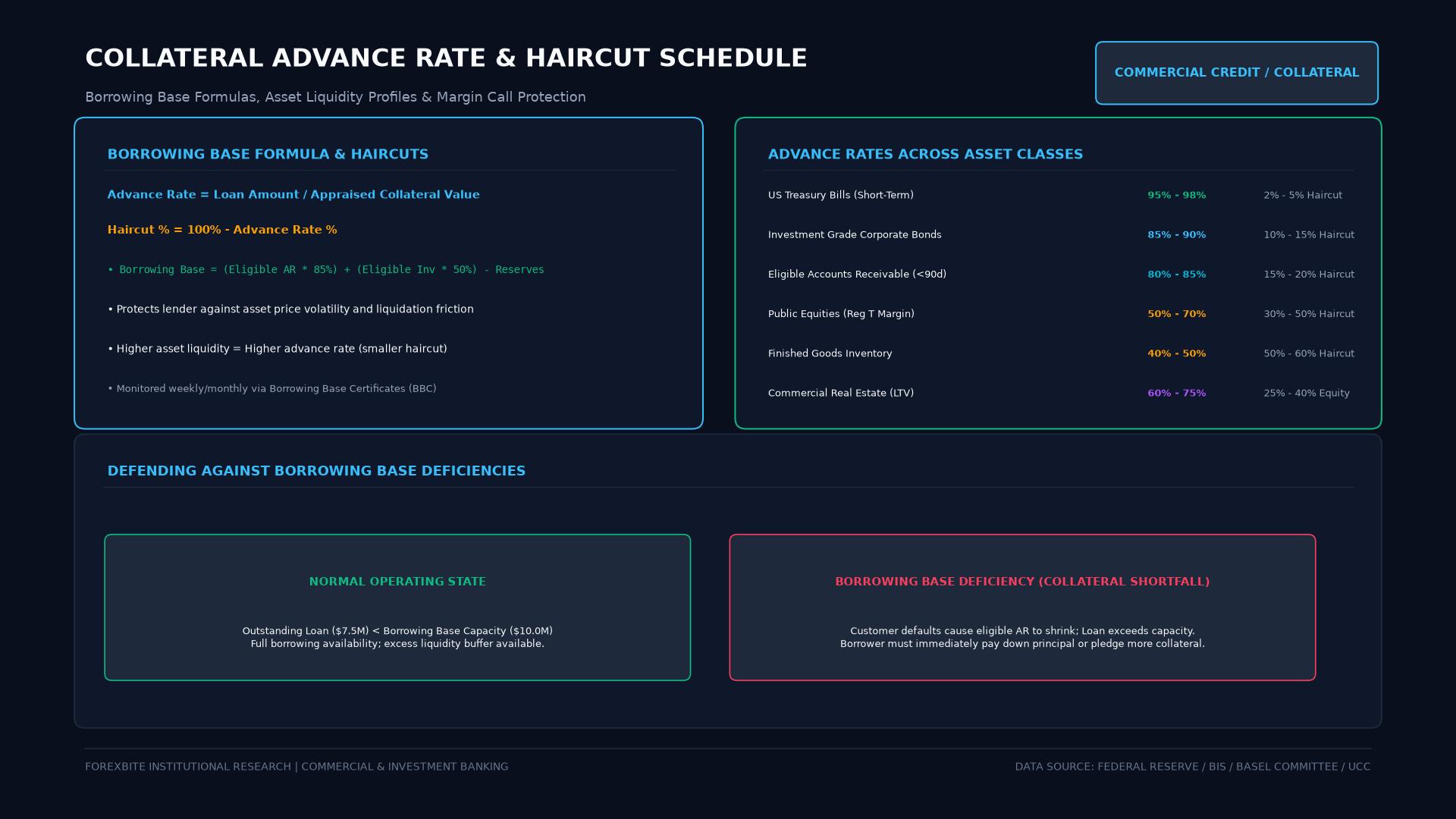 Figure: Borrowing base calculation methodology illustrating eligible collateral classes, haircut discounts, and net liquidity availability for corporate borrowers.
Technical Mechanics: The Borrowing Base Calculation
In corporate treasury management, the advance rate is the core computational variable governing the Borrowing Base:
Maximum Loan Availability = Appraised Collateral Value × Advance Rate %In multi-asset credit facilities, commercial banks calculate the aggregate credit availability by applying differentiated advance rates across asset categories:
Total Borrowing Base = (Eligible AR × AR Advance Rate) + (Eligible Inventory × Inventory Advance Rate) + (M&E × Equipment Advance Rate) - ReservesFactors Determining the Advance Rate
Lenders establish advance rates based on three primary risk characteristics:
- Liquidity and Resale Velocity: How rapidly can the lender convert the asset into liquid cash if the borrower defaults? Liquid commercial invoices from creditworthy buyers command an 85% advance rate, whereas custom work-in-progress inventory receives a 0% advance rate due to lack of secondary market buyers.
- Price Volatility: Assets subject to severe commodity price swings (such as raw lumber or agricultural crops) receive lower advance rates (30% to 50%) to buffer against sudden price drops.
- Legal Perfection and Custody: Assets where the lender holds a perfected first-priority security interest under UCC Article 9 receive higher advance rates than assets stored in third-party international jurisdictions.
Comparative Matrix: Standard Advance Rates Across Asset Classes
| Collateral Category | Standard Advance Rate | Typical Haircut | Primary Risk Drivers |
|---|---|---|---|
| Eligible Accounts Receivable | 80% to 85% | 15% to 20% | Customer dilution, billing disputes, debtor bankruptcy |
| Finished Goods Inventory | 50% to 65% | 35% to 50% | Consumer obsolescence, seasonal demand collapse |
| Raw Materials Inventory | 30% to 50% | 50% to 70% | Volatile commodity spot prices, bulk liquidation friction |
| Machinery & Equipment (NOLV) | 70% to 80% of NOLV | 20% to 30% | Physical wear, specialized retooling, auction discounts |
| US Treasury Securities | 95% to 98% | 2% to 5% | Sovereign backing, extreme secondary market liquidity |
| Public Equities (Reg T Margin) | 50% (Initial) | 50% | High intraday volatility, market crash vulnerability |
Note: NOLV stands for Net Orderly Liquidation Value.
Real-World Case Study: Retailer Inventory Advance Rate Adjustment
In early 2024, a regional sporting goods retailer operated under a $30 million revolving credit line with a commercial bank syndicate. The credit agreement stipulated an 85% advance rate on eligible receivables and a 65% advance rate on finished inventory.
During its annual third-party collateral field examination, auditors discovered that over $6 million of the retailer’s $20 million inventory consisted of discontinued winter outerwear that had remained unsold for two consecutive seasons:
- The Audit Action: The bank disqualified the aged apparel as ineligible inventory and lowered the advance rate on the remaining eligible inventory from 65% to 50% due to slowing retail consumer foot traffic.
- Impact on Borrowing Base:
- Previous Inventory Credit Line: $20,000,000 × 65% = $13,000,000.
- Revised Inventory Credit Line: ($20M - $6M ineligible) × 50% = $7,000,000.
- Liquidity Contraction: The sudden $6 million reduction in available credit forced the retailer to execute promotional flash sales and negotiate supplier payment deferrals to maintain positive bank account liquidity, demonstrating how advance rate adjustments directly dictate corporate working capital.
Frequently Asked Questions (FAQ)
What is the mathematical difference between an advance rate and a haircut?
They are two sides of the same equation. The advance rate is the percentage of the collateral value that the lender will disburse as loan proceeds. The haircut is the remaining percentage that the lender withholds as an equity safety buffer. If a bank applies a 20% haircut to collateral, the advance rate is 80%.
Can advance rates change during the term of a loan?
Yes. Commercial credit agreements frequently contain covenants permitting the lender to reduce advance rates if the borrower’s customer default rates rise, inventory turnover slows, or macro economic conditions deteriorate.
How does the advance rate relate to Loan-to-Value (LTV) in real estate?
In commercial real estate and mortgage lending, the advance rate is universally referred to as the Loan-to-Value (LTV) ratio. An LTV of 75% on a commercial warehouse appraisal of $4 million means the lender will advance a mortgage of $3 million.
Ready to trade forex?
Open a free demo account with a regulated broker. Practice with virtual funds before risking real money.