After market
The after-market refers to the secondary trading activity in a security immediately following its initial public offering (IPO) or seasoned equity issuance, governed by underwriter stabilization rules and market liquidity dynamics.
What Is the After-Market in Capital Markets?
The after-market (often written as “aftermarket”) denotes the secondary market trading phase that commences immediately after an issuer sells newly created securities to institutional and retail investors through an Initial Public Offering (IPO), follow-on offering, or secondary direct listing. Once the investment banking syndicate completes the primary distribution and shares begin trading on an exchange (such as the NYSE or Nasdaq), the security enters the after-market.
In corporate finance and equity syndicate operations, the after-market represents a critical phase of price discovery. Investment bankers, designated market makers (DMMs), hedge funds, and retail participants interact to establish an unassisted equilibrium price. If demand exceeds expectations, the stock surges above its Public Offering Price (POP), creating an “IPO pop.” If market sentiment falters or the issue was overpriced, the after-market experiences downward pressure that triggers statutory underwriting stabilization activities.
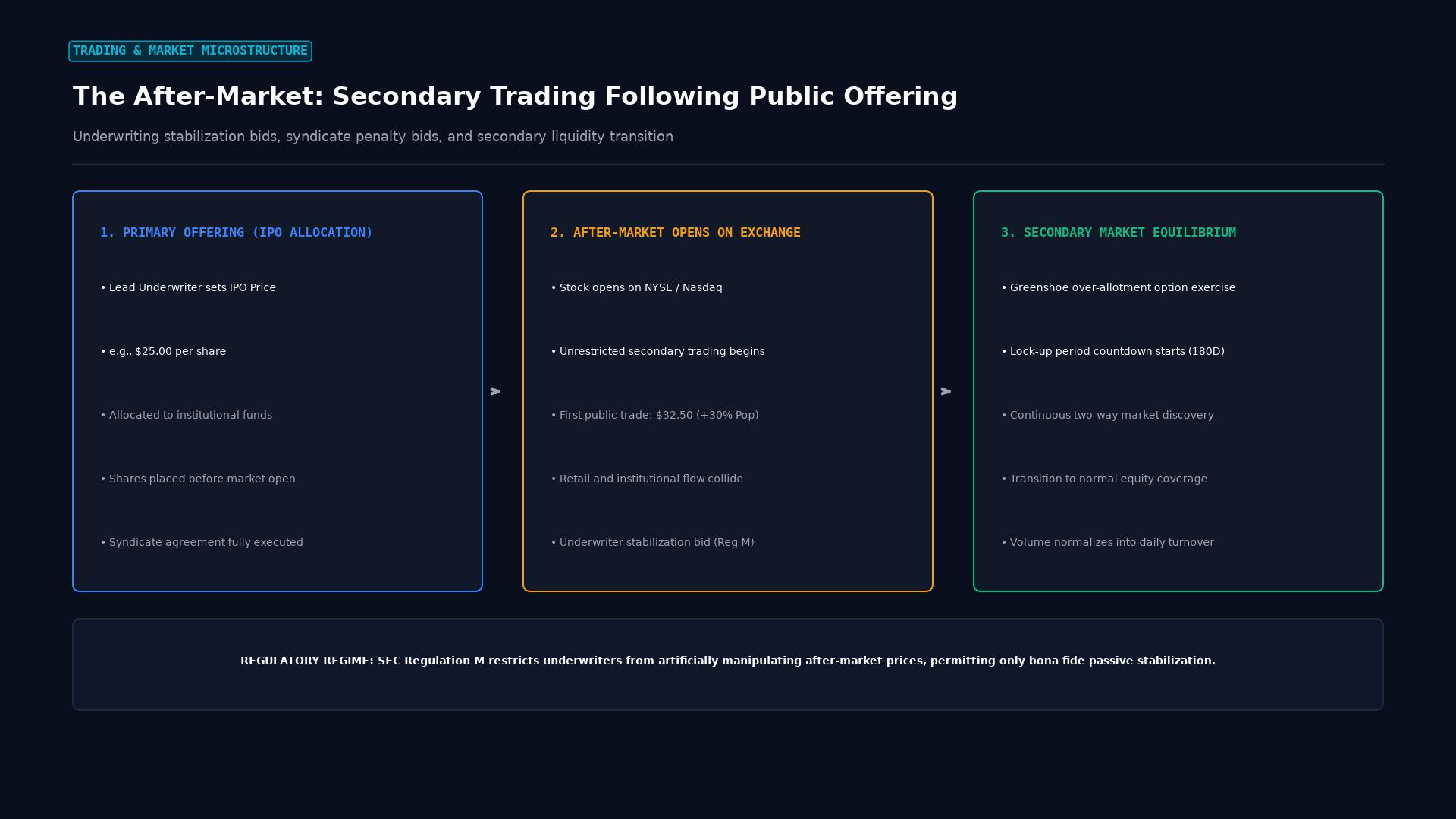 Figure: Transition from primary IPO underwriting allocations into secondary after-market trading: lead underwriter stabilization bids (SEC Reg M), opening liquidity surges, and lock-up countdowns.
Syndicate Stabilization and SEC Regulation M
During the initial days and weeks of after-market trading, underwriting syndicates possess legal authorization to support the market price of the newly listed stock. Under standard market conditions, artificial price manipulation violates federal securities statutes. However, Rule 104 of SEC Regulation M grants an explicit safe harbor for syndicate stabilization:
- Stabilizing Bids: The lead underwriter (syndicate manager) may enter a bid in the open market to purchase shares on behalf of the syndicate to arrest or slow a price decline below the Public Offering Price.
- Price Limitations: A stabilizing bid can never be posted higher than the original offering price or the highest current independent bid on the primary exchange. Underwriters cannot use stabilization to drive the share price upward, only to prevent disorderly market collapses.
The Greenshoe Overallotment Option
The primary financial engineering mechanism enabling after-market stabilization is the overallotment option, universally known as the Greenshoe option (named after the Green Shoe Manufacturing Company, which first employed the structure in 1963):
- Syndicate Short Position: The underwriting syndicate deliberately oversells the initial offering by up to 15% above the base deal size. If the company plans to issue 10,000,000 shares, the underwriters sell 11,500,000 shares to investors, creating an aggregate naked short position of 1,500,000 shares.
- Execution Scenario A (Stock Falls Below POP): If the stock drops in after-market trading, the underwriters step into the secondary market and buy back the 1,500,000 shares at market prices. This buying pressure cushions the stock against steep drops. Because the underwriters sold the shares at the higher POP and repurchased them at a discount in the after-market, the syndicate also retains a trading profit.
- Execution Scenario B (Stock Rallies Above POP): If the stock surges in the after-market, the underwriters do not buy shares on the open exchange, which would push prices higher. Instead, they exercise their Greenshoe option with the issuing company, purchasing up to 1,500,000 newly issued shares directly from the company at the fixed original POP to cover their short position.
The Greenshoe Mechanism in the After-Market:
┌────────────────────────────────────────────────────────────┐
│ Syndicate sells 115% of offering (15% naked short position)│
└─────────────────────────────┬──────────────────────────────┘
                              │
             ┌────────────────┴────────────────┐
             ▼                                 ▼
   Stock Falls Below POP             Stock Surges Above POP
 ┌───────────────────────────┐     ┌───────────────────────────┐
 │ Syndicate buys 15% shares │     │ Syndicate exercises       │
 │ on open after-market.     │     │ Greenshoe option at POP.  │
 │ • Provides price support  │     │ • Issues new shares from  │
 │ • Closes short at profit  │     │   company to cover short  │
 └───────────────────────────┘     └───────────────────────────┘
After-Market Dynamics: Flipping and Lock-Up Expirations
Two major structural forces exert substantial influence over after-market volatility:
1. Investor Flipping and Penalty Bids
“Flipping” occurs when an institutional fund or retail trader receives an allocation at the pre-market Public Offering Price and immediately sells those shares into the after-market on opening day to pocket rapid gains. To discourage institutional flipping, lead underwriters track allocated share movements and may enforce “penalty bids,” reclaiming the selling concession commission from the broker who placed the flipped shares.
2. Lock-Up Agreement Expirations
Company founders, venture capital backers, and key executives typically sign lock-up agreements preventing them from selling shares in the after-market for a defined duration, conventionally 90 to 180 days post-IPO. As the lock-up expiration date approaches, after-market trading often experiences anticipatory selling, as the market prepares to absorb millions of previously restricted insider shares entering the public float.
After-Market vs. After-Hours Trading
In broader financial discussions, the phrase “after-market” is occasionally used colloquially to refer to after-hours trading sessions. Market participants must clearly separate the two concepts:
| Dimension | After-Market (IPO Secondary) | After-Hours Session (Extended Hours) |
|---|---|---|
| Market Focus | Post-listing secondary trading life of a new issue | Daily trading session between 4:00 PM and 8:00 PM Eastern |
| Participant Base | All market participants (Retail, DMMs, Institutions) | Primarily institutional funds and electronic retail brokers |
| Regulatory Driver | SEC Regulation M Rule 104 and Greenshoe covenants | FINRA / SEC electronic communication network (ECN) rules |
| Market Risk | Initial valuation discovery and float absorption | Illiquid order books, extreme spreads, and news volatility |
Key Takeaways
- The after-market encompasses the secondary exchange trading that takes place immediately after a security’s primary public offering.
- SEC Regulation M Rule 104 allows lead underwriters to submit stabilizing bids to prevent catastrophic opening drops below the public offering price.
- The 15% Greenshoe overallotment option provides investment bankers with the capital mechanics necessary to support after-market share prices.
- After-market performance is closely tied to institutional flipping behavior and subsequent corporate lock-up expiration dates.
Frequently Asked Questions
What causes an “IPO pop” in the after-market?
An IPO pop occurs when institutional and retail demand for a new issue significantly exceeds the available shares allocated by the underwriting syndicate. When trading opens on the public exchange, aggressive bidding by investors who missed pre-market allocations drives the share price substantially higher than the initial offering price.
How long does underwriter after-market price stabilization last?
Underwriting syndicates generally maintain stabilizing support for a brief period, typically ranging from several days up to 30 calendar days following the initial listing date. Once the designated stabilization period concludes or the Greenshoe option is exercised in full, the stock trades entirely unassisted.
How does after-market trading affect retail Forex markets?
While after-market equity trading focuses on stocks, major sovereign cross-border IPOs and foreign corporate listings (such as American Depositary Receipts) can generate substantial institutional foreign exchange conversion flows. International syndicates convert domestic currencies into host exchange currencies to settle primary distributions, occasionally creating intraday currency volatility in relevant FX pairs.
Ready to trade forex?
Open a free demo account with a regulated broker. Practice with virtual funds before risking real money.