Actual Market
An Actual Market, synonymous with the cash or physical spot market, is a trading venue where physical commodities, commercial goods, or foreign currencies are bought and sold for immediate settlement and physical delivery.
What Is an Actual Market?
In financial trading, commodities, and macro economics, the Actual Market (frequently referred to as the physical market, cash market, or spot market) is the commercial arena where physical goods, raw materials, energy products, or currencies are bought and sold for immediate transfer and physical delivery.
The actual market stands in stark contrast to derivatives and futures markets. While futures exchanges like the Chicago Mercantile Exchange (CME) or ICE trade paper contracts representing claims on future delivery months (the vast majority of which are closed out or cash-settled prior to expiration), the actual market is where physical grain elevators, oil refineries, metal smelters, and commercial corporate treasuries procure tangible inventory to run factories and power grids.
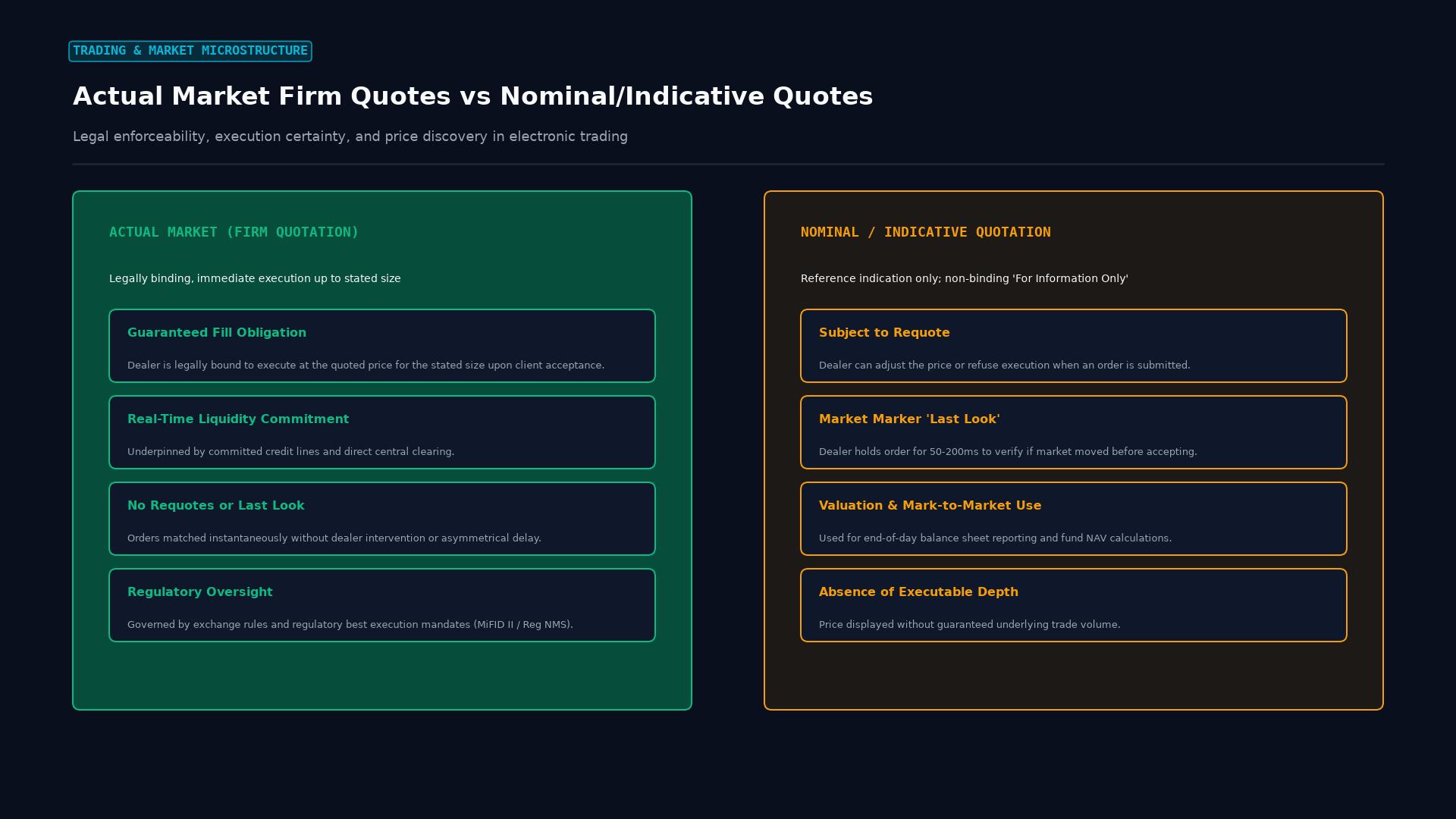 Figure: Trading quote enforceability: legally binding firm quotations with guaranteed execution depth compared to indicative, non-binding indications of interest.
Technical Mechanics & Physical Delivery Flows
Actual markets operate under distinct logistics, quality inspection, and settlement protocols:
1. The Spot Settlement Convention
In the actual market, transactions settle under standardized industry timelines:
- Commodities: Transfer of title occurs upon delivery of negotiable warehouse receipts, pipeline injection tickets, or maritime bills of lading (typically T+2 to T+5 days).
- Spot Foreign Exchange: Physical currency balances transfer across central bank settlement rails under standard T+2 settlement (or T+1 for USD/CAD).
2. The Basis Equation
The financial bridge connecting the actual cash market and the paper futures market is known as the Basis:
Basis = Actual Cash Price - Futures Price- Strengthening Basis: The cash price rises relative to the futures price, signaling tight local physical supply, empty regional storage facilities, or immediate delivery shortages.
- Weakening Basis: The cash price drops relative to futures, revealing local gluts or high storage and transportation costs.
3. Quality and Grade Differentials
Unlike standardized futures contracts that mandate a uniform baseline grade (such as West Texas Intermediate crude at 0.45% sulfur), actual market participants negotiate specific premiums or discounts based on precise chemical assay tests, moisture content, specific gravity, and geographic delivery terminals.
Comparative Matrix: Actual Market vs. Futures Market vs. Forward Market
| Operational Metric | Actual (Cash) Market | Futures Exchange Market | Forward Over-the-Counter Market |
|---|---|---|---|
| Contract Structure | Customized commercial invoices | Standardized exchange contracts | Customized bilateral legal agreements |
| Delivery Reality | 100% physical delivery and transfer | Under 2% physically delivered | Settled via delivery or cash offset |
| Counterparty Risk | Direct commercial counterparty risk | Guaranteed by Central Clearinghouse (CCP) | Direct bilateral credit risk |
| Price Transparency | Private dealer quotes, broker bourses | Public real-time transparent order book | Private OTC quotes between banks |
| Margin Calls | Cash invoice payment; trade credit terms | Daily mark-to-market variation margin | Collateral posted under ISDA agreement |
Real-World Case Study: Physical Brent Crude vs. Paper Futures
In June 2024, a major European oil refinery required 600,000 barrels of light sweet crude to meet summer gasoline production quotas. Rather than speculating on ICE Brent crude futures contracts, the refinery’s procurement desk operated directly in the North Sea Actual Market (Dated Brent):
- The Physical Purchase: The refinery contracted directly with an energy major for a physical cargo loaded at the Sullom Voe terminal in Scotland.
- Quality Premium: Because the actual physical cargo possessed an ultra-low sulfur content of 0.15% (sweeter than standard futures contract specs), the physical cargo traded at a +$1.85 premium over the front-month ICE Brent futures contract (a positive basis).
- Execution: Title was transferred via maritime bill of lading upon vessel departure, with funds transferred via institutional SWIFT bank wire, illustrating the real-world mechanics of the actual cash market.
Frequently Asked Questions (FAQ)
Can retail forex traders trade in the actual physical currency market?
No. Over 99% of retail forex traders trade Contracts for Difference (CFDs) or leveraged rolling spot contracts through retail brokers. These trades are cash-settled financial contracts where profits and losses are credited to the brokerage balance; physical currency is never delivered to the trader’s doorstep.
Why do commercial producers trade in both actual and futures markets?
Commercial producers use the actual market to sell their physical production to local buyers and use the futures market simultaneously as a hedging mechanism to lock in forward selling prices, protecting their business against unexpected commodity price collapses.
What happens if an investor does not close a physical-delivery futures contract?
If an investor holds an expiring futures contract that requires physical delivery past the First Notice Day, the exchange clearinghouse will issue physical delivery notices, legally obligating the holder to accept delivery of the underlying physical commodity at a licensed delivery point and pay the full cash contract value.
Ready to trade forex?
Open a free demo account with a regulated broker. Practice with virtual funds before risking real money.