Agency
Agency is a foundational legal and financial concept encompassing fiduciary relationships where an agent acts on behalf of a principal, agency trade execution models, and debt securities issued by government-sponsored enterprises.
What Is Agency in Finance and Law?
In financial economics, corporate governance, and capital markets, agency operates across three foundational dimensions:
- The Legal and Fiduciary Relationship: A formal arrangement where one party (the principal) legally authorizes another party (the agent) to act, negotiate, and execute commercial transactions on their behalf.
- The Agency Brokerage Trading Model: A securities and foreign exchange execution framework where an intermediary acts purely as a middleman matching buyers and sellers for a commission without taking inventory risk.
- Agency Debt Securities: Fixed-income bonds and mortgage-backed securities issued by US federal government agencies or Government-Sponsored Enterprises (GSEs).
Understanding agency dynamics is essential for evaluating corporate governance risks, brokerage execution quality, and fixed-income credit structures.
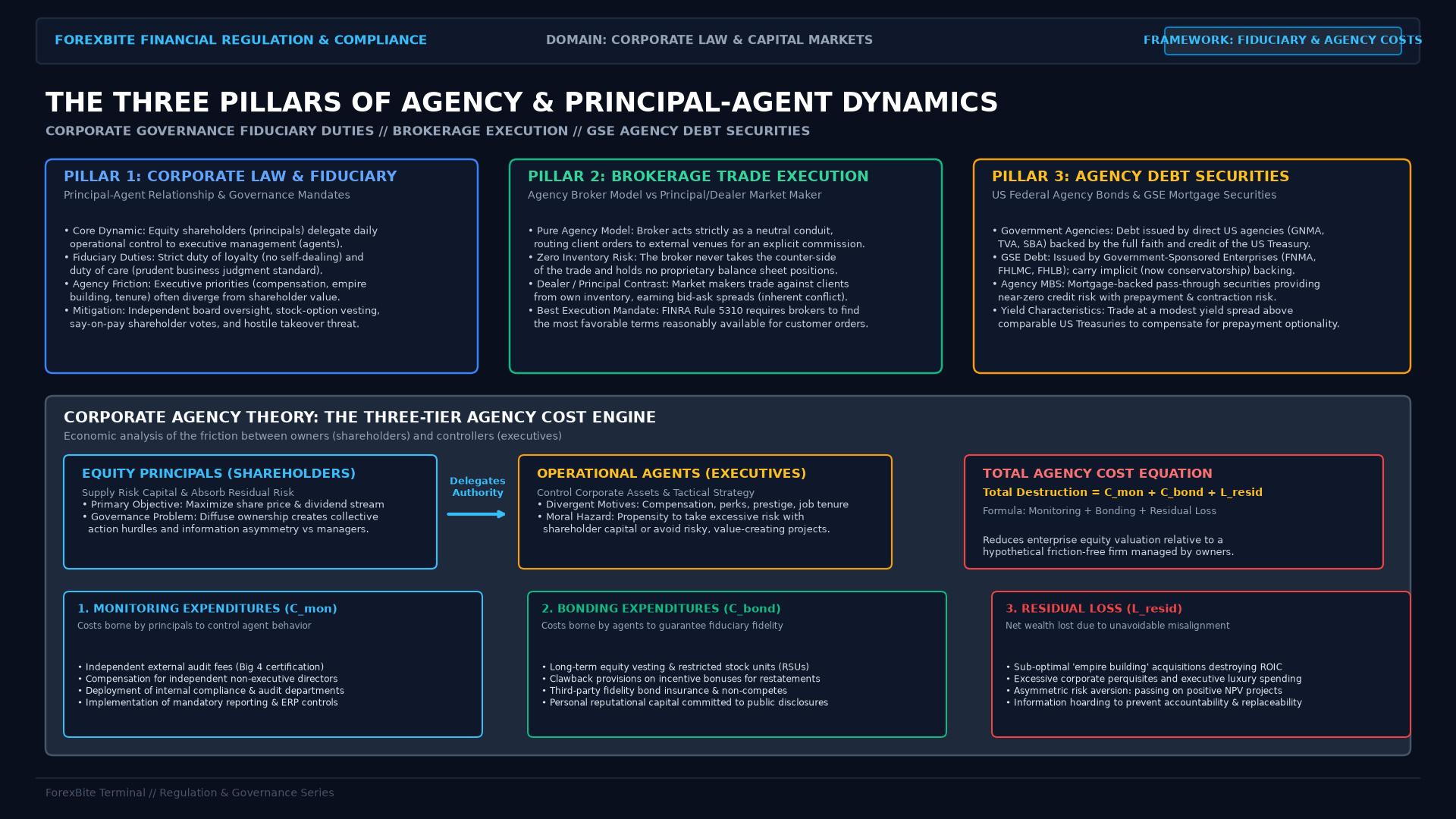 Figure: The three dimensions of financial agency across corporate governance fiduciary duties, brokerage agency execution models, and GSE agency debt securities, alongside the Jensen-Meckling agency cost engine.
Agency Theory and the Principal-Agent Problem
In corporate finance, agency theory analyzes the inherent conflicts of interest that arise when ownership is separated from operational control. Shareholders (principals) invest equity capital into a corporation, but delegate daily strategic management to corporate executives (agents).
Because executives may prioritize personal wealth, prestige, job security, or short-term bonuses over long-term shareholder equity value, a principal-agent conflict emerges. Economists classify the resulting financial frictions as agency costs:
- Monitoring Costs: Capital spent by principals to supervise agent behavior, including hiring independent external audit firms, appointing non-executive board directors, and deploying internal compliance officers.
- Bonding Costs: Costs incurred by agents to assure principals that they will adhere to fiduciary duties, such as signing non-compete agreements, accepting deferred equity vesting schedules, and purchasing fidelity bonds.
- Residual Loss: The net economic value lost when agent decisions inevitably diverge from optimal shareholder wealth maximization (for example, executing value-destroying corporate acquisitions to expand executive status).
Principal-Agent Conflict Mechanics:
┌────────────────────────────────────────────────────────┐
│ Equity Shareholders (Principals)                       │
│ Goal: Long-term enterprise valuation & dividend growth │
└──────────────────────────┬─────────────────────────────┘
                           │ Delegates Control / Faces Agency Costs
                           ▼
┌────────────────────────────────────────────────────────┐
│ Executive Management (Agents)                          │
│ Goal: High compensation, prestige, risk-averse tenure  │
└────────────────────────────────────────────────────────┘
Market Execution: Agency vs. Principal Trading
In securities, commodities, and currency trading, financial intermediaries execute client orders under one of two operational capacities:
| Dimension | Agency Trade Execution | Principal (Dealer) Execution |
|---|---|---|
| Role of Intermediary | Order broker / Agent | Counterparty / Market Maker |
| Inventory Risk | Zero; broker holds no position | Full; dealer trades from own book |
| Revenue Model | Explicit transparent commission | Bid-ask spread markup/markdown |
| Potential Conflict | Minimal; routing incentives only | High; broker profits when client loses |
| Regulatory Benchmark | Strict duty of Best Execution | Fair pricing and markup disclosure |
In an agency trade, the broker transmits the client’s order directly to an exchange, electronic communication network (ECN), or liquidity pool. The broker never owns the security and receives a stated commission. In contrast, in a principal trade, the brokerage sells the security to the client out of its own inventory, creating an inherent conflict where the broker’s profit depends on buying low and selling high.
Fixed Income: Agency Debt and Mortgage Securities
In global bond markets, “agencies” refers to debt obligations issued either directly by federal departments or through Government-Sponsored Enterprises (GSEs) created by the US Congress:
- Direct Federal Agencies: Issued by entities directly owned by the US federal government, such as the Government National Mortgage Association (Ginnie Mae). These securities carry the full faith and credit backing of the United States government, possessing zero credit default risk.
- Government-Sponsored Enterprises (GSEs): Issued by shareholder-owned corporations chartered by Congress to support public borrowing initiatives, such as the Federal National Mortgage Association (Fannie Mae), the Federal Home Loan Mortgage Corporation (Freddie Mac), and the Federal Home Loan Bank (FHLB) system.
US Agency Debt Credit Hierarchy:
┌────────────────────────────────────────────────────────┐
│ US Treasury Securities (Benchmark Zero Credit Risk)    │
└──────────────────────────┬─────────────────────────────┘
                           │
             ┌─────────────┴─────────────┐
             ▼                           ▼
 ┌───────────────────────┐   ┌───────────────────────────┐
 │ Direct Federal Agency │   │ Government-Sponsored (GSE)│
 │ (e.g., Ginnie Mae)    │   │ (Fannie Mae, Freddie Mac) │
 ├───────────────────────┤   ├───────────────────────────┤
 │ • Explicit Full Faith │   │ • Historically Implicit;  │
 │   and Credit Backing  │   │   FHFA Conservatorship    │
 │ • Matches Treasury    │   │ • Trade at tight spread   │
 │   credit rating       │   │   above Treasuries        │
 └───────────────────────┘   └───────────────────────────┘
Agency debt typically trades at a modest yield spread above comparable US Treasuries, compensating investors for prepayment risk (the risk that homeowners refinance underlying mortgages when interest rates drop).
Key Takeaways
- Agency represents a legal relationship where an agent is authorized to act on behalf of a principal under strict fiduciary standards.
- Agency costs arise from divergent incentives between shareholders and corporate executives, requiring monitoring systems and executive compensation alignment.
- Agency trading ensures brokers route orders without taking proprietary inventory risk, contrasting with principal dealer execution.
- Agency bonds encompass both direct federal agency securities (explicit government backing) and GSE debt (implicit government backing).
Frequently Asked Questions
What is the difference between an agency broker and a market maker?
An agency broker acts purely as an agent for the client, finding an external counterparty and charging an explicit commission. A market maker acts as a principal, quoting both a buy price and a sell price, fulfilling client orders from its own balance sheet and profiting from the bid-ask spread.
How does executive equity compensation address agency problems?
By compensating chief executives with stock options and restricted stock units (RSUs) that vest over multiple years, boards align the financial interests of executives with shareholders, incentivizing managers to build sustainable, long-term corporate value.
Are GSE agency bonds completely guaranteed by the US government?
Historically, GSE bonds carried only an implicit government guarantee. However, following the 2008 financial crisis, Fannie Mae and Freddie Mac were placed into conservatorship under the Federal Housing Finance Agency (FHFA), backed by Senior Preferred Stock Purchase Agreements with the US Treasury, providing de facto federal support.
Ready to trade forex?
Open a free demo account with a regulated broker. Practice with virtual funds before risking real money.