Alien corporation
An alien corporation is a company incorporated under the laws of a foreign country that operates, conducts commercial business, or establishes subsidiaries within the United States.
What Is an Alien Corporation?
In United States corporate jurisprudence and international tax law, an alien corporation is any corporate entity organized, chartered, and incorporated under the laws of a foreign nation that conducts business, holds commercial property, or maintains operational offices within the United States.
American corporate law employs a precise three-tier geographic taxonomy to categorize commercial entities based on where their legal articles of incorporation were filed. Understanding this classification is essential because it dictates state registration requirements, judicial jurisdiction, reporting obligations, and exposure to federal taxation.
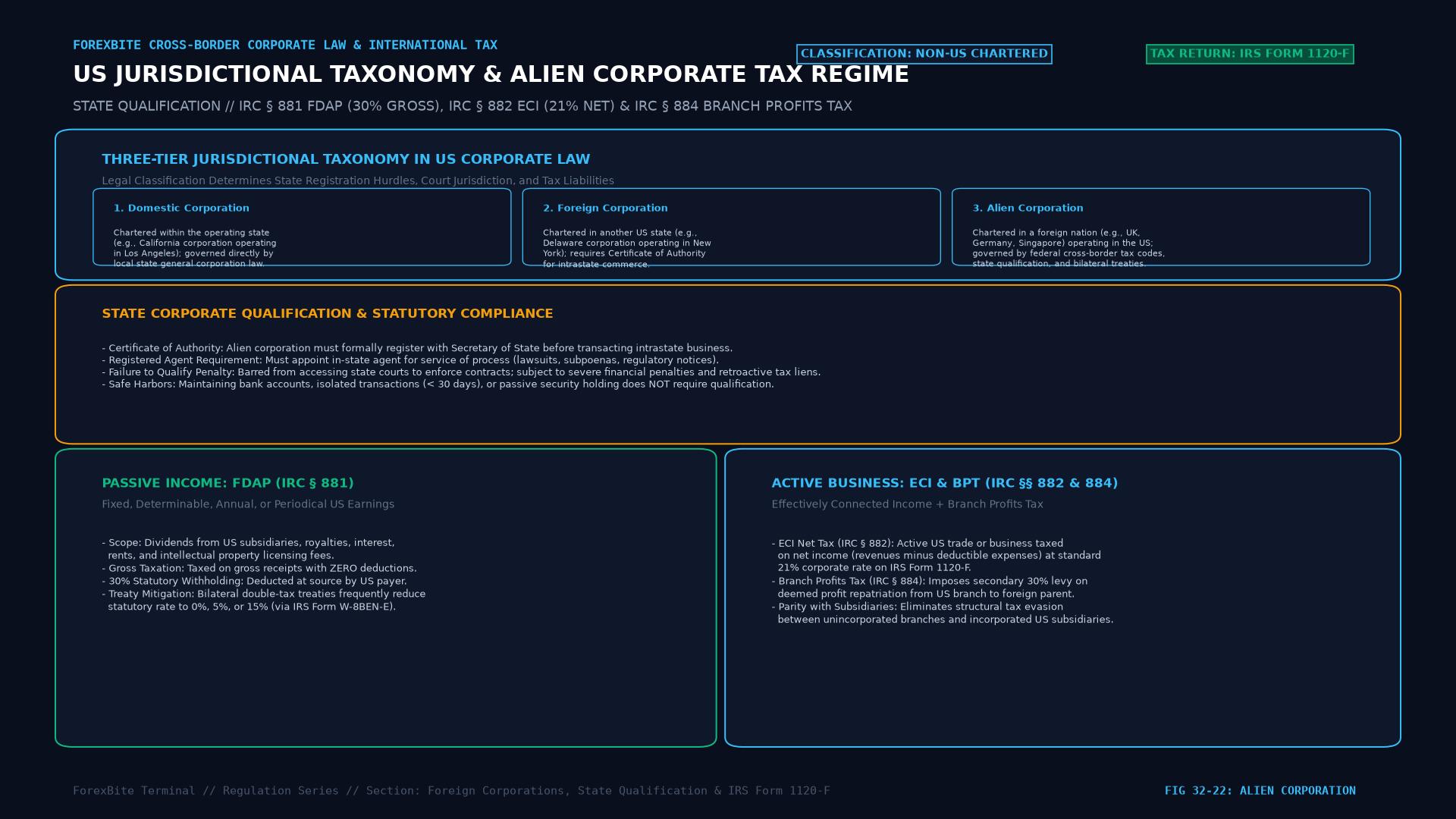 Figure: US three-tier corporate classification and federal tax architecture for alien corporations across FDAP gross withholding, ECI net corporate tax, and branch profits tax.
State Qualification and Foreign Authorization
Under state corporate statutes (such as the Model Business Corporation Act), an alien corporation cannot simply open an office and conduct intrastate commerce in a US state without statutory authorization. It must satisfy formal compliance hurdles:
- Certificate of Authority: The alien entity must file an application for a Certificate of Authority with the Secretary of State in every state where it conducts active business. This process is commonly called foreign qualification.
- Designation of Registered Agent: The alien corporation must appoint a physical registered agent with an in-state street address authorized to receive service of process and legal notices.
- Penalties for Unauthorized Operations: If an alien corporation conducts intrastate commerce without qualifying, it is barred from filing lawsuits in state courts to enforce contracts and faces substantial statutory financial penalties and back-tax assessments.
Merely maintaining a bank account, executing an isolated transaction completed within 30 days, or selling goods through independent contractors does not constitute “transacting business” requiring a state certificate of authority.
Federal Taxation of Alien Corporations
The Internal Revenue Service (IRS) enforces a specialized statutory tax regime governing alien corporations operating within the US tax perimeter:
IRS Tax Classification of Alien Corporate Income:
┌────────────────────────────────────────────────────────┐
│ Total US-Sourced Gross Revenue of Alien Corporation    │
└──────────────────────────┬─────────────────────────────┘
                           │
             ┌─────────────┴─────────────┐
             ▼                           ▼
 ┌───────────────────────┐   ┌───────────────────────────┐
 │ Passive Income (FDAP) │   │ Active Trade or Business  │
 │ (Dividends, Royalties,│   │ (Effectively Connected    │
 │ Interest, Rents)      │   │  Income - ECI)            │
 ├───────────────────────┤   ├───────────────────────────┤
 │ Taxed at Gross 30%    │   │ Taxed on Net Income at    │
 │ Withholding (IRC §881)│   │ Standard 21% US Corporate │
 │ (Reduced by Treaties) │   │ Tax Rate (IRC § 882)      │
 └───────────────────────┘   └─────────────┬─────────────┘
                                           │
                                           ▼ Plus (IRC § 884)
                             ┌───────────────────────────┐
                             │ Branch Profits Tax (30%)  │
                             │ (Levied on deemed profit  │
                             │  repatriation to homeland)│
                             └───────────────────────────┘
1. Effectively Connected Income (ECI)
Under IRC Section 882, if an alien corporation engages in a trade or business within the United States, all income that is “effectively connected” with that US commercial activity is taxed on a net basis. The company files IRS Form 1120-F (U.S. Income Tax Return of a Foreign Corporation), calculates gross revenues, subtracts allowable operational business deductions, and pays the standard 21% US corporate income tax rate.
2. Fixed, Determinable, Annual, or Periodical (FDAP) Income
Under IRC Section 881, passive investment income originating from US sources (such as dividends paid by US subsidiaries, patent royalties, or interest) that is not connected to an active US business is taxed on a gross basis at a flat 30% statutory rate. The tax is collected via automatic withholding by the US paying agent. This rate is frequently reduced or eliminated under bilateral tax treaties between the United States and the alien corporation’s home government.
3. The Branch Profits Tax (BPT)
Before 1986, foreign corporations could operate directly in the US through an unincorporated branch, pay the corporate tax on ECI, and remit remaining profits back to their foreign headquarters with zero dividend withholding tax. To level the playing field with US subsidiaries, Congress enacted IRC Section 884, creating the Branch Profits Tax. The BPT imposes an additional 30% tax on the “dividend equivalent amount” of an alien corporation’s effectively connected earnings that are not reinvested in US assets.
Direct Branch vs. US Subsidiary Structure
Multinational corporations expanding into the United States typically evaluate two primary structural vehicles:
| Structural Option | Legal Exposure | Tax Compliance |
|---|---|---|
| Direct Branch of Alien Corp | Parent company balance sheet exposed to US lawsuits | Form 1120-F filing; subject to Branch Profits Tax (IRC § 884) |
| Separately Incorporated US Subsidiary | Liability quarantined within US corporate entity | Standard Form 1120 filing; parent shielded; dividend withholding |
Most multinational enterprises choose to incorporate a separate domestic subsidiary (often in Delaware) rather than operating as a direct branch of an alien corporation. This isolates operational tort and contract liabilities within the US entity, protecting the foreign parent company’s global balance sheet from domestic litigation.
Key Takeaways
- An alien corporation is chartered under the laws of a foreign nation and conducts commercial activity within the United States.
- State laws require alien corporations to register for a Certificate of Authority and maintain an in-state registered agent.
- Effectively Connected Income (ECI) is taxed on a net basis at the 21% corporate rate, while passive FDAP income is subject to 30% gross withholding.
- The Branch Profits Tax (IRC § 884) prevents foreign companies from avoiding dividend withholding by operating through unincorporated branches.
Frequently Asked Questions
What is the difference between a foreign corporation and an alien corporation?
In US law, a foreign corporation is chartered under the laws of another US state (for example, a corporation incorporated in Delaware operating in New York). An alien corporation is chartered under the laws of a nation outside the United States (for example, a corporation organized under the laws of Germany or Japan).
How do bilateral tax treaties affect alien corporations?
Bilateral income tax treaties between the US and foreign nations prevent double taxation. Treaties typically reduce the 30% statutory withholding tax rate on dividends, royalties, and interest to 5% to 15%, and specify that business profits are taxable in the US only if the alien corporation maintains a “permanent establishment” (such as a factory, mine, or fixed office) within the country.
Can an alien corporation list its shares on the New York Stock Exchange?
Yes. Alien corporations list on US exchanges either by issuing ordinary shares directly (if registered under the Securities Act of 1933) or, more commonly, by sponsoring American Depositary Shares (ADS) traded via American Depositary Receipts (ADRs) issued by major US depositary banks.
Ready to trade forex?
Open a free demo account with a regulated broker. Practice with virtual funds before risking real money.