Activity
An Activity in business and managerial accounting is a discrete, identifiable unit of work performed by personnel, machinery, or software within an enterprise that consumes resources and produces measurable outputs.
What Is an Activity in Financial and Operational Management?
In managerial accounting, business process reengineering, and enterprise operations, an Activity is a discrete, measurable, and identifiable unit of work executed by people, mechanical equipment, software systems, or organizational facilities.
Activities represent the fundamental atomic building blocks of modern cost management systems like Activity-Based Costing (ABC) and Activity-Based Management (ABM). While traditional corporate accounting organizes expenditures into static departmental silos (such as “Marketing,” “Human Resources,” or “Plant Maintenance”), operational managers recognize that business results are generated by interconnected networks of dynamic activities.
Every activity consumes organizational resources (such as labor hours, electrical power, software licenses, and physical floor space) and transforms those inputs into an operational output that directly supports a product, service, customer relationship, or statutory compliance mandate.
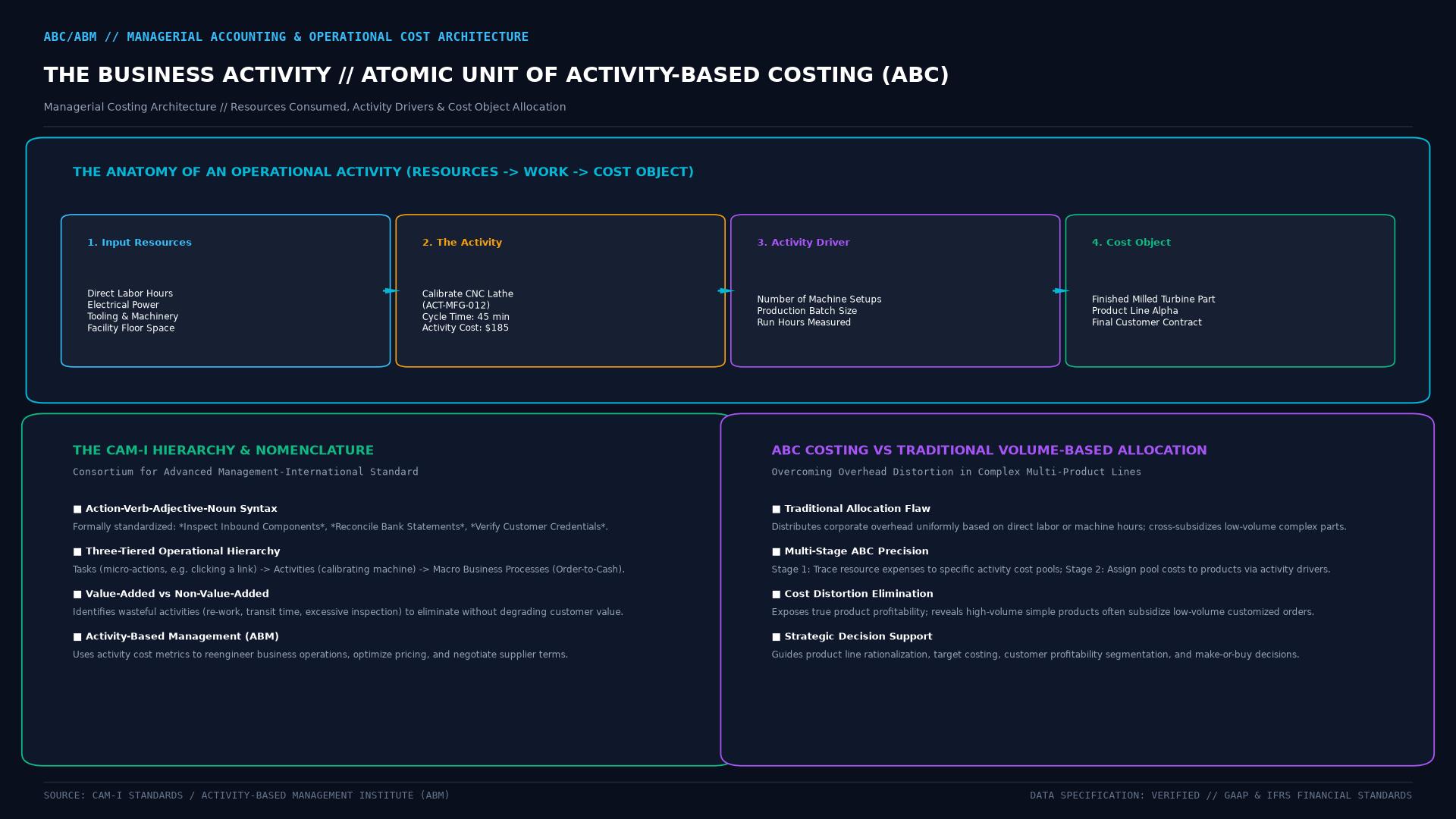 Figure: The operational anatomy of an activity within Activity-Based Costing (ABC) and Activity-Based Management (ABM), showing input resources, activity driver execution, cost object assignment, and the CAM-I process hierarchy.
Technical Mechanics & The Process Network
In modern enterprise management, individual activities do not exist in isolation. They connect sequentially to form comprehensive business processes:
1. The Standard Nomenclature Convention
Under standards established by the Consortium for Advanced Management-International (CAM-I), an activity is formally documented using the Action-Verb-Adjective-Noun syntactic rule:
- Verb (Action): Identifies the primary operational function (e.g., Inspect, Reconcile, Fabricate, Verify).
- Adjective (Scope): Modifies the operational context (e.g., Inbound, Electronic, Overdue, Critical).
- Noun (Object): Identifies the recipient or artifact of the work (e.g., Materials, Invoices, Circuits, Credentials). Examples include: Reconcile Monthly Bank Statements, Assemble Lithium Battery Cells, and Verify Customer KYC Documentation.
2. Activity Networks and Macro Business Processes
Multiple related activities link together in a cause-and-effect chain to form an end-to-end Business Process:
- Order-to-Cash (O2C) Process: Composed of activities: Receive Customer Order -> Verify Customer Credit -> Pick Warehouse Goods -> Package Shipment -> Generate Commercial Invoice -> Process Remittance Receipt.
- Procure-to-Pay (P2P) Process: Composed of activities: Generate Requisition -> Issue Purchase Order -> Inspect Inbound Goods -> Match Three-Way Invoice -> Disburse ACH Vendor Payment.
3. Aggregation: Tasks, Activities, and Macro-Activities
Cost management architects structure work across a three-tiered hierarchy of operational detail:
- Tasks: Highly detailed micro-actions (e.g., clicking mouse to open invoice PDF, typing password, printing paper copy). Tracking at this level is excessively expensive and creates administrative gridlock.
- Activities: The optimal intermediate level for cost modeling (e.g., Process Inbound Vendor Invoice).
- Macro-Activities (Processes): Broad corporate functions (e.g., Accounts Payable Management).
Comparative Matrix: Activity vs. Task vs. Department
| Dimension | Activity | Task | Organizational Department |
|---|---|---|---|
| Level of Scope | Intermediate operational process unit | Highly granular physical action | Broad administrative corporate division |
| Typical Example | Calibrate Injection Molding Press | Tighten bolt on clamping plate | Manufacturing Engineering |
| Cost Allocation | Core unit for assigning ABC cost drivers | Too granular for financial cost tracking | Traditional overhead cost center |
| Measurement Metric | Activity Driver (Hours, setups, transactions) | Seconds or keystrokes | Annual department budget ceiling |
| Cross-Functional | Frequently spans multiple departments | Confined to single worker workstation | Rigid, siloed functional hierarchy |
Real-World Case Study: Cross-Functional Customer Return Redesign
In 2023, an omnichannel consumer electronics retailer with $120 million in sales experienced rising operational costs associated with customer returns. Under traditional financial reporting, the customer service department was blamed because its payroll had expanded by 24%.
The operational strategy team mapped the actual Activity Chain governing returns across the organization:
- Activity 1 (Store Front): Receive Returned Merchandise (Customer Service).
- Activity 2 (Warehouse): Inspect and Test Electronic Condition (Quality Control).
- Activity 3 (IT / Finance): Reconcile Credit and Issue Customer Refund (Accounting).
- Activity 4 (Logistics): Package and Ship Defective Goods to Factory (Shipping).
The activity audit revealed that 65% of the total return handling cost occurred not in customer service, but in Activity 2 and Activity 4 due to manual testing of non-defective items that customers returned simply because user manuals were unclear.
By introducing an automated self-service QR code return portal and clarifying online setup videos, the retailer eliminated 40% of physical return volume, cutting consolidated return activity costs by $1.8 million annually.
Frequently Asked Questions (FAQ)
What is the difference between an activity and a cost center?
A cost center is a formal administrative organizational unit within a company (such as the Legal Department or IT Helpdesk) that has an assigned manager and budget. An activity is the specific work performed within or across cost centers. Multiple departments can contribute labor to a single shared activity.
How does an enterprise prevent an activity model from becoming too complex?
Cost accountants use the 80/20 Pareto principle: identify the 20% of core operational activities that generate 80% of total organizational expenses. Non-critical micro-tasks are aggregated into broader activity pools to maintain a sustainable, manageable model containing roughly 50 to 120 total activities.
Can activities be outsourced?
Yes. Activity analysis and Activity-Based Costing are the primary analytical tools used to make Make-or-Buy (outsourcing) decisions. By measuring the true fully loaded activity cost of performing a task internally (such as Payroll Tax Administration or Data Center Server Maintenance), management can compare that cost directly against commercial third-party vendor proposals.
Ready to trade forex?
Open a free demo account with a regulated broker. Practice with virtual funds before risking real money.