All Industry Activity Index Japan
The All Industry Activity Index is a monthly macroeconomic benchmark published by Japan's Ministry of Economy, Trade and Industry (METI) that tracks total output across the Japanese economy.
What Is the All Industry Activity Index in Japan?
The All Industry Activity Index (Zen-Sangyo Katsudo Shisu) is a high-impact monthly macroeconomic indicator published by Japan’s Ministry of Economy, Trade and Industry (METI). The index measures the net month-over-month and year-over-year percentage change in total physical production and commercial service output across every major sector of the Japanese domestic economy.
While official Japanese Gross Domestic Product (GDP) is tabulated and released quarterly by the Cabinet Office with substantial reporting delays, the METI All Industry Activity Index is calculated and published on a monthly basis. Consequently, macroeconomists, institutional bond managers, and foreign exchange (Forex) traders treat the index as the definitive monthly proxy for Japanese economic growth, using it to forecast quarterly GDP revisions and Bank of Japan (BOJ) monetary policy shifts.
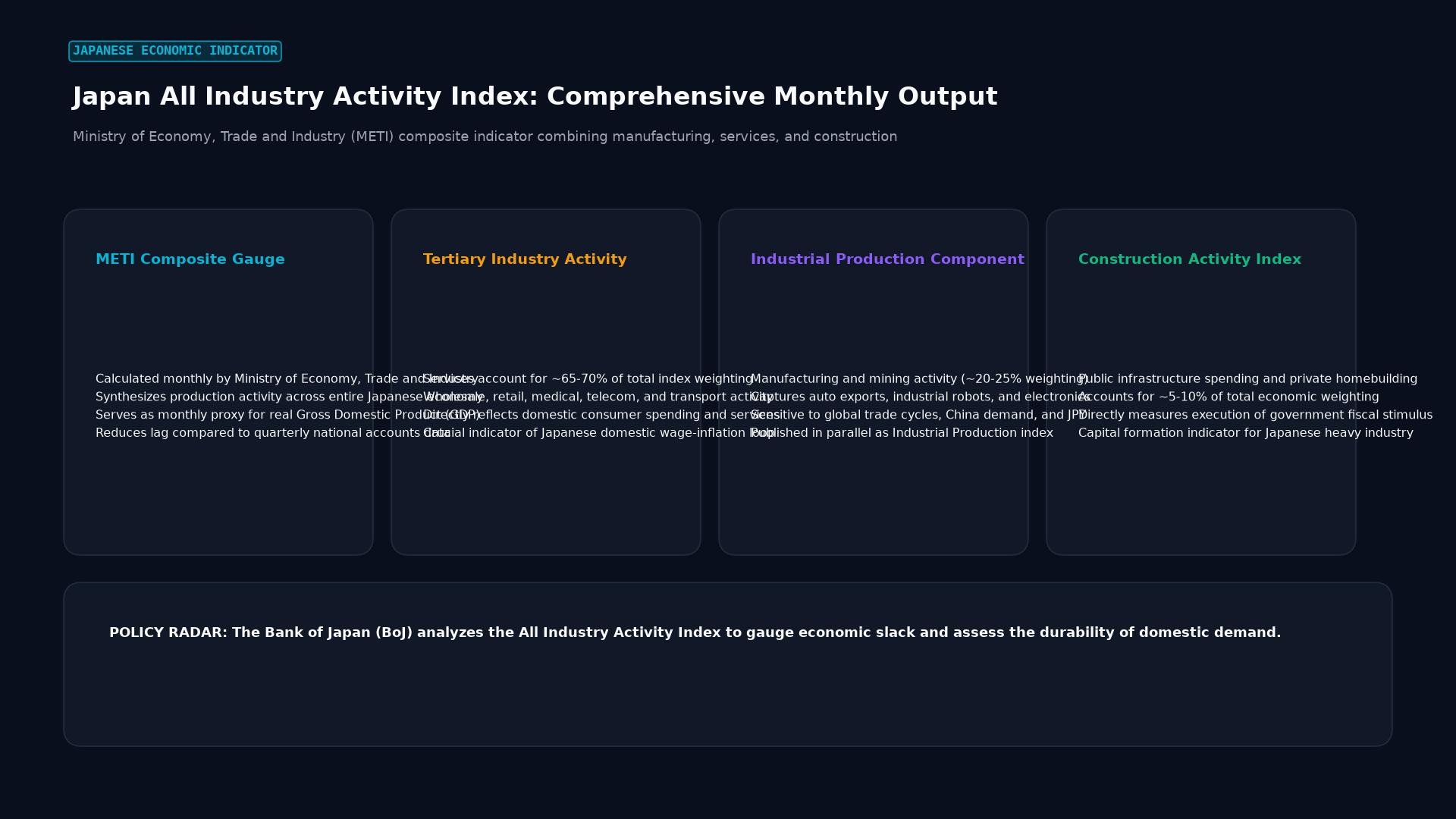 Figure: Ministry of Economy, Trade and Industry (METI) composite indicator combining manufacturing, services, and construction
Sector Composition and Mathematical Weighting
The headline index consolidates four distinct economic sectors, normalized to a base year index value of 100:
1. Tertiary Industry Activity Index (~70% Weight)
The largest single component of the benchmark. It measures operational turnover across Japan’s massive service economy, encompassing wholesale trade, retail merchandising, financial intermediation, telecommunications, hospitality, healthcare, and enterprise business services.
2. Industrial Production Index (~20% Weight)
Covering mining and manufacturing production. This sub-index captures output from Japan’s globally dominant industrial export sectors, including automotive manufacturing (Toyota, Honda), robotics, semiconductors, machine tools, and industrial chemicals.
3. Construction Industry Activity Index (~7% Weight)
Measures capital investment in private residential construction, commercial real estate development, and public civil engineering works financed by municipal and national infrastructure budgets.
4. Public Sector Activity Index (~3% Weight)
Tracks non-market administrative services, public utilities, and educational operations executed by national and local government bodies.
Forex Market Transmission: Impact on the Japanese Yen (JPY)
In foreign exchange markets, the Japanese Yen operates as both a primary G3 international currency and a global funding currency for cross-border carry trades. The All Industry Activity Index directly influences Yen currency crosses (such as USD/JPY, EUR/JPY, and GBP/JPY) through interest rate expectations:
Macro Transmission Loop from METI Index to Japanese Yen:
┌────────────────────────────────────────────────────────┐
│ METI Index Released (Substantial Beat Above Consensus) │
└──────────────────────────┬─────────────────────────────┘
                           │
             ┌─────────────┴─────────────┐
             ▼                           ▼
 ┌───────────────────────┐   ┌───────────────────────────┐
 │ Broad Industrial &    │   │ Rising Domestic Consumer  │
 │ Service Expansion     │   │ Demand & Wage Pressures   │
 └───────────┬───────────┘   └───────────┬───────────────┘
             │                           │
             └─────────────┬─────────────┘
                           ▼
 ┌────────────────────────────────────────────────────────┐
 │ Bank of Japan (BOJ) Under Pressure to Tighten Policy   │
 │ (Increases Overnight Call Rate / Limits Bond Purchases)│
 └─────────────────────────┬──────────────────────────────┘
                           │
                           ▼
 ┌────────────────────────────────────────────────────────┐
 │ Japanese Yen (JPY) Appreciates Across Global Markets   │
 │ (USD/JPY Plunges Lower as Carry Trades Unwind)         │
 └────────────────────────────────────────────────────────┘
Conversely, if the index reports consecutive negative prints, signaling domestic stagnation or export weakness, the Bank of Japan maintains accommodative monetary settings. This depresses domestic Japanese yields, prompting global traders to borrow Yen at low interest rates to invest in higher-yielding foreign assets.
Analytical Comparison: METI Index vs. BOJ Tankan
Institutional analysts cross-reference the All Industry Activity Index with other Japanese economic data:
| Indicator | Issuing Authority | Analytical Nature | Core Frequency |
|---|---|---|---|
| All Industry Activity Index | METI | Hard, quantitative supply-side output | Monthly |
| BOJ Tankan Survey | Bank of Japan | Qualitative executive business sentiment | Quarterly |
| Economy Watchers Survey | Cabinet Office | Grassroots retail and consumer sentiment | Monthly |
| Cabinet Office GDP | Cabinet Office | Formal national expenditure accounts | Quarterly |
While the Tankan survey measures corporate sentiment and future capital expenditure plans, the All Industry Activity Index tracks actual realized production and commercial output, providing hard empirical confirmation of whether business optimism translated into physical economic activity.
Key Takeaways
- The All Industry Activity Index is published monthly by METI, measuring overall economic production across Japan.
- It serves as the primary high-frequency monthly proxy for Japanese quarterly GDP.
- The index is dominated by Tertiary Services (~70%) and Industrial Production (~20%), with construction and government making up the remainder.
- Stronger-than-expected index readings generate upward pressure on the Japanese Yen (JPY) by signaling potential Bank of Japan monetary policy tightening.
Frequently Asked Questions
At what time is the METI All Industry Activity Index released?
METI typically publishes the report around the 20th of each month at 1:30 PM Japan Standard Time (JST), which corresponds to late-night trading in New York and early-morning trading in Europe.
How does the All Industry Activity Index differ from industrial production data?
Industrial production measures output exclusively from factories, manufacturing plants, and mines (covering roughly 20% of Japan’s economy). The All Industry Activity Index combines industrial production with services, construction, and government activity, providing a comprehensive view of the entire national economy.
Why do USD/JPY traders monitor Japanese services output?
Although Japan is famous for manufactured goods exports, services represent the domestic core of the economy. A surge in services activity indicates robust domestic wage growth and consumer spending, which are the primary prerequisites required by the Bank of Japan to raise interest rates.
Ready to trade forex?
Open a free demo account with a regulated broker. Practice with virtual funds before risking real money.