Allegation
An allegation is a formal assertion of fact set forth in a legal pleading, regulatory complaint, or indictment that the asserting party undertakes to prove through admissible evidence.
What Is an Allegation in Securities and Financial Law?
In civil litigation, criminal jurisprudence, and financial regulatory enforcement, an allegation is a formal assertion of fact stated in a legal pleading (such as a civil complaint, regulatory charging document, or criminal indictment). It outlines conduct that the plaintiff or prosecuting agency asserts occurred and intends to prove during legal proceedings.
Until substantiated by verified evidence and validated by a judge, jury, or administrative law judge, an allegation remains an unproven assertion. However, in the capital markets, the mere publication of formal regulatory allegations by agencies like the Securities and Exchange Commission (SEC) or the Commodity Futures Trading Commission (CFTC) can trigger immediate commercial consequences, including credit rating downgrades, counterparty margin increases, and severe equity price drops.
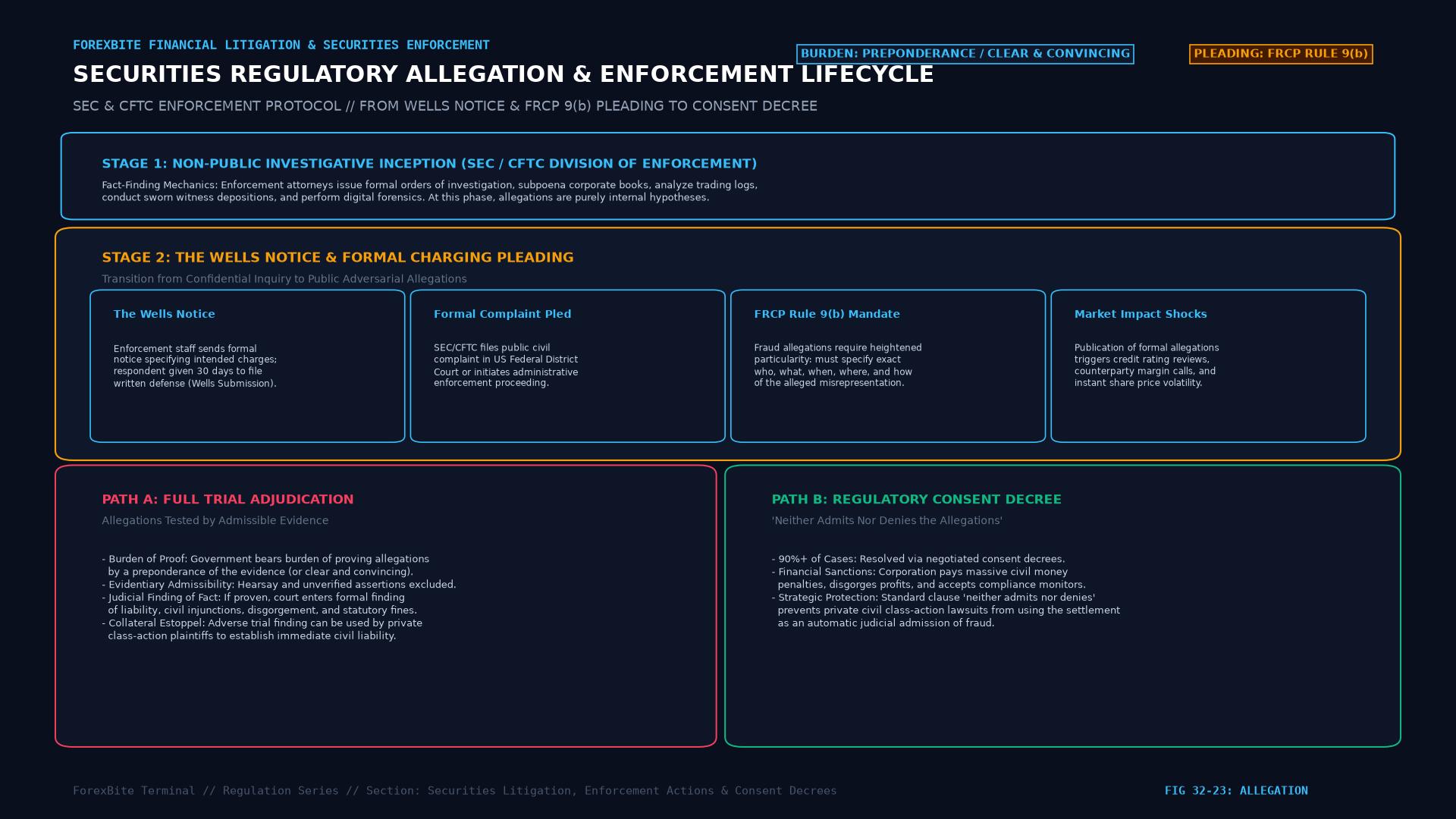 Figure: The procedural lifecycle of securities regulatory allegations from non-public investigation and Wells Notice to FRCP 9(b) complaint, trial adjudication, and consent decree settlements.
Securities Enforcement Lifecycle: From Wells Notice to Complaint
In United States securities oversight, the drafting and filing of regulatory allegations follow a formalized institutional trajectory:
1. The Wells Notice
Before the SEC staff files formal enforcement allegations, it conventionally issues a Wells Notice to the individual or financial firm under investigation. The notice outlines the specific statutory violations the enforcement staff intends to allege (such as accounting fraud, market manipulation, or unregistered broker-dealer operations) and provides the recipient with an opportunity to submit a written defense (a Wells Submission) arguing why charges should not be brought.
2. Formal Complaint and Specific Pleading
If settlement negotiations fail, the SEC files a public complaint in federal district court or initiates an administrative proceeding. In fraud cases, federal procedural rules (specifically Federal Rule of Civil Procedure 9(b)) demand heightened pleading standards. The agency cannot rely on vague accusations; it must state its allegations with particularity, detailing the exact who, what, when, where, and how of the fraudulent misrepresentation.
The “Neither Admit Nor Deny” Settlement Convention
The vast majority of corporate regulatory enforcement actions in the financial sector conclude without a full court trial through a negotiated settlement. In these consent decrees, corporate respondents routinely agree to pay substantial civil penalties, disgorge alleged illicit profits, and accept operational monitors while executing an explicit legal clause: “neither admitting nor denying the allegations.”
| Settlement Element | Corporate Purpose | Regulatory Objective |
|---|---|---|
| Monetary Penalty | Settles regulatory claim and avoids trial | Deters misconduct and punishes enterprise |
| Disgorgement | Relinquishes disputed revenue | Compensates harmed investors via Fair Funds |
| “Neither Admit Nor Deny” | Prevents collateral estoppel in civil lawsuits | Secures immediate enforcement without trial |
| Injunction Agreement | Agrees not to violate securities laws in future | Enables severe criminal contempt for repeat offenses |
By settling without admitting the truth of the government’s allegations, the corporation protects itself against collateral estoppel. If the firm admitted to the allegations in an SEC settlement, private shareholder class action attorneys could use that formal admission as conclusive proof of liability in parallel civil lawsuits.
Impact on Financial Markets and Public Equities
When regulatory or criminal allegations are unsealed against a public corporation, the market reaction is immediate and severe:
- Information Asymmetry and Price Discovery: Investors reprice the company’s valuation to account for potential fines, executive removal, and lost customer contracts. Allegations of revenue inflation often trigger immediate share price collapses of 20% to 50%.
- Shareholder Derivative and Class Action Lawsuits: Under the Private Securities Litigation Reform Act of 1995 (PSLRA), private plaintiffs file class actions alleging securities fraud following regulatory announcements, seeking damages on behalf of investors who purchased shares at artificially inflated prices.
- Credit Facility Cross-Defaults: Commercial loan agreements contain covenants stating that material litigation or government fraud allegations constitute an event of default, empowering banks to freeze credit lines and demand debt acceleration.
Key Takeaways
- An allegation is a formal claim of fact in a legal pleading that requires evidentiary proof in court.
- In securities fraud litigation, allegations must be pleaded with particularity under Federal Rule of Civil Procedure 9(b).
- Financial regulatory settlements routinely permit firms to pay fines while “neither admitting nor denying” the government’s allegations.
- Public regulatory allegations can trigger cross-defaults on corporate credit lines and initiate shareholder class action litigation.
Frequently Asked Questions
What is the difference between an allegation and a conviction?
An allegation is an unproven assertion made by a prosecutor or plaintiff at the beginning of a legal proceeding. A conviction is a final legal judgment reached by a court or jury after the allegations have been proven beyond a reasonable doubt in a criminal trial or admitted through a formal guilty plea.
What burden of proof must be satisfied to prove civil securities allegations?
In civil securities enforcement actions brought by the SEC or private investors, allegations must be proven by a preponderance of the evidence, meaning the evidence demonstrates that the alleged facts are more likely true than not true (a greater than 50% probability). This is a lower threshold than the criminal standard of “beyond a reasonable doubt.”
Can an individual sue a company based solely on news reports of an SEC allegation?
An investor can file a civil complaint based on allegations disclosed in regulatory filings. However, under the Private Securities Litigation Reform Act (PSLRA), the complaint must satisfy strict pleading requirements, demonstrating that the plaintiff suffered actual financial loss caused directly by the misrepresentations asserted in the allegations.
Ready to trade forex?
Open a free demo account with a regulated broker. Practice with virtual funds before risking real money.