Allied member
An allied member was historically an approved general partner, executive officer, or principal voting shareholder of an NYSE member broker-dealer who did not personally own an exchange trading seat.
What Is an Allied Member in Exchange Governance?
In the regulatory history of the New York Stock Exchange (NYSE) and American securities markets, an allied member was an approved individual who served as a general partner, executive corporate officer, or principal voting shareholder in a member broker-dealer firm, but who did not personally own a physical exchange trading “seat.”
During the era when major securities exchanges operated as private, member-owned mutualized cooperatives (prior to demutualization in 2006), the exchange established a strict governance boundary. While physical execution on the trading floor was reserved exclusively for registered regular members (seat holders), the firm’s non-trading executive leadership was required to be vetted, licensed, and registered as “allied members.” This classification subjected the brokerage firm’s senior executives directly to the disciplinary authority, ethical codes, and capital requirements of the exchange.
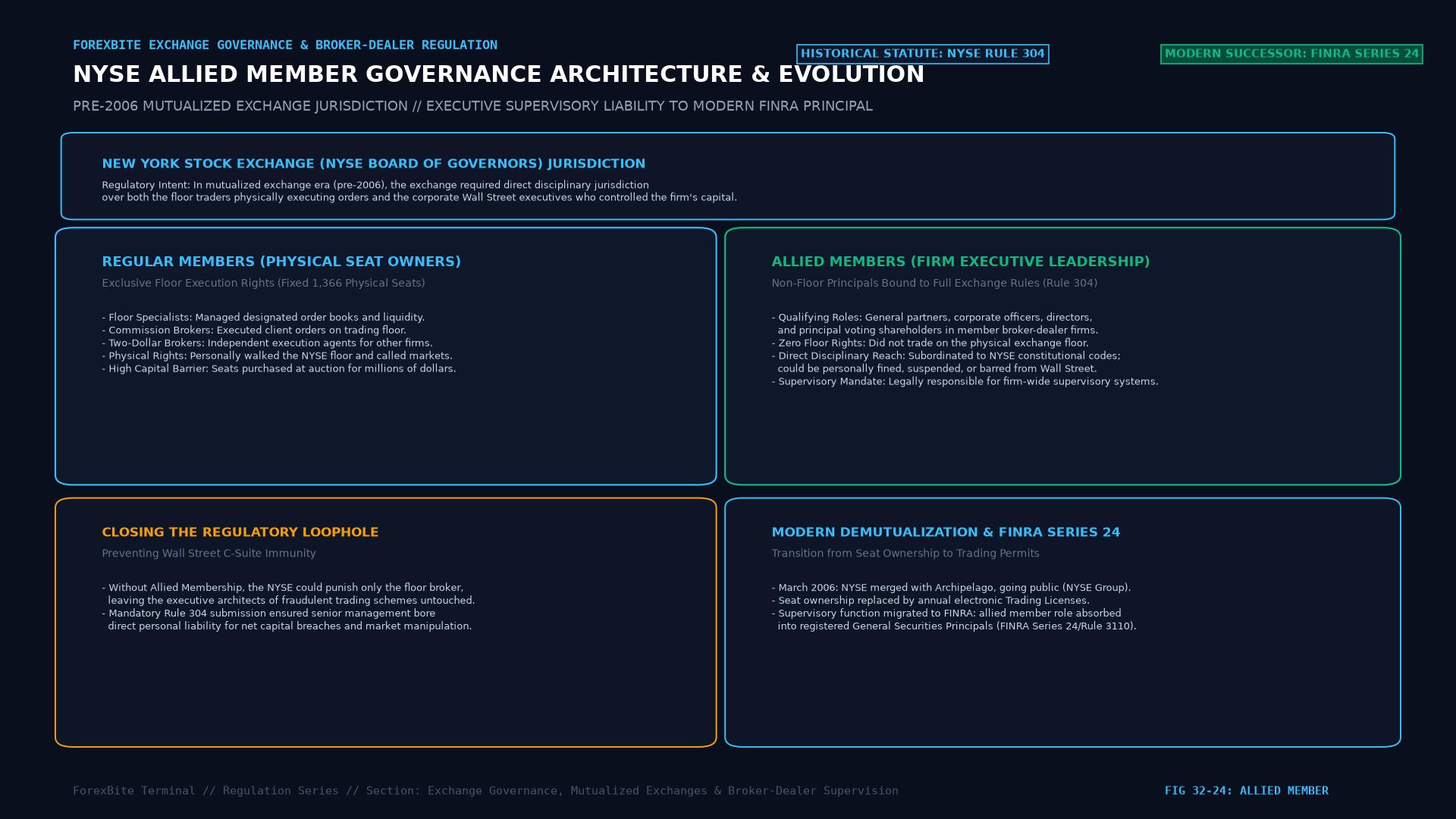 Figure: Governance architecture of the mutualized NYSE, illustrating regular seat ownership, allied member executive oversight, and modern transition to FINRA Series 24 principals.
Regulatory Authority and Exchange Jurisdiction
The primary institutional motivation behind creating the allied member classification was preventing a dangerous regulatory loophole. If the NYSE could discipline only the specific floor brokers who executed orders on the exchange floor, the senior Wall Street executives who directed the firm’s capital, designed marketing strategies, and supervised trading desks would remain beyond the exchange’s direct legal reach.
To close this gap, NYSE Rule 304 established mandatory standards for allied membership:
- Submission to Exchange Jurisdiction: Before a brokerage firm could clear trades on the exchange, every general partner, executive vice president, and substantial shareholder was required to sign an agreement submitting to the full constitution and rules of the NYSE.
- Personal Disciplinary Liability: If a member firm engaged in market manipulation, unauthorized trading, or net capital violations, the NYSE Board of Governors could initiate disciplinary proceedings directly against allied members personally, assessing individual fines, suspensions, or permanent lifetime industry bans.
- Supervisory Obligations: Allied members were legally held responsible for establishing and maintaining adequate supervisory systems over the firm’s registered representatives, ensuring compliance with federal securities statutes and exchange rules.
Evolution: The 2006 Demutualization and Modern Classifications
The classification of allied member underwent a structural transformation in March 2006, when the New York Stock Exchange merged with electronic trading platform Archipelago Holdings, transforming from a private member-owned cooperative into a publicly held commercial corporation (NYSE Group, Inc.):
Structural Transition of Exchange Governance:
┌────────────────────────────────────────────────────────┐
│ Pre-2006 Mutualized Member Cooperative                │
│ Regular Members (1,366 Physical Seats) & Allied Members│
└──────────────────────────┬─────────────────────────────┘
                           │ 2006 Demutualization & Public Listing
                           ▼
┌────────────────────────────────────────────────────────┐
│ Modern Electronic Exchange & SRO Architecture          │
│ Trading Licenses & FINRA Registered Principals         │
└────────────────────────────────────────────────────────┘
Following demutualization and the consolidation of exchange regulatory departments under the Financial Industry Regulatory Authority (FINRA):
- Physical trading seats were abolished and replaced by transferable annual Trading Licenses.
- The historical title of “Allied Member” was phased out of the NYSE rulebook.
- Senior brokerage executives are now categorized under modern regulatory definitions as Associated Persons, Registered Principals (FINRA Series 24), and Control Affiliates.
| Historical Classification | Modern Regulatory Equivalent | Governing Exam / License |
|---|---|---|
| Regular Member | Designated Market Maker (DMM) / Floor Broker | NYSE Floor Exam (Series 19/21) |
| Allied Member | General Securities Principal | FINRA Series 24 / Principal Registration |
| Member Firm | Member Organization / FINRA Broker-Dealer | Form BD / FINRA Membership Agreement |
Key Takeaways
- An allied member was a general partner or executive officer of an NYSE member firm who did not own a physical trading seat.
- The designation ensured that non-trading senior brokerage executives were personally subject to NYSE rules and disciplinary actions.
- Allied members were required to maintain supervisory oversight over registered brokers and firm capital adequacy.
- Following the 2006 NYSE demutualization, the title was retired, replaced by modern FINRA Registered Principal classifications.
Frequently Asked Questions
Could an allied member physically execute trades on the NYSE floor?
No. Physical execution on the NYSE trading floor was reserved exclusively for regular members who owned or leased a physical seat on the exchange. Allied members handled executive leadership, compliance, and capital management from corporate headquarters.
How did a broker-dealer become an NYSE member organization?
To become an approved member organization, a brokerage firm had to ensure that at least one partner or officer was a regular member (seat holder), and all other general partners, directors, and voting shareholders had to be vetted and approved as allied members by the exchange.
What replaced the concept of allied membership today?
Today, regulatory oversight is administered primarily by FINRA in coordination with national securities exchanges. Senior executives who manage broker-dealers register as General Securities Principals (Series 24) or Financial and Operations Principals (FinOP Series 27), adhering to unified federal and SRO supervisory rules.
Ready to trade forex?
Open a free demo account with a regulated broker. Practice with virtual funds before risking real money.