American Depositary Receipt (ADR)
An American Depositary Receipt (ADR) is a negotiable U.S. dollar-denominated certificate issued by a U.S. depositary bank representing shares in a foreign corporation, allowing American investors to buy foreign equities on domestic exchanges.
Introduced by J.P. Morgan in 1927 for British retailer Selfridges, an American Depositary Receipt (ADR) is a specialized financial instrument that allows U.S. investors to purchase shares in foreign companies without having to execute cross-border transactions, open foreign brokerage accounts, or deal with multi-currency clearing protocols.
ADRs trade on major U.S. stock exchanges—such as the New York Stock Exchange (NYSE) and Nasdaq—in U.S. dollars, clear through the Depository Trust Company (DTC), and settle on standard U.S. settlement cycles. However, because the underlying asset is an equity listed in a foreign country, holding an ADR introduces direct, embedded foreign exchange exposure.
How the ADR Mechanism Works
The issuance and lifecycle of an ADR involve a synchronized partnership between three institutional entities:
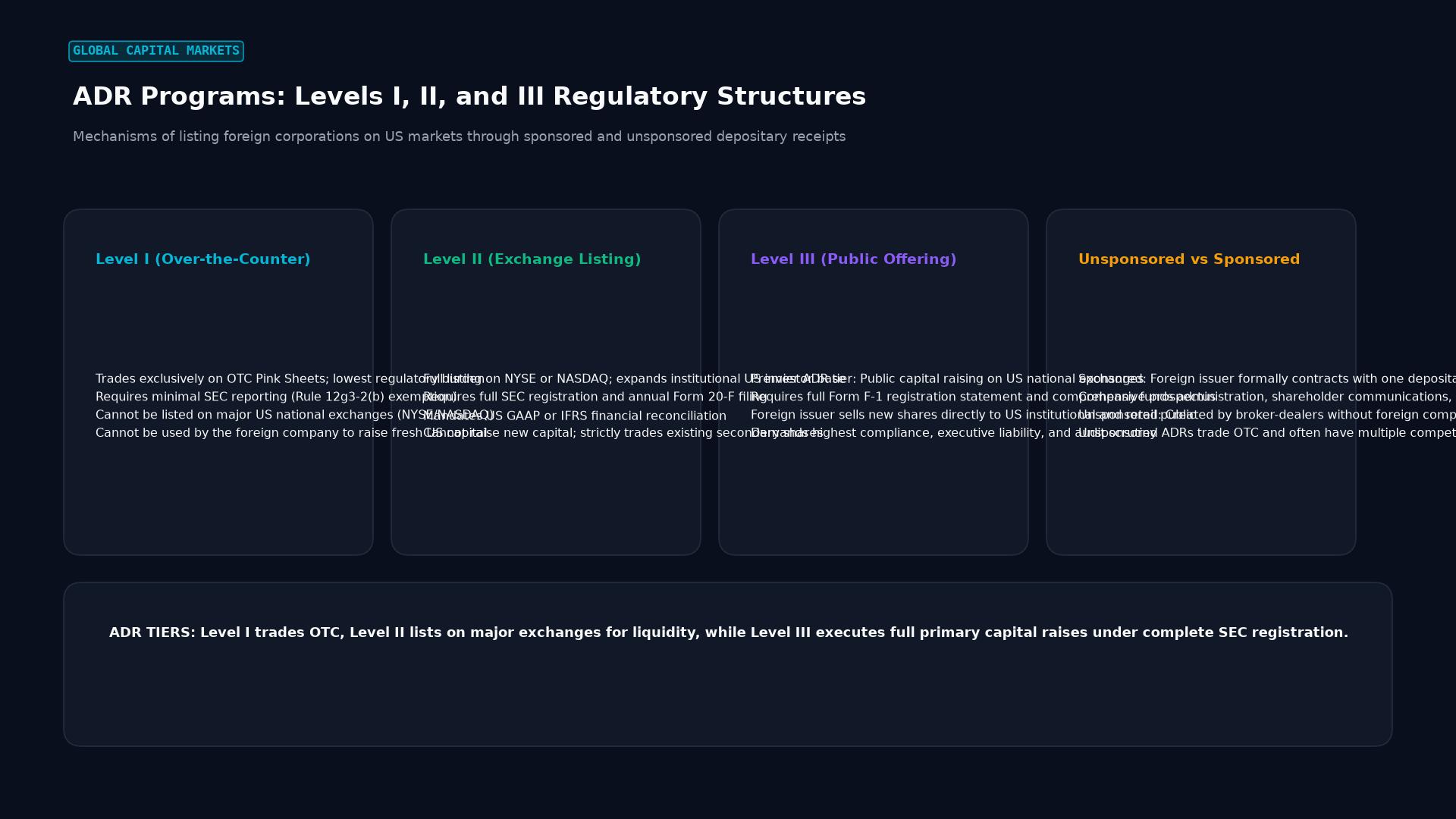 Figure: Mechanisms of listing foreign corporations on US markets through sponsored and unsponsored depositary receipts
- Custody Deposit: The foreign company (or a broker purchasing shares on the foreign exchange) delivers a block of ordinary domestic shares to a local custodian bank in the home country.
- Certificate Issuance: A major U.S. depositary bank (such as BNY Mellon, Citigroup, or JPMorgan Chase) issues ADR certificates representing ownership of those custodial shares.
- The ADR Ratio: ADRs do not always correspond to ordinary shares on a 1:1 basis. The depositary bank establishes a conversion ratio to ensure the security trades within a conventional U.S. share price bracket (typically $20 to $100):
- A 1:5 Ratio means 1 ADR represents 5 underlying foreign shares.
- A 10:1 Ratio means 10 ADRs represent 1 high-value foreign share.
The Three Tiers of Sponsored ADRs
ADRs are categorized as either unsponsored (created by a depositary bank without the foreign company’s formal involvement) or sponsored (issued in direct collaboration with the foreign firm):
| ADR Level | Exchange Listing | SEC Reporting Requirements | Ability to Raise Capital in U.S. |
|---|---|---|---|
| Level I | Over-the-Counter (OTC Pink Sheets) | Minimal; exempt from full U.S. GAAP reconciliation under Rule 12g3-2(b) | No |
| Level II | Listed on major exchanges (NYSE, Nasdaq) | Full SEC registration; must file annual Form 20-F | No |
| Level III | Listed on major exchanges (NYSE, Nasdaq) | Highest tier; strict SEC compliance, U.S. GAAP reconciliation, Form F-1 | Yes (used to execute initial public offerings and issue new shares) |
The Embedded Forex Risk in ADR Trading
A critical point for global macro traders is that trading an ADR does not eliminate currency risk:
$$\text{ADR Price (in USD)} \approx \left(\frac{\text{Home Share Price}}{\text{ADR Ratio}}\right) \times \text{Spot Exchange Rate}$$
Even though an American investor purchases the ADR in U.S. dollars and receives dividend distributions in dollars, the underlying revenue, earnings, and asset base of the company are denominated in its domestic home currency.
Practical Currency Impact Scenario:
Suppose a UK pharmaceutical company trades in London at £10.00, with an ADR ratio of 1:1 trading on the NYSE. The GBP/USD spot exchange rate sits at 1.3000:
- Initial ADR Price: $£10.00 \times 1.3000 = \mathbf{$13.00 \text{ USD}}$.
- The Currency Shock: Over the next quarter, the company’s business performs well, and its London share price remains flat at £10.00. However, the British pound depreciates by 10% against the dollar, falling to 1.1700.
- Resulting ADR Value: $£10.00 \times 1.1700 = \mathbf{$11.70 \text{ USD}}$.
- The Outcome: The American investor suffers a 10% portfolio loss on their U.S. brokerage account due entirely to foreign exchange translation risk, despite zero change in the company’s underlying London share valuation.
Dividend Conversions and Withholding Taxes
When the foreign company distributes dividends, it pays them to the local custodian bank in domestic currency. The depositary bank converts the funds into U.S. dollars at the prevailing spot rate and distributes net cash to ADR holders. In this process, the payout is subject to foreign government dividend withholding taxes and depositary bank administrative pass-through fees.
Cross-Border Arbitrage: The Law of One Price
High-frequency algorithmic trading desks continuously monitor price discrepancies between the foreign ordinary share and its corresponding U.S. ADR.
If the ADR trades at a temporary discount to the home share after adjusting for the spot exchange rate, quantitative arbitrageurs simultaneously buy the ADR in New York and short the ordinary share in London or Tokyo. The depositary bank can cancel ADRs to release physical shares or issue fresh ADRs against newly deposited shares, closing the pricing spread in milliseconds and enforcing the Law of One Price.
Key Takeaways
- U.S. Dollar Gateway: ADRs allow U.S. investors to trade foreign corporate equities on domestic exchanges denominated in U.S. dollars.
- Custodial Foundation: Ordinary domestic shares are held in escrow by a local custodian, against which a U.S. depositary bank issues receipts.
- Embedded Forex Risk: Although denominated in USD, an ADR’s underlying value fluctuates directly with shifts in the exchange rate between the dollar and the home currency.
- Three Regulatory Levels: Level I trades OTC, while Levels II and III require full SEC reporting, with Level III permitting public capital raising.
- Global Arbitrage Alignment: Cross-border quantitative trading enforces tight price parity between the ADR in New York and ordinary shares in domestic financial hubs.
Frequently Asked Questions
What fees are associated with holding an American Depositary Receipt?
ADR holders are charged an annual custody fee known as an ADR pass-through fee (typically 1 to 3 cents per share), deducted automatically by the depositary bank from dividend payouts or charged directly through the broker’s account ledger.
Can an investor convert an ADR into physical foreign shares?
Yes. Institutional investors and brokers can surrender ADRs to the depositary bank to receive the underlying ordinary shares in the company’s domestic market, subject to a cancellation fee and local transfer taxes.
What is the difference between an ADR and a GDR?
An American Depositary Receipt (ADR) is issued specifically for trading within United States financial markets. A Global Depositary Receipt (GDR) is typically issued simultaneously across multiple international financial markets (most notably London, Frankfurt, and Luxembourg) to access European and international institutional capital.
Ready to trade forex?
Open a free demo account with a regulated broker. Practice with virtual funds before risking real money.