Cross Rate
A cross rate, also known as a currency cross, is an exchange rate between two national currencies that does not involve the US Dollar. Prominent examples include EUR/GBP, EUR/JPY, GBP/JPY, and AUD/NZD, which are derived mathematically from each currency's respective quote against the US Dollar.
What Is a Cross Rate?
In the international foreign exchange market, currency pairs are broadly categorized into three groups: major pairs, minor pairs (crosses), and exotic pairs. A cross rate (often referred to simply as a currency cross) is an exchange rate quote between two currencies, neither of which is the United States Dollar (USD).
Because the US Dollar serves as the global primary reserve currency and acts as an intermediary vehicle currency in over 88% of all daily interbank foreign exchange transactions, standard market quotations originally paired every foreign currency against the dollar (e.g., EUR/USD, USD/JPY, GBP/USD).
Historically, if an investor holding Euros wanted to acquire Japanese Yen, no direct market existed. The investor was required to execute two separate transactions: first sell Euros for US Dollars, and then sell those US Dollars for Japanese Yen. Today, electronic matching engines automate this two-step process instantaneously behind the scenes, allowing traders to execute currency crosses like EUR/JPY or EUR/GBP with a single click.
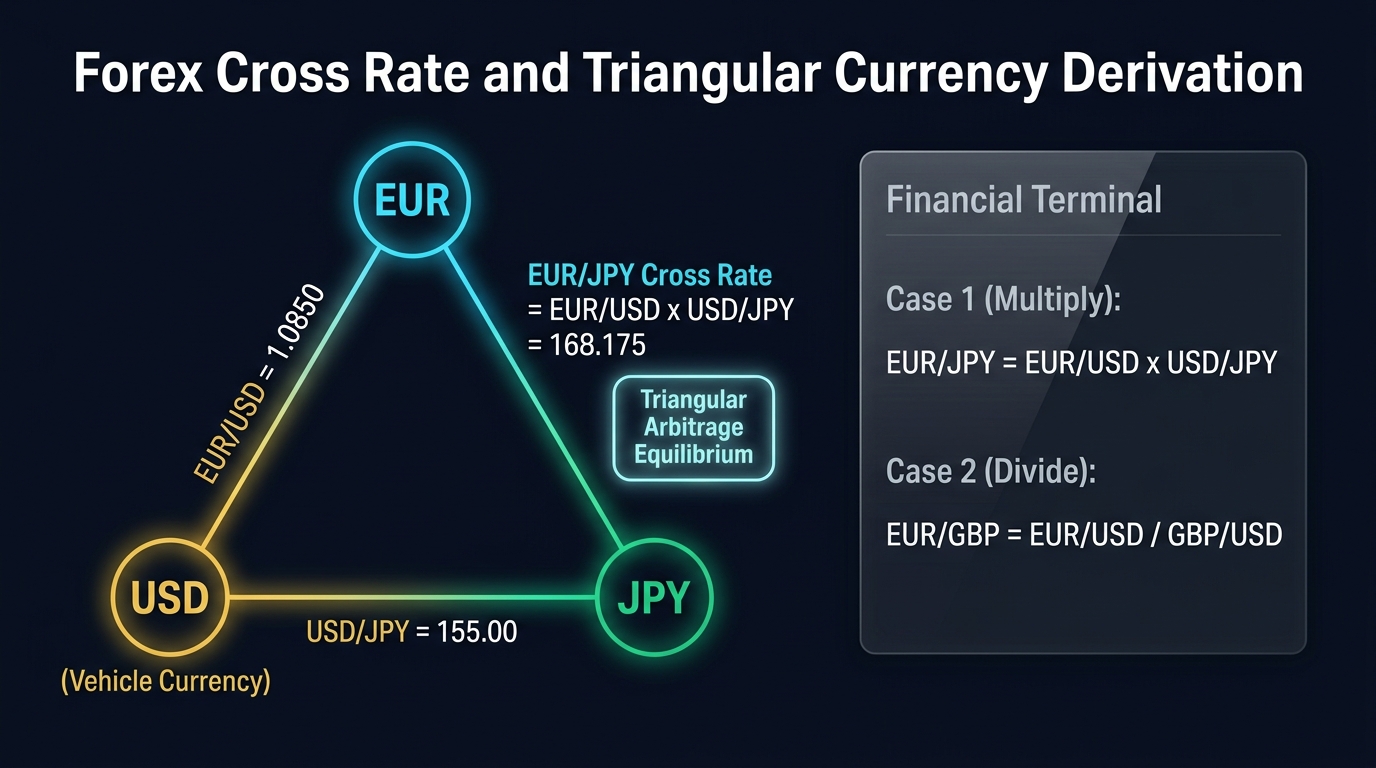
How Cross Rates Are Derived Mathematically
Even when a broker provides a direct quote for a cross pair, liquidity providers compute the underlying price and spread by triangulating the two corresponding US Dollar pairs.
Depending on whether the US Dollar is the base currency or the quote currency in the underlying pairs, the cross rate is derived via one of two mathematical operations:
Case 1: When USD Is the Quote Currency in One Pair and the Base Currency in the Other
Consider calculating the cross rate for EUR/JPY:
- Base pair: EUR/USD (USD is the quote currency)
- Quote pair: USD/JPY (USD is the base currency)
To find how many Japanese Yen equal one Euro, multiply the two exchange rates: $$ \text{EUR/JPY} = \text{EUR/USD} \times \text{USD/JPY} $$
If EUR/USD is trading at 1.0850 and USD/JPY is trading at 155.00: $$ \text{EUR/JPY} = 1.0850 \times 155.00 = 168.175 $$
Case 2: When USD Is the Quote Currency in Both Pairs
Consider calculating the cross rate for EUR/GBP:
- Base pair: EUR/USD
- Comparison pair: GBP/USD
To find how many British Pounds equal one Euro, divide the base currency quote by the target currency quote: $$ \text{EUR/GBP} = \frac{\text{EUR/USD}}{\text{GBP/USD}} $$
If EUR/USD is trading at 1.0850 and GBP/USD is trading at 1.3000: $$ \text{EUR/GBP} = \frac{1.0850}{1.3000} \approx 0.8346 $$
If the live market quote for a cross pair diverges by even a fraction of a pip from these mathematical relationships, algorithmic arbitrageurs immediately execute triangular trades to exploit the dislocation, forcing the rates back into equilibrium.
Why Traders Prefer Cross Rates
Currency crosses offer unique strategic advantages over standard dollar-based pairs:
1. Pure Relative Macro Trends (Isolating the Dollar)
When trading EUR/USD or USD/JPY, price action is frequently dominated by American macroeconomic headlines—Federal Reserve speeches, US CPI releases, or Treasury yield swings. If a trader wants to trade an economic divergence between the United Kingdom and Japan without exposure to US interest rate decisions, trading GBP/JPY isolates that specific relationship cleanly.
2. High-Volatility Momentum Trading
Certain cross pairs are famous for explosive volatility. GBP/JPY (traditionally nicknamed “The Beast” or “Geppy” on trading desks) combines the volatility of the British Pound with the sensitivity of the Japanese Yen, generating daily trading ranges exceeding 150 to 250 pips. It is favored by trend-following breakout traders.
3. Clean Range-Bound Environments
Conversely, regional cross pairs connecting highly integrated economies—such as EUR/GBP (Eurozone and the UK) or AUD/NZD (Australia and New Zealand)—frequently trade inside remarkably well-defined horizontal trading ranges for months at a time, making them ideal for mean-reversion and grid-trading strategies.
The Cost of Trading Crosses: Synthetic Spreads
A vital consideration when trading cross pairs is the bid-ask spread. Because interbank market makers construct cross liquidity synthetically through two dollar-based transactions, the spread on a cross pair is mathematically wider than that of major pairs:
$$ \text{Spread}{\text{Cross}} \approx \text{Spread}{\text{Leg 1}} + \text{Spread}_{\text{Leg 2}} $$
For example, while EUR/USD and USD/JPY might trade with tight institutional spreads of 0.2 to 0.5 pips each, the synthetic cross EUR/JPY will typically feature a spread of 1.0 to 1.8 pips. For lower-volume crosses (such as GBP/NZD or CAD/CHF), spreads can expand to 3.0 to 6.0 pips, requiring traders to target wider profit horizons to overcome transaction friction.
Practical Trading Example: The Interest Rate Divergence Trade
Suppose a macro trader analyzes central bank policy heading into the second quarter:
- The Bank of England (BoE) remains hawkish, holding the Bank Rate high at 5.25% to combat domestic services inflation.
- The Bank of Japan (BoJ) maintains ultra-accommodative monetary policy with benchmark rates near 0.10%.
- The Federal Reserve is sending mixed, ambiguous signals, making dollar pairs choppy and unpredictable.
Rather than trading Cable (GBP/USD) or USD/JPY and taking on US Dollar event risk, the trader selects the GBP/JPY cross:
- Setup: GBP/JPY breaks out above a multi-week resistance consolidation at 195.00.
- Execution: The trader enters a long position at 195.20, targeting 198.50 (+330 pips).
- Carry Yield: Because British interest rates (5.25%) drastically exceed Japanese rates (0.10%), the trader collects substantial positive daily rollover swap on the long position every evening at the New York close.
- Outcome: Over the following three weeks, capital flows into the yield differential. GBP/JPY trends smoothly to 198.50 without interference from US economic data, delivering substantial capital gains alongside positive carry income.
Key Takeaways
- A cross rate is any foreign exchange quote between two currencies that does not include the US Dollar.
- Cross rates are mathematically derived from each currency’s respective bilateral exchange rate against the US Dollar.
- Common crosses include EUR/JPY, GBP/JPY, EUR/GBP, and AUD/NZD.
- Crosses allow traders to speculate on economic divergences between two nations without taking on US Dollar volatility.
- Spreads on cross pairs are typically wider than major pairs because liquidity providers must hedge through two separate dollar transactions.
FAQ
Why are cross pairs sometimes called “minors”? In forex terminology, “majors” refers strictly to the seven currency pairs paired against the US Dollar (EUR/USD, USD/JPY, GBP/USD, USD/CHF, AUD/USD, USD/CAD, NZD/USD). Non-dollar currency pairs between major economies are traditionally termed “minors” or “crosses.”
Is GBP/JPY a cross rate? Yes. Even though both the British Pound and the Japanese Yen are major global reserve currencies, because the pair does not include the US Dollar, GBP/JPY is classified as a currency cross.
Can cross rates be traded with high leverage? Yes. Regulated brokers offer standard leverage on minor cross pairs (typically up to 1:20 or 1:30 in regulated jurisdictions like the EU, UK, and Australia, and higher in offshore regions), though margin requirements may be slightly higher than for the most liquid major pairs like EUR/USD.
Ready to trade forex?
Open a free demo account with a regulated broker. Practice with virtual funds before risking real money.