Around
Interbank foreign exchange dealing terminology indicating that the forward swap points for a currency pair straddle zero (par), meaning the bid forward point is at a discount (deducted from spot) while the offer forward point is at a premium (added to spot).
What Does “Around” Mean in Forex Trading?
In the interbank foreign exchange forward and swap markets, around is specialized trading jargon used by market makers and voice brokers to quote forward swap points that straddle par (zero).
In conventional forward foreign exchange pricing, forward points are either:
- Positive (at a premium): Added directly to both the spot bid and spot offer because the base currency has a lower interest rate than the quote currency.
- Negative (at a discount): Subtracted directly from both the spot bid and spot offer because the base currency has a higher interest rate than the quote currency.
However, when interbank interest rates between two currencies are nearly identical, or when the bid-ask spread of the forward points spans across zero, swap points cannot be classified simply as an outright premium or discount. The dealer uses the word around to signal that the bid point sits below par (a discount) while the offer point sits above par (a premium).
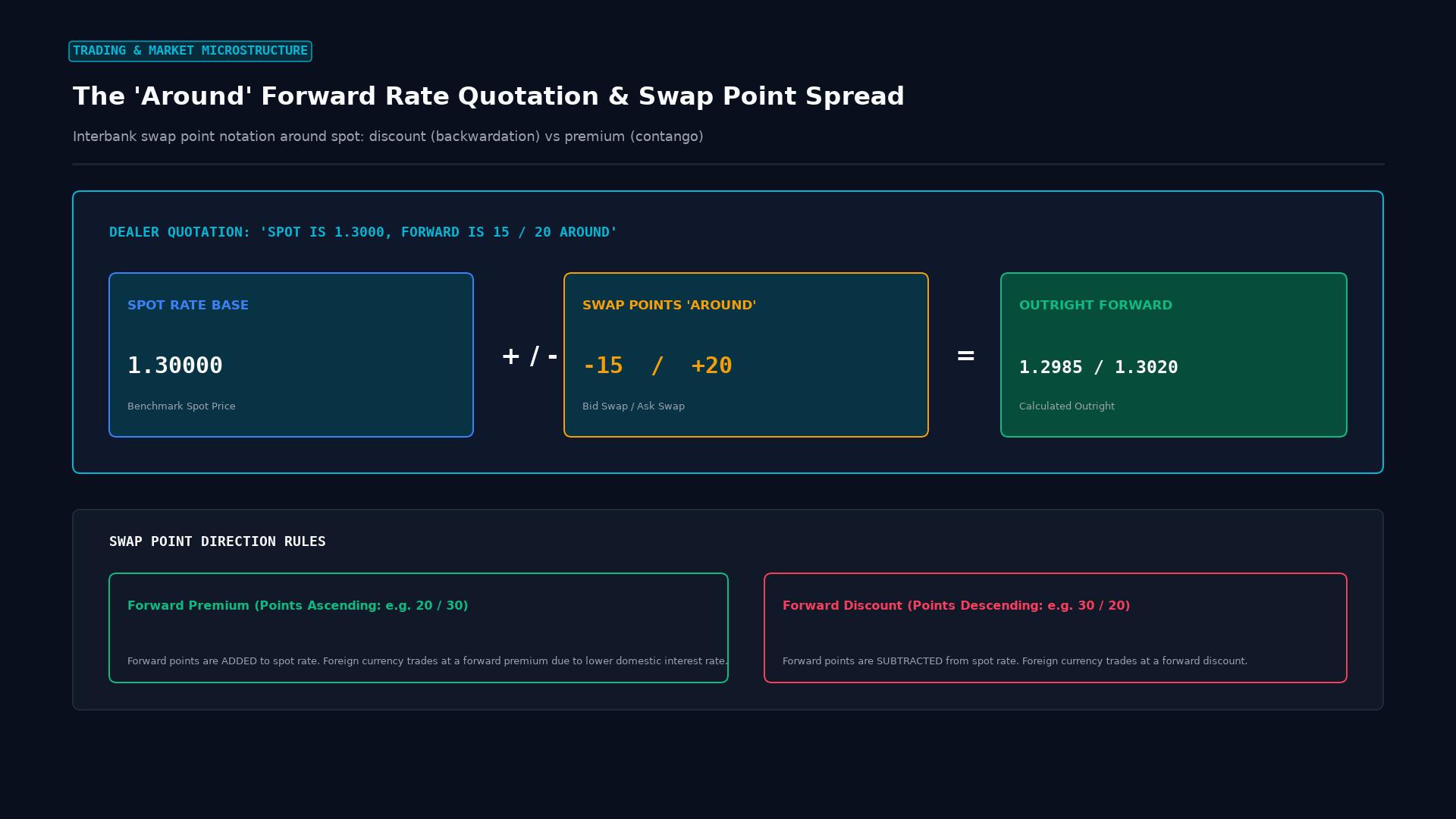 Figure: Interbank FX forward quotation notation: calculating outright forward exchange rates by adding forward premiums or subtracting forward discounts ‘around’ spot.
The Market Microstructure of “Around” Quotes
Under the law of Covered Interest Rate Parity (CIRP), the forward points ($F - S$) represent the interest rate differential between the two currencies over the life of the contract:
$$F = S \times \left( \frac{1 + r_{\text{quote}} \times \frac{d}{360}}{1 + r_{\text{base}} \times \frac{d}{360}} \right)$$
Where:
- $F$ = Forward outright rate.
- $S$ = Spot exchange rate.
- $r_{\text{quote}}, r_{\text{base}}$ = Benchmark money market interest rates.
- $d$ = Number of days to forward value date.
When $r_{\text{quote}} \approx r_{\text{base}}$, the theoretical forward points are zero ($F = S$). But dealers must still make a two-sided two-way price to capture a bid-ask spread. Consequently, the dealer’s bid forward point will fall below zero, while their offer forward point will rise above zero.
Decoding Interbank Quotation Shorthand
When a corporate treasurer asks an FX desk for a 1-month forward quote and the trader responds:
“EUR/USD spot is 1.0850, forward points are two by two around.”
This shorthand translates to:
- Bid Points: $-0.0002$ ($2$ pips discount, subtracted from spot).
- Offer Points: $+0.0002$ ($2$ pips premium, added to spot).
- The forward points are symmetrical around zero par.
If the quote is asymmetrical—for example, “one and a half by two and a half around”—it means $-1.5$ pips on the bid and $+2.5$ pips on the offer.
Step-by-Step Mathematical Calculation: Computing Outright Rates
Converting an “around” swap quote into an executable forward outright price requires applying the discount to the bid and the premium to the offer:
$$\text{Forward Outright Bid} = \text{Spot Bid} - \text{Bid Forward Points}$$ $$\text{Forward Outright Offer} = \text{Spot Offer} + \text{Offer Forward Points}$$
Practical Dealing Example: 3-Month EUR/USD Forward
An institutional importer requests a 3-month forward outright quote from a liquidity desk:
- Spot Quote:
1.08500 / 1.08520(Spot spread = 2.0 pips) - 3-Month Forward Swap Points: “1.5 by 2.0 around”
Step 1: Parse the Forward Points
- Bid Forward Points: $-1.5\text{ pips} = -0.00015$
- Offer Forward Points: $+2.0\text{ pips} = +0.00020$
Step 2: Compute Forward Outrights
- Outright Bid: $$1.08500 - 0.00015 = 1.08485$$
- Outright Offer: $$1.08520 + 0.00020 = 1.08540$$
Resulting Forward Market
The customer is quoted a 3-month forward rate of 1.08485 / 1.08540. Notice that while the spot spread was 2.0 pips ($1.08520 - 1.08500$), the forward spread expanded to 5.5 pips ($1.08540 - 1.08485$), reflecting both spot spread and forward liquidity risk.
Comparative Matrix: Forward Market Quotation Conventions
| Interbank Term | Mathematical Sign | Direction Relative to Spot | Interest Rate Condition | Rule for Outright Rate |
|---|---|---|---|---|
| At a Premium | Both points positive ($+$ / $+$) | Forward trades above spot | Base rate $<$ Quote rate | Add points to both bid and offer |
| At a Discount | Both points negative ($-$ / $-$) | Forward trades below spot | Base rate $>$ Quote rate | Deduct points from both bid and offer |
| At Par | Points equal exactly zero ($0.0 / 0.0$) | Forward equals spot rate | Base rate $=$ Quote rate | Spot price equals forward price |
| Around (Around Par) | Bid negative, Offer positive ($-$ / $+$) | Forward bid below spot, offer above spot | Base rate $\approx$ Quote rate | Deduct bid points, add offer points |
Significance for FX Swaps and Treasury Desks
- Short-Dated Swaps Liquidity: “Around” quotes are most prevalent in ultra-short maturities, including Overnight (O/N) and Tomorrow-Next (Tom-Next) swaps. Because the holding period is only 24 hours, interest rate differentials equate to fractions of a single pip, causing market spreads to naturally straddle zero.
- Central Bank Convergence: When major central banks (such as the Federal Reserve, the European Central Bank, and the Bank of England) align monetary policies at similar benchmark target rates, entire 1-month to 6-month swap curves frequently trade “around” par.
- Execution Clarity and Error Prevention: In electronic trading systems (Bloomberg FIT, Refinitiv FXall), pricing engines must explicitly recognize the negative sign on the bid leg to prevent catastrophic trade mispricing.
Key Takeaways
- “Around” is interbank dealer terminology used when forward swap points straddle zero par.
- The bid forward point is at a discount (subtracted from spot), while the offer forward point is at a premium (added to spot).
- It occurs primarily when the interest rates of the two currencies are closely matched, or in short-dated tenors like Tom-Next.
- Forward outright bid rates are calculated as $\text{Spot Bid} - \text{Points}$, while forward outright offers are calculated as $\text{Spot Offer} + \text{Points}$.
- Quotes such as “2 by 2 around” mean 2 pips discount on the bid and 2 pips premium on the offer.
Frequently Asked Questions
Why don’t dealers just say “minus 2 and plus 2”?
In fast-paced voice trading and interbank messaging, verbal economy is essential to minimize confusion and transaction latency. Saying “two by two around” or “around par” is universally recognized on global dealing desks as indicating that the spread straddles zero.
Does trading “around par” mean there is zero cost to hedge?
No. While the interest rate differential between the two currencies may be close to zero, the market maker’s spread still exists. You sell forward below spot (the discounted bid) and buy forward above spot (the premium offer), ensuring the dealer captures their bid-ask spread.
In which currency pairs are “around” quotes most common?
They are most frequent in currency pairs between economies with tightly synchronized monetary policies, such as EUR/CHF, AUD/NZD, or USD/CAD, as well as major pairs when central bank rates converge.
What is the difference between “at par” and “around”?
“At par” means the forward points are exactly zero (the forward rate equals the spot rate). “Around” means the spread spans across par, with the bid below zero and the offer above zero.
Ready to trade forex?
Open a free demo account with a regulated broker. Practice with virtual funds before risking real money.