Value Date
A value date—also termed the settlement date—is the specific agreed business day on which a financial contract officially settles and the legal exchange of currency funds takes place between counterparties.
In foreign exchange and banking, the value date is the legally binding calendar day on which a financial transaction is settled through the actual electronic delivery and receipt of funds. When banks, corporations, or institutional investors execute a currency trade, the trade date (when the price is agreed upon) is distinct from the value date (when cash balances actually clear into accounts).
For retail currency speculators who trade on margin without ever taking physical delivery of currency notes, the value date remains an essential operational concept because it dictates daily rollover fees, financing debits, and the timing of triple-swap charges.
Value Date Conventions in Foreign Exchange
Depending on the contract type and the currency pair traded, the foreign exchange market observes four standard value date conventions:
| Convention | Code / Abbreviation | Settlement Horizon | Common Usage |
|---|---|---|---|
| Value Today (Cash) | TOD / T+0 | Settles on the exact day the transaction is executed | Emergency intraday liquidity; specialized interbank balancing |
| Value Tomorrow | TOM / T+1 | Settles on the next immediate business day | Standard for USD/CAD, USD/TRY, USD/PHP; Tom-Next swaps |
| Value Spot | SPOT / T+2 | Settles two business days following the trade execution date | The universal benchmark for the global spot forex market |
| Forward Value Date | FWD | Settles on a designated future date beyond spot (e.g., 1M, 3M, 1Y) | Commercial forward contracts and corporate currency hedging |
The Mechanics of the Spot Value Date (T+2)
The global standard for spot currency settlement is T+2 (Trade date plus two business days). This historical convention originated to allow physical paper checks and telecommunication messages to travel across international borders, clear through central bank payment networks, and verify reciprocal funds.
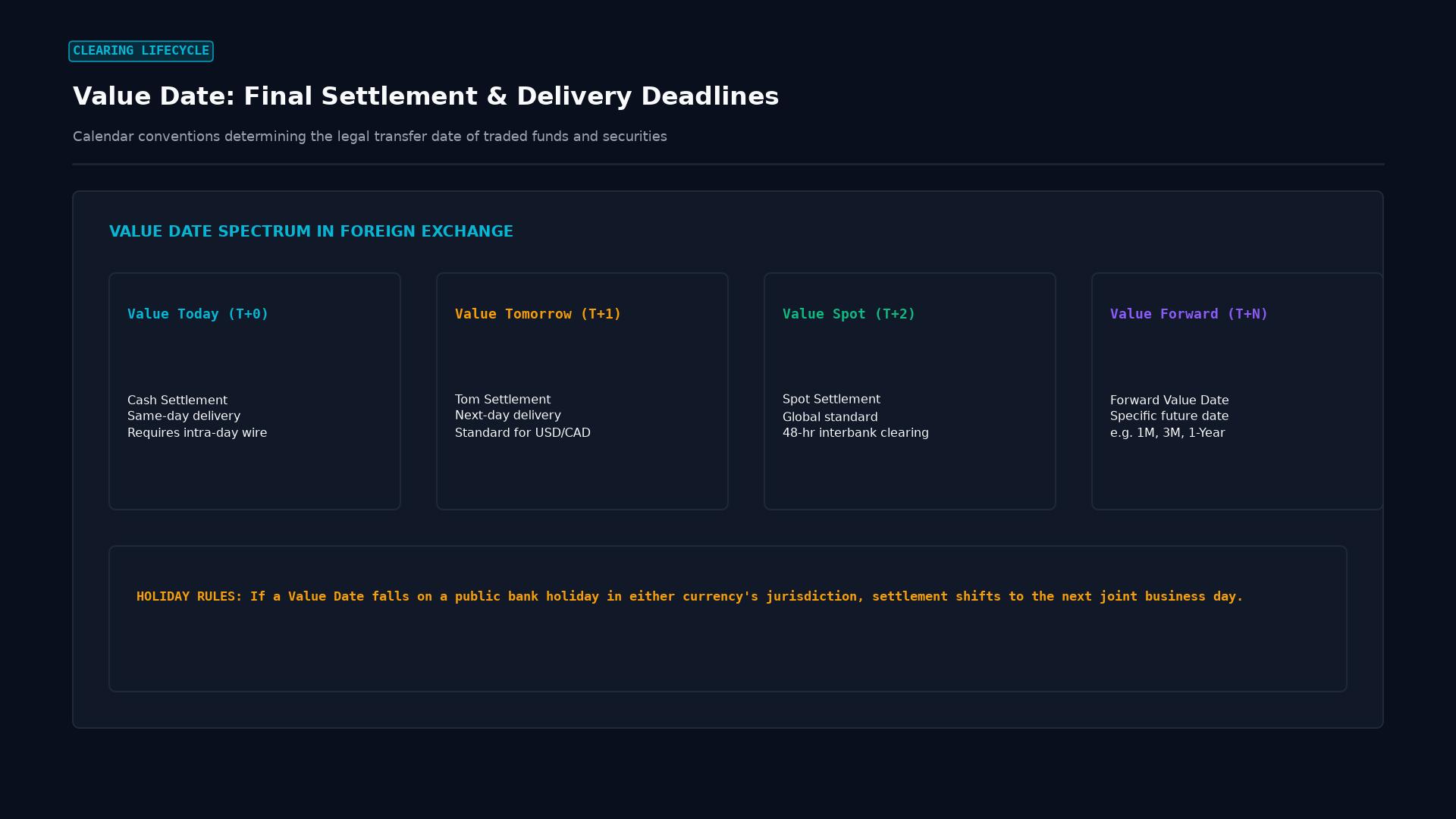 Figure: Settlement date calendar: Value Today (T+0), Value Tomorrow (T+1), Spot Value (T+2), and forward delivery dates across international holidays.
The Modified Following Business Day Rule
A valid value date requires that commercial banking systems in both currency jurisdictions be open for business:
- If a trade is executed on EUR/USD, the value date must be a working bank day in both Frankfurt (Eurozone) and New York (United States).
- If a scheduled value date falls on a weekend or a national bank holiday in either country, the value date automatically rolls forward to the next joint business day under the standard “Modified Following” convention.
Value Dates in Retail Forex: The “Tom-Next” Rollover
Because retail forex traders seek capital gains on price fluctuations rather than receiving deliverable currency into commercial bank vaults, brokerages must prevent contracts from reaching physical maturity on their value date:
- The 5:00 PM EST Threshold: At 5:00 PM New York time, the global forex market officially rolls its calendar day. Any open position that would otherwise settle on the upcoming value date must be extended.
- The Tomorrow-Next (Tom-Next) Swap: The broker’s liquidity engine automatically executes a synthetic rollover: closing the position at the expiring value date and reopening it for the next valid value date.
- The Swap Fee / Credit: The difference in benchmark interest rates between the two currencies over that 24-hour extension period generates an overnight swap credit or debit applied directly to the trader’s balance.
The “Triple Wednesday” Phenomenon
Forex markets are closed on Saturdays and Sundays, but bank interest accrues continuously seven days a week:
- A spot trade opened on Monday settles on Wednesday.
- A spot trade opened on Wednesday settles on Friday.
- Rolling an open trade from Wednesday over into Thursday shifts the value date from Friday to Monday, bridging across the two weekend days.
- As a result, brokers apply three days of rollover swap on Wednesday night (or Friday night for T+1 pairs like USD/CAD) to account for Saturday and Sunday financing.
Key Takeaways
- Settlement Reality: The value date is the official day when currency funds legally transfer between counterparties.
- T+2 Baseline: Most spot forex transactions observe a two-business-day settlement timeline, with North American pairs like USD/CAD observing T+1.
- Mutual Banking Days: Both countries’ banking systems must be open for a date to qualify as a valid value date.
- Tom-Next Mechanism: Retail brokers prevent physical settlement by continuously rolling open contracts to the next forward value date.
- Triple Swaps: Because weekends accrue interest, positions held across Wednesday night incur three days of rollover financing.
Frequently Asked Questions
Why does USD/CAD settle on T+1 instead of T+2?
USD/CAD settles on a T+1 (next business day) basis because the financial centers of New York and Toronto are in the same time zone and maintain highly integrated cross-border electronic payment systems, eliminating the need for a 48-hour processing window.
Does a value date affect my trading if I day-trade?
No. If you open and close a position within the same trading session (before 5:00 PM EST), the position is liquidated before the end-of-day rollover process begins. No overnight swap is charged, and the value date never advances.
What happens to a value date during a national holiday?
If a value date lands on a public bank holiday in either country (for example, U.S. Independence Day on July 4), the value date shifts forward to the next mutual business day when banks in both nations are open.
Ready to trade forex?
Open a free demo account with a regulated broker. Practice with virtual funds before risking real money.