Two-Way Price
A two-way price is a financial quote that displays both the bid price (where a market maker buys) and the ask or offer price (where a market maker sells) simultaneously for a specific currency pair or asset.
A two-way price—frequently termed a two-way quote—is the universal pricing standard across foreign exchange and institutional financial markets. Rather than providing a single ambiguous valuation for a currency, a liquidity provider or broker simultaneously quotes two distinct prices: the bid price (at which the dealer commits to purchase from the client) and the ask or offer price (at which the dealer commits to sell to the client).
The difference between these two competing quotes represents the bid-ask spread, which serves as the primary compensation for market makers who provide continuous liquidity and absorb inventory risk.
The Anatomy of a Two-Way Quotation
When viewing a currency pair on an electronic trading terminal, the quote is displayed as two side-by-side figures:
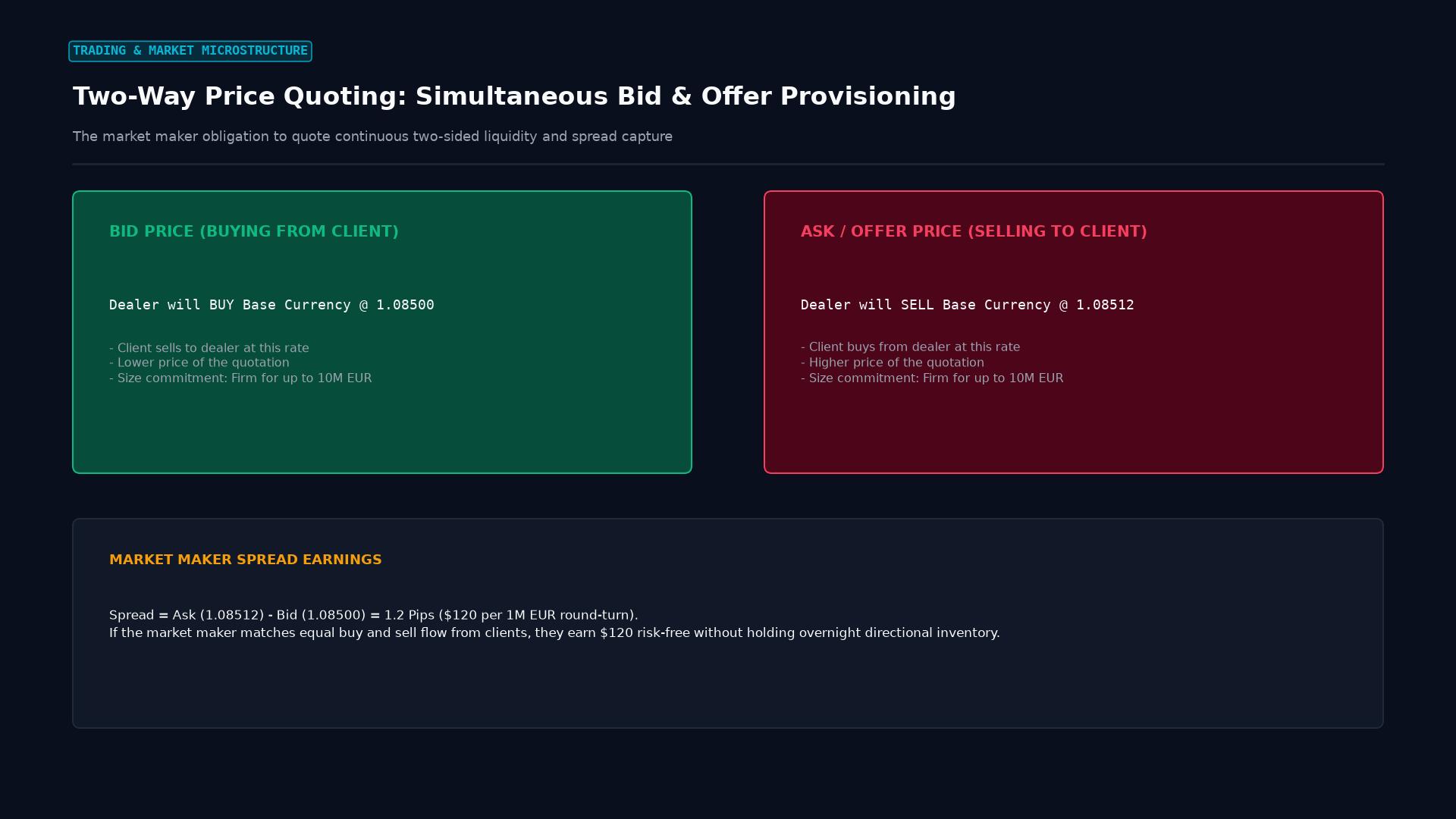 Figure: Market maker quoting obligations: quoting simultaneous firm bid and ask prices to capture the spread while providing continuous liquidity.
- The Bid Price (1.08500): The price at which the broker or liquidity provider will buy the base currency (EUR) from you. If you want to enter a short position (sell EUR/USD) or exit an existing long position, your trade executes at the Bid.
- The Ask / Offer Price (1.08512): The price at which the broker will sell the base currency to you. If you want to enter a long position (buy EUR/USD) or close an existing short position, your trade executes at the Ask.
- The Big Figure and the Pips: Dealers often abbreviate two-way quotes in verbal and institutional communications. For example, a quote of
1.0850 / 52conveys the “big figure” (1.08) once, followed by the respective bid and ask pips.
Why Two-Way Pricing is Mandatory in Market Making
In an over-the-counter (OTC) marketplace like spot forex, market makers (such as commercial tier-1 banks and liquidity providers) are contractually obligated to maintain fair, orderly, and continuous markets.
Providing two-way pricing serves three essential market functions:
- Guaranteed Liquidity: Market participants can execute buy or sell orders at any given millisecond without waiting to find an exact matching counterpart.
- Risk Neutrality: A market maker does not want to bet on the directional future of the currency. By quoting continuous two-way prices, the dealer matches opposing retail flow (buying at the bid from sellers and selling at the ask to buyers), capturing the spread with minimal directional market exposure.
- Price Discovery: The aggregation of thousands of institutional two-way quotes across primary matching networks (like EBS and Refinitiv) establishes the real-time global spot exchange rate.
Factors That Expand or Narrow Two-Way Spreads
The width of a two-way spread reflects market efficiency, volatility, and available liquidity:
| Market Condition | Two-Way Spread Behavior | Underlying Cause |
|---|---|---|
| London / New York Overlap | Ultra-Tight (0.0 to 0.8 pips) | Peak global banking liquidity; high competition among Tier-1 liquidity providers. |
| High-Impact News (NFP, CPI, FOMC) | Widening (5 to 25 pips) | Algorithmic market makers pull liquidity or widen spreads to protect against toxic order flow and extreme slippage. |
| Daily Rollover Window (5:00 PM EST) | Temporary Expansion (3 to 10 pips) | New York trading desks close as Asian desks are just opening; interbank liquidity drops during settlement rollover. |
| Exotic Currency Pairs (e.g., USD/ZAR, USD/TRY) | Structurally Wide (30 to 100+ pips) | Lower overall daily trading turnover, higher country risk, and volatile local liquidity pools. |
Practical Example: The Immediate Cost of the Spread
Understanding two-way pricing is crucial for managing trading costs and calculating real-time profit and loss:
- The Long Trade: A trader opens a long position of 2.0 standard lots ($200,000 notional) on GBP/USD, currently quoted at 1.2720 / 1.2722.
- Execution Price: The buy order executes at the Ask price: 1.2722.
- The Instant Floating Loss: As soon as the trade appears on the terminal, the liquidation value of the position is governed by the Bid price (1.2720).
- The trade begins with an immediate floating unrealized loss of 2 pips.
- On a 2-lot trade ($20 per pip), the initial floating loss is exactly -$40.00.
- Reaching Breakeven: For the trader to close the trade at breakeven, the underlying market must rally so that the Bid price reaches 1.2722 (which means the Ask price has moved up to 1.2724). Every pip the market moves above 1.2722 is pure net profit.
Key Takeaways
- Simultaneous Double Quote: A two-way price quotes both the Bid (selling price) and Ask (buying price) concurrently.
- The Spread Cost: The difference between the Bid and Ask is the bid-ask spread, representing the primary transaction cost for traders and revenue for market makers.
- Execution Rules: Traders always buy at the higher Ask price and sell at the lower Bid price.
- Liquidity Dependent: Two-way spreads are tightest during overlapping high-volume trading sessions and expand sharply during economic news releases or market panics.
- Instant Negative P&L: All trades open at an immediate minor floating loss equal to the width of the spread.
Frequently Asked Questions
Why is the Ask price always higher than the Bid price?
The Ask price must be higher than the Bid price to allow market makers to earn a fee for providing liquidity and taking on the inventory risk of holding currency positions. If the Bid were higher than the Ask, traders could instantly buy at the lower price and sell at the higher price, creating an instant arbitrage loop that would bankrupt the dealer.
What is the “Big Figure” in a two-way price quote?
The big figure refers to the first few digits of an exchange rate that rarely change from minute to minute. For instance, if EUR/USD trades at 1.0850, “1.08” is the big figure. Traders on interbank dealing desks often only state the last two pips (e.g., “50 at 52”) because the big figure is already universally understood.
How does Depth of Market (Level 2) relate to two-way pricing?
Level 2 Depth of Market displays a stacked ladder of multiple two-way quotes at progressively worse prices along with the volume available at each tier. While the top of the book shows the tightest two-way price for small lots, larger institutional orders sweep through multiple price tiers on the ladder.
Ready to trade forex?
Open a free demo account with a regulated broker. Practice with virtual funds before risking real money.