Association Cambiste International
The premier global professional association for wholesale financial market participants, founded in Paris in 1955. ACI establishes professional ethical standards, educational certifications, and best practices for foreign exchange, money markets, and interest rate derivatives, notably authoring the original Model Code that underpinned the modern FX Global Code.
What is the Association Cambiste Internationale?
The Association Cambiste Internationale (now officially operating as ACI Financial Markets Association or ACI FMA) is the leading non-profit global professional body representing participants in the wholesale foreign exchange, money markets, interest rate derivatives, and precious metals markets.
Founded in Paris in 1955 by foreign exchange dealers from major European financial capitals, the organization takes its name from cambiste—the traditional French term for a professional foreign exchange dealer or money changer. Today, ACI FMA counts thousands of individual members across dozens of national associations worldwide, encompassing central bank specialists, commercial bank liquidity providers, corporate treasurers, interdealer brokers, and financial technology operators.
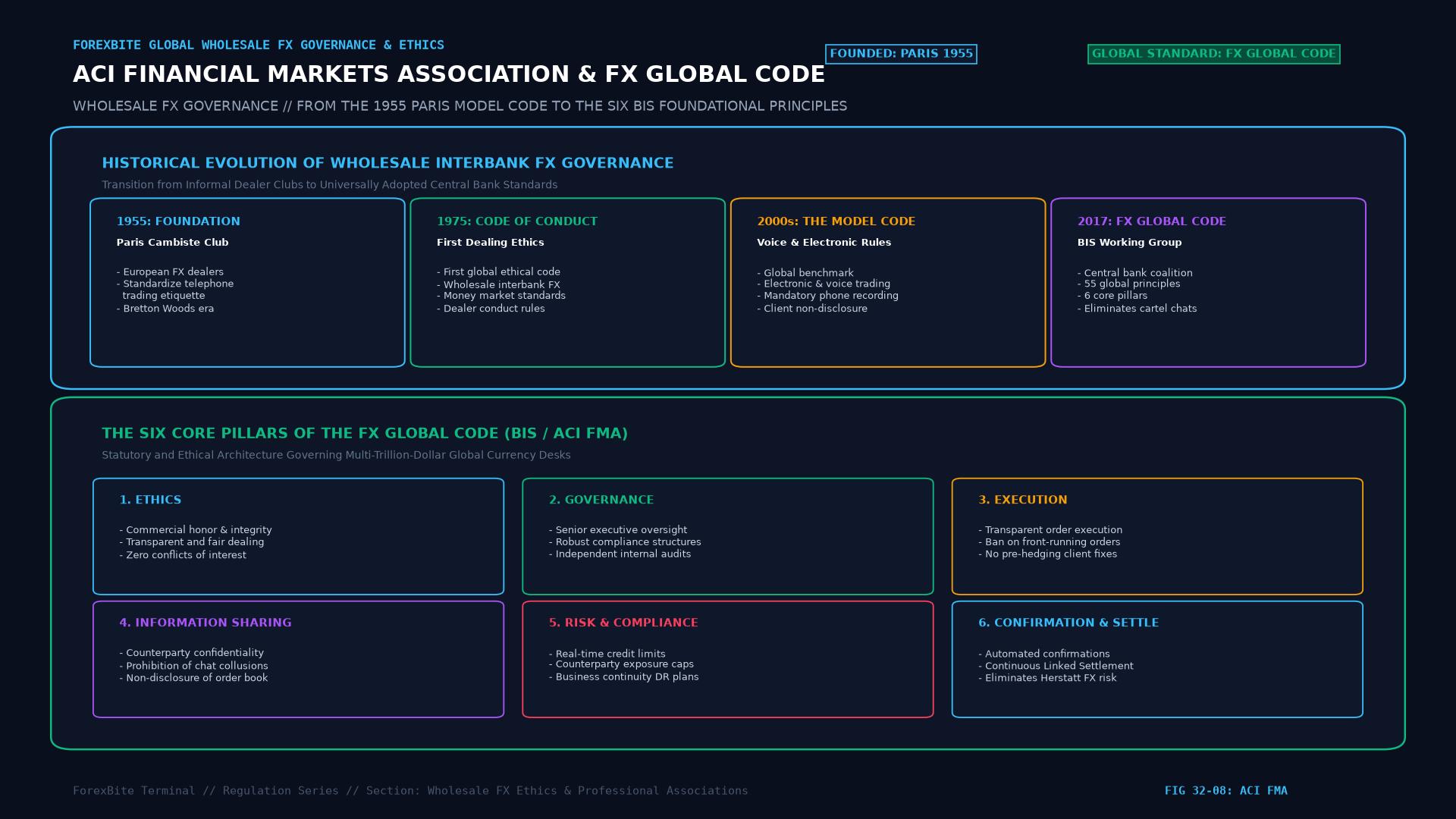 Figure: The historical evolution of wholesale FX market governance from the 1955 Paris foundation to the six foundational pillars of the modern BIS FX Global Code.
Historical Origins and the Birth of the Model Code
In the post-World War II Bretton Woods era, international trade expanded rapidly, requiring banks across Europe to establish active cross-border currency dealing desks. Because foreign exchange is an over-the-counter (OTC) decentralized market lacking a central regulatory clearing house, dealers required standardized ethical protocols to govern verbal telephone trading.
In response, ACI developed the ACI Model Code in the 1970s. The Model Code became the first comprehensive international set of best practices for wholesale financial transactions, addressing:
- Quotation integrity and firm versus indicative pricing.
- Confidentiality and non-disclosure of client order flow.
- Personal account trading conflicts for dealers.
- Rules governing market manipulation, front-running, and collusion.
- Standard operating procedures for resolving disputed trades and recording telephone lines.
From the Model Code to the Modern FX Global Code
Following the interbank benchmark manipulation scandals of 2012–2013 (the “Forex Cartel” chats), global central banks and market participants recognized the need for a universally enforced, statutory-backed code of conduct.
Convened under the auspices of the Bank for International Settlements (BIS), the Foreign Exchange Working Group leveraged ACI’s decades of Model Code governance to draft the FX Global Code in May 2017. The code establishes six foundational principles:
- Ethics: Market participants must observe high standards of commercial honor, integrity, and fairness.
- Governance: Institutions must maintain robust management oversight and operational controls to deter misconduct.
- Execution: Trading desks must exercise transparency, fairness, and care when handling customer orders, explicitly prohibiting front-running or pre-hedging designed to disadvantage the customer.
- Information Sharing: Market participants must protect confidential counterparty data and communicate in an open, unambiguous manner.
- Risk Management & Compliance: Desks must operate comprehensive risk frameworks to mitigate market, credit, counterparty, and operational risks.
- Confirmation & Settlement: Institutions must maintain timely, automated, and legally binding settlement procedures to reduce systemic settlement risk (Herstatt risk).
Professional Certifications and Educational Mandates
Beyond regulatory advocacy, ACI FMA serves as the globally recognized examination board for front-, middle-, and back-office banking professionals:
| Certification | Target Audience | Primary Core Competencies |
|---|---|---|
| ACI Dealing Certificate | Junior & Mid-level FX Dealers, Treasury Traders | Foreign exchange pricing, money market calculations, interest rate swaps, yield curve construction, ACI ethics. |
| ACI Operations Certificate | Settlement Specialists, Middle/Back Office Staff | Trade confirmation, CLS settlement workflows, collateral management, netting agreements, regulatory reporting. |
| ACI Diploma | Senior Traders, Desk Heads, Treasury Executives | Advanced asset-liability management (ALM), complex structured options, risk modeling, credit risk mitigation. |
| ELAC (E-Learning & Attestation) | All Wholesale Market Participants | Continuous annual compliance and ethical certification on the FX Global Code. |
Comparative Matrix: Global Financial Governance Bodies
| Organization | Legal Structure | Primary Focus | Regulatory Authority | Key Global Output |
|---|---|---|---|---|
| ACI FMA | International Professional Association | Individual market participant ethics, education, and trading standards | Self-regulatory / Professional body | ACI Model Code, Dealer Certifications |
| ISDA | Trade Association | Over-the-counter derivatives contracts and legal netting | Private industry legal framework | ISDA Master Agreement, Credit Support Annex (CSA) |
| BIS (Bank for International Settlements) | International Financial Institution | Central bank cooperation and systemic financial stability | Treaty-based international bank | Basel III Capital Accords, FX Global Code sponsorship |
| SIFMA | U.S. Industry Trade Group | Securities firms, banks, and asset managers in the United States | Lobbying and domestic industry advocacy | Standardized securities clearing procedures |
Why ACI Standards Matter to Retail and Institutional Traders
While retail traders do not directly trade on interbank dealer squawk boxes, the operational framework established by ACI directly protects market integrity:
- Combating “Last Look” Abuse: ACI guidelines helped define the fair application of the Last Look feature on ECN platforms, preventing algorithmic liquidity providers from unfairly rejecting trades when prices move in the customer’s favor.
- Order Execution Transparency: Retail brokers adopting ACI-aligned standards must disclose how client orders are routed, filled, and matched, ensuring trades are not artificially manipulated against the customer.
- Professional Competence of Liquidity Providers: Tier 1 interbank market makers employ traders certified under ACI Dealing protocols, ensuring that bid-ask spreads, swap points, and market depth remain liquid and orderly.
Key Takeaways
- Association Cambiste Internationale (ACI FMA) is the premier global professional association for foreign exchange and wholesale money market dealers.
- Founded in Paris in 1955, the organization created the original Model Code, which served as the blueprint for ethical conduct in over-the-counter trading.
- The principles of the ACI Model Code directly shaped the modern FX Global Code established under the Bank for International Settlements.
- ACI administers globally recognized professional credentials, including the ACI Dealing Certificate and ACI Diploma.
- ACI standards protect all market participants by discouraging unethical dealer collusion, front-running, and abusive algorithmic execution practices.
Frequently Asked Questions
What does “Cambiste” mean?
“Cambiste” is a traditional French word derived from the Latin cambium, meaning “exchange.” In international banking terminology, a cambiste is a licensed or recognized specialist who buys and sells foreign currencies on behalf of an institution.
Is adherence to ACI codes of conduct legally mandatory?
ACI guidelines and the FX Global Code are technically non-statutory (soft law). However, major central banks, commercial banks, and supervisory authorities (such as the UK FCA and European Central Bank) require regulated institutions to sign Statements of Commitment to the FX Global Code, making adherence an industry-standard operational mandate.
Who can become a member of ACI?
Membership is open to individuals actively engaged in wholesale financial markets, including traders, money market dealers, corporate treasury officers, central bankers, middle- and back-office operations specialists, and financial software developers.
What is the difference between ACI and ISDA?
ACI FMA represents the individual professional traders and operational staff, focusing on ethical execution, trade conduct, and education. ISDA (International Swaps and Derivatives Association) represents institutions, focusing on the legal, contractual, and documentation architecture of OTC derivatives contracts.
Ready to trade forex?
Open a free demo account with a regulated broker. Practice with virtual funds before risking real money.