Over-the-Counter Market (OTC)
An over-the-counter (OTC) market is a decentralized financial market where participants trade currencies, bonds, and derivatives directly between two parties without the supervision or physical location of a centralized exchange.
An over-the-counter (OTC) market is a decentralized financial marketplace where trading occurs directly between two market participants (a bilateral transaction) rather than on an organized, centralized exchange floor like the New York Stock Exchange or CME Group.
The foreign exchange market is the largest OTC market in the world, processing more than $7.5 trillion in daily turnover. Rather than channeling all buy and sell orders through a single clearinghouse, the forex OTC market functions as a continuous, interconnected electronic web of global banks, financial institutions, sovereign funds, electronic communication networks (ECNs), and retail brokers operating 24 hours a day across global financial hubs.
How the OTC Market Structure Works in Forex
In an OTC market, there is no single “official” price for a currency pair like EUR/USD at any given millisecond. Instead, prices represent bilateral quotes provided by market makers and liquidity providers.
The ecosystem is organized into a tiered hierarchy of credit relationships and liquidity pools:
- Tier-1 Interbank Market: At the apex sit global commercial and investment banks (including JPMorgan Chase, Citigroup, UBS, and Deutsche Bank). These institutions trade massive currency blocks (typically $5 million to $50 million per ticket) directly with one another over proprietary credit lines or primary matching platforms like EBS (Electronic Broking Services) and Refinitiv Matching.
- Non-Bank Liquidity Providers: Quantitative market-making firms (such as XTX Markets, Citadel Securities, and Jump Trading) provide continuous two-way liquidity into interdealer platforms using high-frequency algorithmic pricing.
- Prime of Prime (PoP) Brokers: Institutions that maintain credit lines with Tier-1 banks, allowing mid-tier hedge funds, asset managers, and retail brokerages to tap into institutional interbank liquidity.
- Retail Forex Brokers & Traders: Retail brokers aggregate liquidity from multiple providers to offer retail clients streaming bid and ask prices via MetaTrader, cTrader, or proprietary mobile apps.
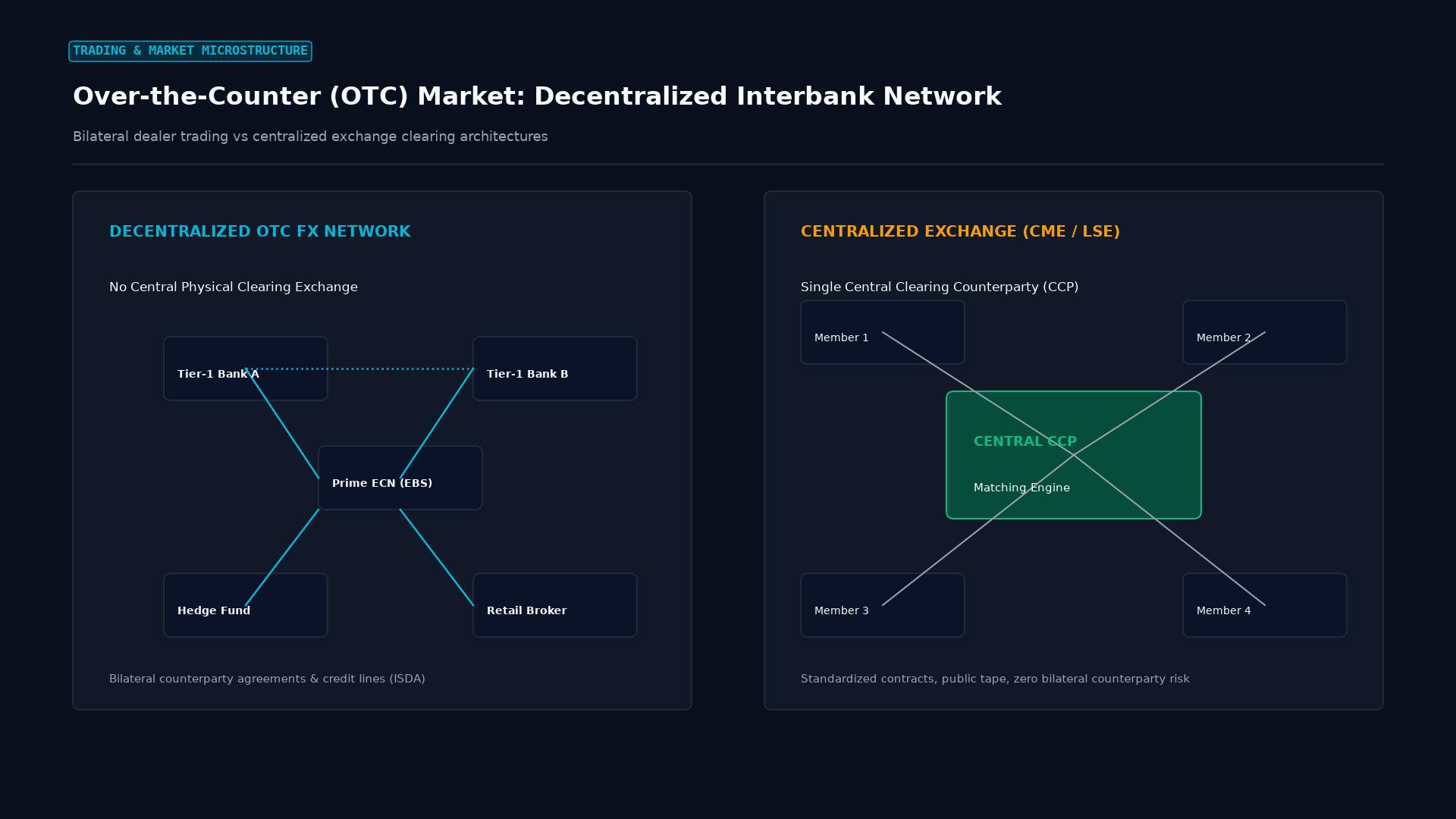 Figure: Decentralized bilateral OTC trading between global tier-1 banks and ECN networks compared to centralized exchange clearing counterparty models.
OTC Markets vs. Centralized Exchanges
Understanding the structural differences between an OTC market and an exchange-traded market is essential for evaluating execution quality and counterparty risk:
| Dimension | Over-the-Counter (OTC) Market | Centralized Exchange |
|---|---|---|
| Market Architecture | Decentralized global electronic network | Single physical or electronic clearinghouse (e.g., CME, NYSE) |
| Price Determination | Bilateral quotes from market makers and ECNs | Central limit order book (CLOB) with uniform price matching |
| Contract Standardization | Fully customizable (flexible sizes, bespoke dates for forwards) | Rigid standardized contracts (fixed lot sizes, set expiration dates) |
| Counterparty Risk | Borne directly by the two trading parties or broker | Absorbed by a central clearinghouse guarantor |
| Trading Hours | 24 hours a day, 5.5 days a week continuous | Discrete trading sessions with opening/closing bells |
| Order Book Transparency | Fragmented liquidity; internal order flow | Centralized tape; public Level 2 market depth and total volume |
Advantages of the OTC Forex Market
The decentralized structure of the foreign exchange market provides distinct advantages that make it the bedrock of international commerce:
- Continuous 24-Hour Liquidity: Because trading passes seamlessly from Sydney and Tokyo to London and New York, participants can hedge currency risk or execute trades immediately in response to overnight geopolitical events without waiting for an opening bell.
- Deep Liquidity and Execution Capacity: With multi-trillion-dollar daily liquidity, the OTC forex market absorbs enormous order volumes in major currency pairs without creating catastrophic market dislocations.
- Customization for Corporations: Multinational corporations hedging cross-border payments can negotiate customized OTC forward contracts with banks for exact dates and non-standard amounts, avoiding the rigid monthly expiries of exchange-traded futures.
Counterparty Risk in OTC Trading
The primary structural risk in an OTC market is counterparty risk—the danger that the other side of the trade will default on their contractual obligation before or during settlement.
In an exchange-traded model, a central clearinghouse steps between every buyer and seller, guaranteeing the settlement of every trade. If a firm goes bankrupt, the clearinghouse uses margin funds and default waterfalls to settle the obligation.
In an OTC environment:
- Institutional banks manage counterparty risk by signing extensive bilateral legal agreements, known as ISDA Master Agreements (International Swaps and Derivatives Association), which mandate daily collateral exchanges (variation margin).
- For retail traders, counterparty risk is concentrated entirely in their chosen retail broker. If an unregulated offshore broker becomes insolvent, the retail trader’s funds are exposed. This makes choosing a Tier-1 regulated brokerage (regulated by the FCA, ASIC, CFTC, or CySEC) essential.
Key Takeaways
- Decentralized Network: The OTC market has no central physical trading floor or clearinghouse; trades occur directly between counterparties across a global electronic network.
- Forex Market Foundation: The global currency market is predominantly an OTC marketplace, processing over $7.5 trillion in daily volume.
- Bespoke Contracts: Unlike standardized exchange-traded futures, OTC transactions allow parties to negotiate customized contract sizes and specific settlement dates.
- Counterparty Dependence: Transactions rely on the financial solvency and integrity of the counterparty, making institutional credit checks and strict retail regulatory oversight vital.
- Continuous Global Trading: The OTC currency market operates seamlessly around the clock from Sunday evening to Friday afternoon, passing liquidity between global financial capitals.
Frequently Asked Questions
Is retail forex trading considered OTC?
Yes. When a retail trader executes a trade on a platform like MetaTrader, they are not trading on a central exchange like the CME. They are executing an OTC contract directly with their broker (acting as principal or routing to an institutional liquidity provider).
How is the spot price of EUR/USD determined without a central exchange?
Spot prices are formed through continuous price discovery on primary interbank matching engines (such as EBS and Refinitiv). The quotes from these interbank engines serve as the global benchmark, which retail brokers and price aggregators reference to construct their streaming bid-ask spreads.
What is the difference between OTC forex and forex futures?
OTC forex consists of spot contracts, forwards, and swaps traded bilaterally between financial institutions or through brokers with flexible contract terms. Forex futures are standardized contracts traded on a regulated central exchange (such as CME Group) with fixed delivery dates, centralized clearing, and public volume reporting.
Ready to trade forex?
Open a free demo account with a regulated broker. Practice with virtual funds before risking real money.