Back to Back
In corporate finance and banking, an arrangement where two multinational parent corporations in different jurisdictions grant domestic currency loans to each other's foreign subsidiaries to circumvent exchange controls and eliminate currency translation risk. In institutional trading desks, a back-to-back transaction refers to a matched principal trade where a dealer immediately executes an offsetting position in the market upon filling a client order, holding zero inventory risk.
What Does “Back to Back” Mean in Finance?
In global banking and financial markets, the term back to back describes two distinct structural practices:
- Corporate Banking (Back-to-Back / Parallel Loan): A cross-border financing agreement in which two multinational corporations located in different countries issue local-currency loans to each other’s domestic subsidiaries. By funding foreign operations in domestic currency, both corporations eliminate foreign exchange conversion fees, bypass government capital controls, and insulate their balance sheets from currency volatility.
- Trading Desks (Back-to-Back / Matched Principal Trading): An execution model in which a dealer, broker, or market maker matches a client’s buy or sell order by executing an identical, simultaneous offsetting transaction with an external liquidity provider. The trading desk takes no inventory or market directional risk, functioning purely as a conduit to harvest a risk-free commission or spread markup.
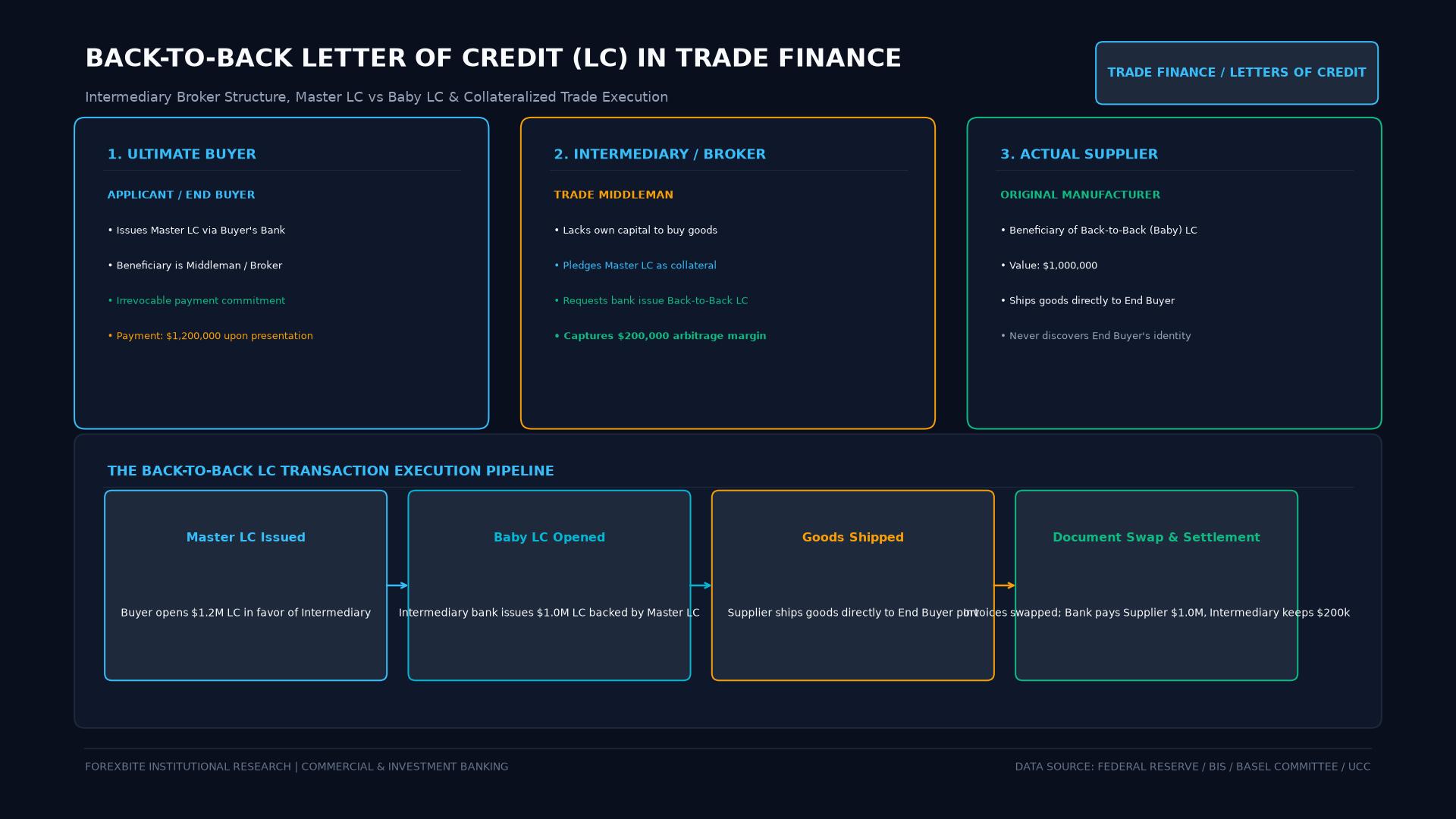 Figure: Documentary trade finance structure: export master letter of credit matched with import baby letter of credit to finance goods delivery without working capital depletion.
Historical Origins: The Catalyst for Modern Currency Swaps
The corporate back-to-back loan originated in the 1970s in the United Kingdom. To defend the British Pound from speculative devaluation, the UK government enacted strict foreign exchange controls, imposing a punitive tax—known as the dollar premium—on UK corporations attempting to wire pounds overseas to invest in the United States.
To bypass this regulatory barrier, British companies partnered with American corporations expanding into the UK:
- The British parent held excess British Pounds; its American subsidiary needed pounds to build UK manufacturing plants.
- The American parent held excess U.S. Dollars; its British subsidiary needed dollars to expand in the US.
- Instead of exchanging currencies through the formal foreign exchange market, each parent company extended an ordinary domestic loan to the other’s subsidiary.
While back-to-back loans successfully sidestepped capital controls, they suffered from significant legal liabilities. If one subsidiary defaulted, the other loan remained legally binding under traditional contract law. In 1981, investment bankers at Salomon Brothers formalized this structure into the modern cross-currency swap (most famously between IBM and the World Bank), where rights of set-off are contractually unified under a single derivative agreement.
Step-by-Step Corporate Financing Case Study
Consider US Tech Corp (headquartered in New York) and UK Retail Ltd (headquartered in London). The current spot exchange rate is GBP/USD = 1.2500.
- US Tech Corp requires £8,000,000 to fund its London software engineering hub.
- UK Retail Ltd requires $10,000,000 to acquire logistics facilities in California.
- Borrowing foreign currency directly from commercial banks in foreign jurisdictions would incur foreign exchange translation risk, higher interest margins, and local withholding taxes.
Structuring the Parallel Loan
- Loan 1 (United States): US Tech Corp lends $10,000,000 to UK Retail’s Delaware subsidiary for 5 years at an agreed interest rate of 5.00%.
- Loan 2 (United Kingdom): UK Retail Ltd lends £8,000,000 to US Tech’s London subsidiary for 5 years at an agreed interest rate of 5.00%.
Cash Flow Servicing and Settlement
- Annually, UK Retail’s US subsidiary pays $$500,000$ in interest to US Tech Corp.
- Concurrently, US Tech’s London subsidiary pays $£400,000$ in interest to UK Retail Ltd.
- At maturity (Year 5), the principal sums of $$10,000,000$ and $£8,000,000$ are repaid to the original domestic parent corporations.
Strategic Benefits
- Zero Foreign Exchange Risk: No currency crossed an international border; all debt servicing occurred domestically in the operational currency of each business.
- Capital Control Immunity: If either jurisdiction imposes sudden restrictions on foreign currency remittances, the loans remain completely intact.
Back-to-Back Transactions on Trading Desks (A-Book / Matched Principal)
In electronic trading and brokerage operations, back-to-back execution describes a non-risk-taking dealership model:
- Client Order Received: A trader places an order to buy 100 lots of EUR/USD with a retail broker at 1.08502.
- Immediate Offset: Rather than holding the other side of the trade on its internal balance sheet (B-Book / market making), the broker’s liquidity bridge automatically submits a buy order for 100 lots with an interbank tier-1 prime broker (such as Citi or Deutsche Bank) at 1.08500.
- The Outcome: The client receives their 100 lots, the prime broker fulfills the trade, and the intermediary captures a guaranteed, risk-free 0.2 pip markup ($200) without carrying overnight market volatility exposure.
Comparative Matrix: Back-to-Back Structures vs. Derivatives
| Structural Parameter | Corporate Back-to-Back Loan | Cross-Currency Swap | Intercompany Loan | Trading Desk Matched Principal |
|---|---|---|---|---|
| Legal Framework | Two separate loan agreements | Single ISDA Master Agreement | Single intra-group loan | Direct ECN / STP brokerage routing |
| Balance Sheet Impact | Gross debt expands on both balance sheets | Off-balance sheet derivative exposure | Consolidated intra-firm debt | Zero inventory on broker balance sheet |
| Default Risk | High (Asymmetrical default risk) | Low (Contractual right of set-off) | Internal group risk only | Low (Immediate settlement via clearinghouse) |
| FX Conversion | None (Domestic disbursements) | Synthetic exchange of cash flows | International wire required | Real-time electronic matching |
| Regulatory Purpose | Bypassing capital controls & tax drag | Hedging long-term balance sheet risk | Moving internal subsidiary cash | Eliminating broker market risk |
Pitfalls and Institutional Hazards of Back-to-Back Loans
- The Double Default / Asymmetry Trap: Under standard contract law, two separate loan documents do not grant an automatic right of legal set-off. If UK Retail’s US subsidiary goes bankrupt and ceases making loan payments, US Tech Corp cannot simply stop paying its loan to UK Retail in London without breaching British contract law. This critical legal vulnerability is why modern corporations prefer ISDA cross-currency swaps.
- Transfer Pricing and Tax Scrutiny: Tax authorities (such as the IRS under Section 482 and the OECD under BEPS guidelines) monitor back-to-back arrangements closely to verify that the interest rates charged reflect arm’s-length commercial terms rather than artificial corporate profit shifting.
Key Takeaways
- In corporate finance, a back-to-back (parallel) loan involves two multinational corporations lending domestic currencies to each other’s foreign subsidiaries.
- The structure eliminates foreign exchange translation risk, reduces borrowing costs, and sidesteps sovereign capital controls.
- The back-to-back loan served as the historic precursor that directly sparked the creation of modern cross-currency swaps in 1981.
- In financial trading operations, back-to-back execution refers to matched principal dealing, where an intermediary offsets client trades immediately without taking inventory risk.
- The chief legal drawback of corporate back-to-back loans is the lack of automatic right of set-off in bankruptcy, a flaw resolved by modern derivative netting agreements.
Frequently Asked Questions
Why did currency swaps replace back-to-back loans in modern finance?
Currency swaps replaced back-to-back loans because swaps are unified under a single legal agreement (such as the ISDA Master Agreement). This gives counterparties an automatic legal right of set-off: if one counterparty defaults, the other counterparty is immediately relieved of its payment obligations. Furthermore, swaps do not inflate corporate balance sheets with gross debt.
What is a “back-to-back letter of credit” in trade finance?
In international trade, a back-to-back letter of credit (LC) is used by trade intermediaries. The intermediary receives an irrevocable LC from the ultimate buyer, and then uses that instrument as collateral to have their own bank issue a second, matching LC to the original manufacturer or supplier.
Does a broker running a back-to-back desk have a conflict of interest with clients?
No. Brokers operating a pure back-to-back model (often called STP or A-Book brokers) do not trade against their clients. They pass all orders directly to institutional liquidity providers and profit solely from transaction commissions and spreads, aligning their interests with the trader’s profitability and volume.
Can back-to-back loans be used between two companies in the same country?
Generally no. The core economic utility of a back-to-back loan is cross-border and cross-currency arbitrage—allowing entities in two different monetary regimes to access foreign currency locally without crossing foreign exchange wire networks.
Ready to trade forex?
Open a free demo account with a regulated broker. Practice with virtual funds before risking real money.