Current Account
The current account is the broadest measure of a country's trade with the rest of the world. It records transactions in goods, services, primary income (investment returns), and secondary income (transfers). A current account surplus means the country earns more from abroad than it sends; a deficit means the reverse. The current account is the most closely watched component of the Balance of Payments for currency valuation analysis.
Current Account vs. Trade Balance: The Key Difference
Traders often conflate the current account with the trade balance. They’re related but distinct. The trade balance measures only goods exports minus goods imports. The current account is broader — it adds services trade, investment income, and transfer payments to get the full picture of cross-border money flows.
For a country like the United States: its goods trade deficit is significantly larger than its current account deficit, because US service exports (financial services, technology licensing, education, tourism) and investment income (returns on overseas assets) partially offset the goods deficit.
For the UK: it runs a consistent goods deficit but a substantial services surplus, primarily through financial services, legal services, and business consulting. The combined current account deficit is smaller than the goods trade deficit alone.
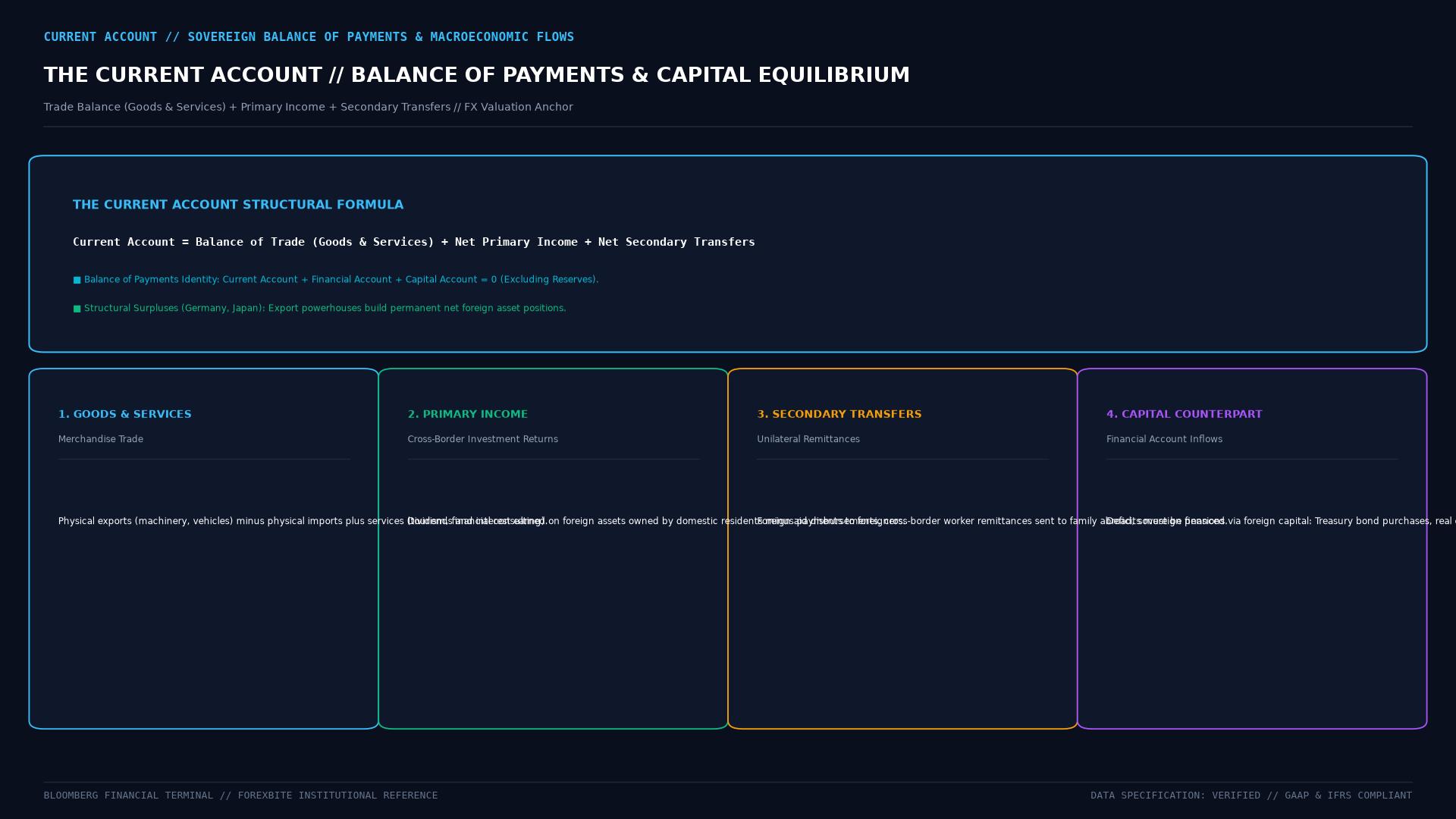 Figure: The Current Account framework within the Balance of Payments ($CAB = Balance of Goods & Services + Net Primary Income + Net Secondary Income$), detailing financial account balancing and long-term currency impact.
The Four Components
1. Goods trade (merchandise trade): Physical exports minus physical imports. The most visible component — monthly trade balance reports feed into this. Oil exporters, manufacturing exporters, and commodity producers dominate current account surplus positions through this channel.
2. Services trade: The US earns significant services surpluses through technology companies, financial services, education (foreign students paying US university fees), and tourism. Singapore, Luxembourg, and Hong Kong similarly generate services surpluses through financial intermediation.
3. Primary income: Returns on international investment: dividends received from foreign equity holdings, interest on bonds, repatriated profits from subsidiaries abroad. Japan earns a large and growing primary income surplus — a legacy of decades of overseas investment — which has partially offset its goods trade balance deterioration from rising energy import costs.
4. Secondary income (current transfers): Money flows without a corresponding economic transaction:
- Remittances: workers abroad sending money home (a major positive for India, Mexico, Philippines, Egypt, Pakistan)
- Foreign aid: wealthy nations sending development assistance (negative for donors)
- Contributions to international organizations (EU budget contributions, UN dues)
Why the Current Account Moves Currency
The current account’s forex significance comes from the net foreign exchange demand it creates:
Surplus countries are continuously converting foreign currency earnings into domestic currency. Exporters receive dollars, euros, or yen and must convert to local currency to pay domestic wages, taxes, and suppliers. This creates persistent, structural demand for the domestic currency.
Deficit countries must obtain foreign currency to pay for excess imports. This creates persistent supply of domestic currency (selling it to buy the needed foreign currencies) — structural downward pressure.
However, this relationship is significantly mediated by the financial account. A deficit country that attracts more capital inflows than its current account deficit requires can maintain a strong currency. This is the US situation — its current account deficit is more than offset by the global demand for dollar-denominated assets.
Tracking Current Account Data
Current account data is typically published quarterly, with a lag of several months. For trading purposes:
- Monthly goods trade balance (published 4-6 weeks after month-end) is the leading indicator
- Quarterly current account provides the complete picture including services and income
- IMF World Economic Outlook provides current account projections that can shift multi-month currency positioning
Countries with rapidly deteriorating current accounts are vulnerable to sudden stops — sharp reversals of capital flows that can trigger currency crises. Emerging markets with current account deficits funded by short-term portfolio flows (rather than stable FDI) are most at risk.
Key Takeaways
- Current account = goods + services + primary income + secondary income (broader than trade balance)
- Surplus = net earner of foreign exchange → structural demand for domestic currency
- Deficit = net spender of foreign exchange → structural supply of domestic currency
- Financial account flows can override current account effects on exchange rates
- Quarterly publication; monthly goods trade data is the leading indicator
FAQ
Which countries consistently run the largest current account surpluses? Germany (driven by manufactured goods exports), China (manufactured exports), Japan (combination of goods and primary income), Netherlands and Switzerland (financial services and corporate headquarters effects). These countries experience persistent structural currency demand.
Can a current account deficit be sustainable indefinitely? It depends on how the deficit is financed. A deficit funded by stable FDI inflows can persist for many years without crisis. A deficit funded by short-term portfolio investment is more vulnerable — those flows can reverse rapidly in response to global risk sentiment changes. The US is the unique case where reserve currency status has sustained deficits for decades.
Ready to trade forex?
Open a free demo account with a regulated broker. Practice with virtual funds before risking real money.