Bank Line
An approved credit facility extended by a commercial or investment bank to a corporate borrower, financial institution, or brokerage firm, establishing a maximum borrowing threshold that can be drawn down as revolving debt, letters of credit, or trading margin.
What is a Bank Line?
A bank line (formally known as a bank line of credit or bank facility) is a legally binding financing arrangement established between a commercial or investment bank and an institutional borrower. Rather than providing a lump-sum term loan that accrues immediate interest on the full balance, the bank establishes a pre-approved credit ceiling. The borrower retains the right to draw down, repay, and redraw funds as operational, hedging, or liquidity demands dictate.
In the foreign exchange and institutional derivatives sectors, bank lines play a specialized, critical role. Prime brokerage banks extend multi-million dollar credit and settlement lines to retail brokerages, hedge funds, and proprietary trading desks. These lines provide the collateral backing required to execute and settle billions in foreign exchange turnover without transferring cash for every individual transaction.
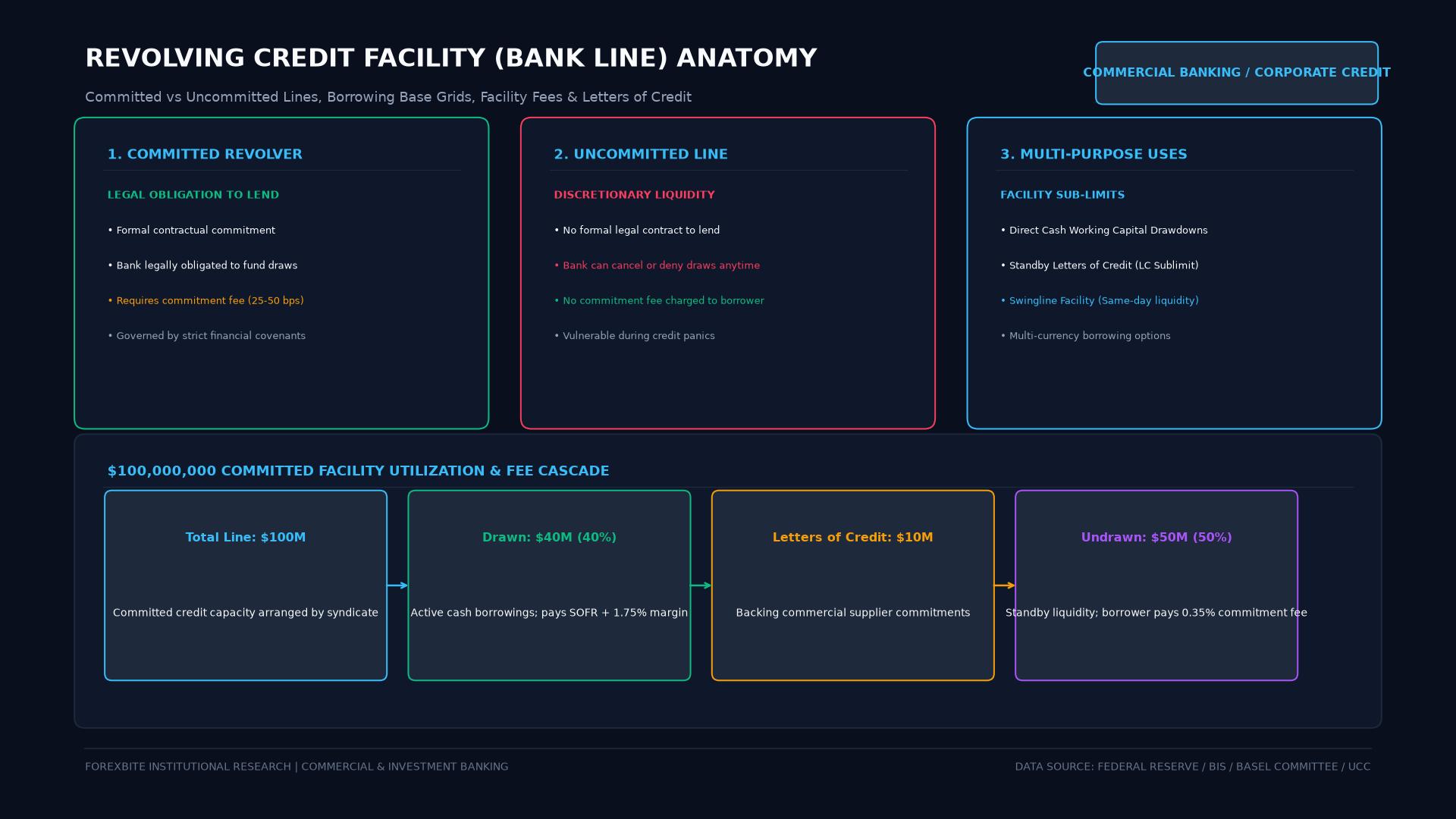 Figure: Commercial liquidity facility framework: committed revolving credit facilities versus uncommitted advising lines, covenant triggers, and undrawn commitment fees.
Committed vs. Uncommitted Bank Lines
Financial institutions structure bank lines under two distinct legal classifications:
1. Committed Credit Facilities
- Legal Guarantee: The lender is contractually mandated to advance funds upon the borrower’s request up to the approved limit, provided the borrower has not breached covenant thresholds.
- Cost Structure: The borrower pays a stated interest rate (e.g., SOFR + 150 bps) on active drawn funds, plus a continuous commitment fee (typically 15 to 50 basis points) on undrawn, available balances.
- Strategic Utility: Corporate treasuries rely on committed facilities as mandatory liquidity backstops to support commercial paper programs or protect against sudden credit contractions.
2. Uncommitted (Advised) Lines
- Discretionary Lending: The bank retains the legal right to approve or reject individual drawdown requests based on daily balance sheet constraints or deteriorating credit risk.
- Cost Structure: No ongoing commitment fee is assessed on undrawn amounts, reducing overhead costs.
- Trading Application: Common in interbank trading and daily foreign exchange settlement, where credit lines are adjusted dynamically in response to market volatility.
The Role of Bank Lines in Foreign Exchange Trading
In over-the-counter (OTC) foreign exchange trading, transactions settle on a $T+2$ basis (Value Date). Without credit lines, market participants would have to wire gross currency balances continuously, creating catastrophic liquidity bottlenecks:
- Foreign Exchange Settlement Lines: Banks assign bilateral credit limits to corporate clients and fund managers. When a fund buys $50 million of EUR/USD, the bank executes the trade against the client’s settlement line without requiring the client to deposit $50 million in cash upfront.
- Prime Brokerage Margin Lines: Retail forex brokers maintain bank lines with Tier 1 prime brokers (e.g., JPMorgan, UBS, Deutsche Bank). These lines fund the intraday leverage provided to retail traders, with the bank monitoring net open positions and imposing automated haircut requirements.
- Rollover Swap Financing: Overnight swap adjustments and mark-to-market variations are continuously debited and credited against the institution’s bank line, maintaining operational continuity.
Corporate Case Study: Managing Working Capital Through a Revolving Line
Consider a global electronics distributor based in North America that imports components from Japan. The company operates with a $25,000,000 committed revolving bank line at an agreed rate of SOFR + 1.75% with a 0.25% undrawn commitment fee.
Operational Cash Flow Scenario
- Day 1: The company draws down $12,000,000 to settle an open letter of credit for Japanese yen-denominated microchips.
- Drawn balance: $$12,000,000$ (Accrues interest daily).
- Undrawn balance: $$13,000,000$ (Incurs 0.25% annualized fee).
- Day 45: The company receives payment from major retail partners and wires $8,000,000 back to the bank.
- Remaining debt balance: $$4,000,000$.
- Available credit ceiling automatically resets back to $21,000,000.
Strategic Value
Had the distributor taken a conventional term loan, it would have paid full interest on $25,000,000 across the entire year. By utilizing an adaptable revolving bank line, interest expense was limited strictly to capital actively deployed.
Comparative Matrix: Bank Lines vs. Alternative Financing
| Financing Structure | Drawdown Flexibility | Interest Incurred | Commitment Fee | Balance Sheet Impact | Primary Use Case |
|---|---|---|---|---|---|
| Revolving Bank Line | High (Draw, repay, redraw) | Only on drawn capital | Yes (On undrawn balance) | Floating short-term liability | Working capital, liquidity buffer, FX margin |
| Term Loan | Single lump-sum disbursement | On 100% of principal | None | Fixed debt schedule | Capital expenditures, mergers, real estate |
| Commercial Paper | Programmatic short-term notes | Fixed discount rate | Dealer placement fees | Unsecured money market debt | Low-cost funding for blue-chip corporates |
| Overdraft Facility | Automated negative balance | High / punitive daily rate | Minimal | Temporary ledger deficit | Short-term intraday cash deficits |
Risk Factors: Covenants and Line Reductions
- Material Adverse Change (MAC) Clauses: Credit agreements frequently contain MAC clauses allowing the lender to freeze or cancel uncommitted bank lines if the borrower’s operating performance or macro environment suffers severe distress.
- Financial Covenants: Borrowers must maintain strict balance sheet health, such as minimum Interest Coverage Ratios ($\text{EBITDA} / \text{Interest Expense} \ge 3.0$) and maximum Debt-to-Equity ratios. Breaching a covenant triggers technical default, giving the bank the right to demand immediate repayment.
- Liquidity Squeezes: During systemic crises (such as the 2008 Lehman collapse or the March 2020 pandemic onset), corporations aggressively draw down their entire bank lines simultaneously to hoard cash, straining bank capital reserves.
Key Takeaways
- A bank line is an approved credit facility allowing borrowers to draw, repay, and redraw capital up to a fixed limit.
- Borrowers incur interest charges exclusively on drawn capital, alongside nominal commitment fees on undrawn reserves.
- Committed facilities offer guaranteed legal access to liquidity, while uncommitted lines are extended at the bank’s discretion.
- In foreign exchange markets, bank lines serve as the vital operational backbone for trade settlement, prime broker margin, and rollover financing.
- Breaching debt covenants or triggering Material Adverse Change clauses can cause lenders to freeze or demand immediate settlement of the facility.
Frequently Asked Questions
What is the difference between a bank line and a term loan?
A term loan delivers the entire borrowed sum in a single disbursement upfront, requiring immediate interest and scheduled principal amortizations. A bank line functions like an institutional credit card: you draw only what you need, pay interest only on what is borrowed, and can reuse the line as funds are repaid.
What is a “commitment fee” on a bank line?
A commitment fee is an annualized percentage (typically 0.15% to 0.50%) paid to the lending bank to compensate it for setting aside capital reserves to ensure the funds are guaranteed and available whenever the borrower calls upon them.
Why do forex brokers need bank lines with Tier 1 banks?
Forex brokers aggregate client trading volume and hedge net exposure with Tier 1 liquidity providers. Tier 1 banks require credit lines to absorb fluctuating mark-to-market intraday profits and losses, enabling real-time execution without requiring cash wires for every single lot traded.
Can a bank cancel a credit line without warning?
For uncommitted facilities, yes—banks can withdraw or curtail uncommitted lines at their sole discretion. For committed facilities, banks can only freeze or terminate lines if the borrower breaches contractual debt covenants, fails to submit financial reports, or experiences an event of default.
Ready to trade forex?
Open a free demo account with a regulated broker. Practice with virtual funds before risking real money.