Bear Put Spread
A bear put spread is a vertical debit options strategy where a trader buys a higher-strike put option and simultaneously sells an equal number of lower-strike put options with the same expiration date, designed to capitalize on moderate downward price declines while capping maximum loss.
A bear put spread—also known as a debit put spread or long put vertical spread—is a popular options trading strategy designed to profit from moderate downward price movement in an underlying asset while strictly limiting upfront capital risk.
By purchasing a put option with a higher strike price and simultaneously selling (writing) a second put option with a lower strike price sharing the exact same expiration date, the trader offsets a significant portion of the cost of the trade. In return for this reduced upfront expense and mitigated time decay (Theta), the trader accepts a cap on their maximum potential profit.
Structure and Mechanics of the Spread
A bear put spread is established as a net debit transaction, meaning cash is debited from the trader’s account at inception:
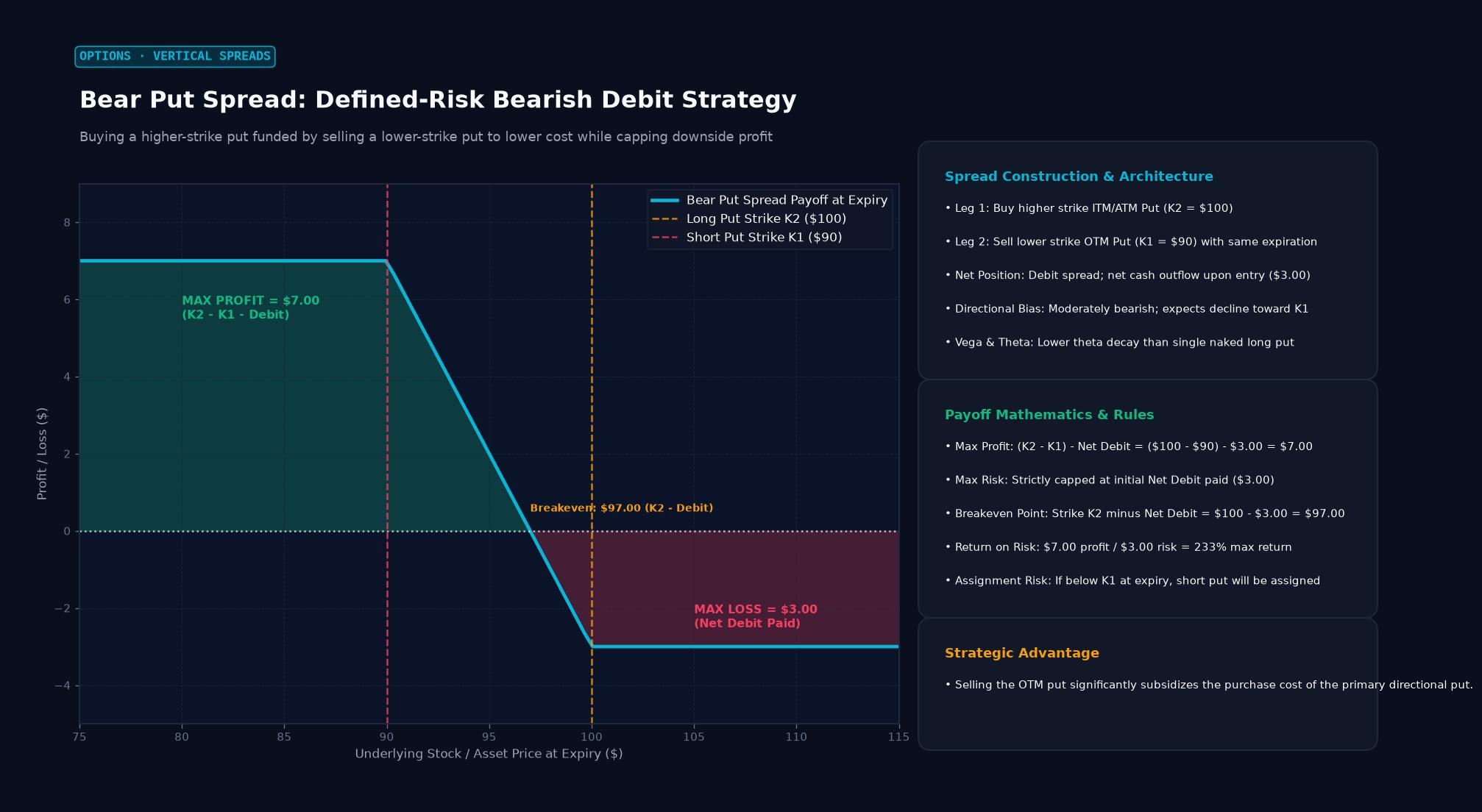 Figure: Buying a higher-strike put funded by selling a lower-strike put to lower cost while capping downside profit
- Leg 1 (Long Put): The trader buys an at-the-money (ATM) or slightly in-the-money (ITM) put option at strike $K_2$, paying premium $P_2$. This leg provides the downward profit engine.
- Leg 2 (Short Put): The trader sells an out-of-the-money (OTM) put option at a lower strike $K_1$, collecting premium $P_1$. The cash received from this sale subsidizes the purchase of Leg 1.
- The Net Debit: $$\text{Net Debit (Max Loss)} = P_2 - P_1$$
The Mathematical Risk-Reward Profile
The financial payoff of a bear put spread is strictly bounded between a defined maximum profit and a defined maximum loss:
| Metric | Mathematical Formula | Economic Interpretation |
|---|---|---|
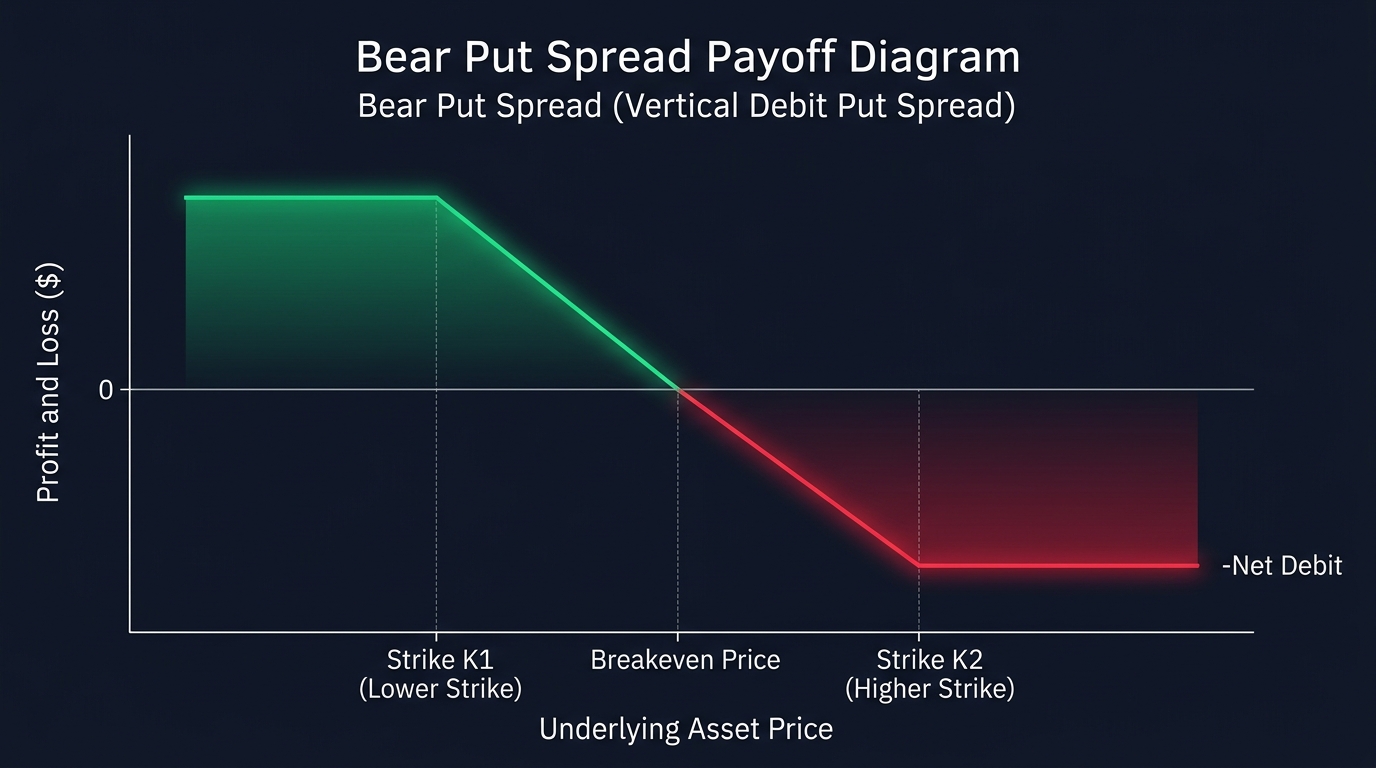
| Maximum Loss | $\text{Net Debit} = P_2 - P_1$ | Incurred if the asset closes at or above higher strike $K_2$ at expiration |
| Maximum Profit | $(K_2 - K_1) - \text{Net Debit}$ | Realized if the asset closes at or below lower strike $K_1$ at expiration |
| Breakeven Point | $K_2 - \text{Net Debit}$ | The exact underlying price needed at expiration to recover the initial debit |
Payoff Table at Expiration: A Concrete EUR/USD Spread
- Underlying Spot Price at Entry: 1.0900
- Long Put (Strike $K_2$): 1.0900 Put (Cost: 120 pips, or $1,200 per standard contract)
- Short Put (Strike $K_1$): 1.0700 Put (Credit: 40 pips, or $400 per standard contract)
- Net Debit (Max Risk): $120 - 40 = \mathbf{80 \text{ pips ($800)}}$
- Max Profit: $(1.0900 - 1.0700) - 0.0080 = 200 - 80 = \mathbf{120 \text{ pips ($1,200)}}$
- Breakeven Price: $1.0900 - 0.0080 = \mathbf{1.0820}$
| Closing Price at Expiration | Long 1.0900 Put Value | Short 1.0700 Put Value | Net Spread Value | Net P&L (after $800 cost) |
|---|---|---|---|---|
| 1.1000 (Rallies) | $0 | $0 | $0 | -$800 (Max Loss) |
| 1.0900 (Flat) | $0 | $0 | $0 | -$800 (Max Loss) |
| 1.0820 (Breakeven) | $800 | $0 | $800 | $0.00 (Breakeven) |
| 1.0750 (Declines) | $1,500 | $0 | $1,500 | +$700 Profit |
| 1.0700 (Target Hit) | $2,000 | $0 | $2,000 | +$1,200 (Max Profit) |
| 1.0500 (Market Crash) | $4,000 | -$2,000 | $2,000 | +$1,200 (Capped Profit) |
Bear Put Spread vs. Buying a Naked Put
Why would a trader sell the lower put option and cap their upside rather than simply buying a naked put?
- Substantial Cost Reduction: In high-volatility environments, purchasing naked put options is expensive. Selling the out-of-the-money put significantly reduces the capital required to take a bearish stance.
- Mitigated Time Decay (Theta): Options lose value every day due to time decay. In a bear put spread, the short put experiences positive time decay that offsets the negative time decay of the long put, allowing the position to withstand days of sideways consolidation without bleeding capital.
- Lower Breakeven Threshold: Because the net debit is lower than the price of a naked put, the underlying asset does not need to drop as far for the trade to become profitable.
Key Takeaways
- Moderately Bearish: A bear put spread is a vertical options strategy tailored for moderate, orderly market declines.
- Defined Risk: Maximum loss is strictly capped at the initial net debit paid to enter the trade.
- Capped Upside: Profit is limited to the difference between the two strike prices minus the net debit, reached when the asset falls to or below the lower strike.
- Cost Efficiency: Writing the lower put subsidizes the long put and cushions the position against destructive time decay (Theta).
- Strategic Breakeven: The breakeven price equals the higher strike minus the net premium paid.
Frequently Asked Questions
What happens if the underlying asset drops far below the short strike?
If the asset collapses far below the lower strike (e.g., in a flash crash), the profit remains capped at the maximum theoretical level. While the long put continues to gain value, the short put gains an identical amount of negative intrinsic liability, neutralizing further gains.
Can a bear put spread be closed before expiration?
Yes. Traders routinely close the spread prior to expiration by executing a closing order (selling the long put and buying back the short put) to lock in profits once the underlying asset has completed the expected downward move.
When should a trader choose a bear put spread over shorting the spot currency?
A bear put spread is ideal when an investor wants to position for a downward move while completely eliminating the risk of a catastrophic margin call or unlimited loss if an unexpected fundamental event causes the currency to gap violently higher.
Ready to trade forex?
Open a free demo account with a regulated broker. Practice with virtual funds before risking real money.