In-the-Money
In-the-money (ITM) describes an option contract that possesses positive intrinsic value, where the current market price is higher than the strike price for a call option, or lower than the strike price for a put option.
What Does In-the-Money (ITM) Mean?
In options trading and financial derivatives, “moneyness” defines the relationship between an option contract’s strike price (the agreed price at which the contract can be exercised) and the prevailing spot price of the underlying asset. An option is classified as in-the-money (ITM) when it holds positive intrinsic value—meaning that if the option were exercised immediately, it would yield an economic profit relative to prevailing market prices.
Whether an option is in-the-money depends strictly on contract type:
- Call Option: In-the-money when the spot price is above the strike price ($S > K$). The holder possesses the legal right to purchase the currency at a price lower than what the open market currently commands.
- Put Option: In-the-money when the spot price is below the strike price ($S < K$). The holder possesses the legal right to sell the currency at a price higher than the open market quote.
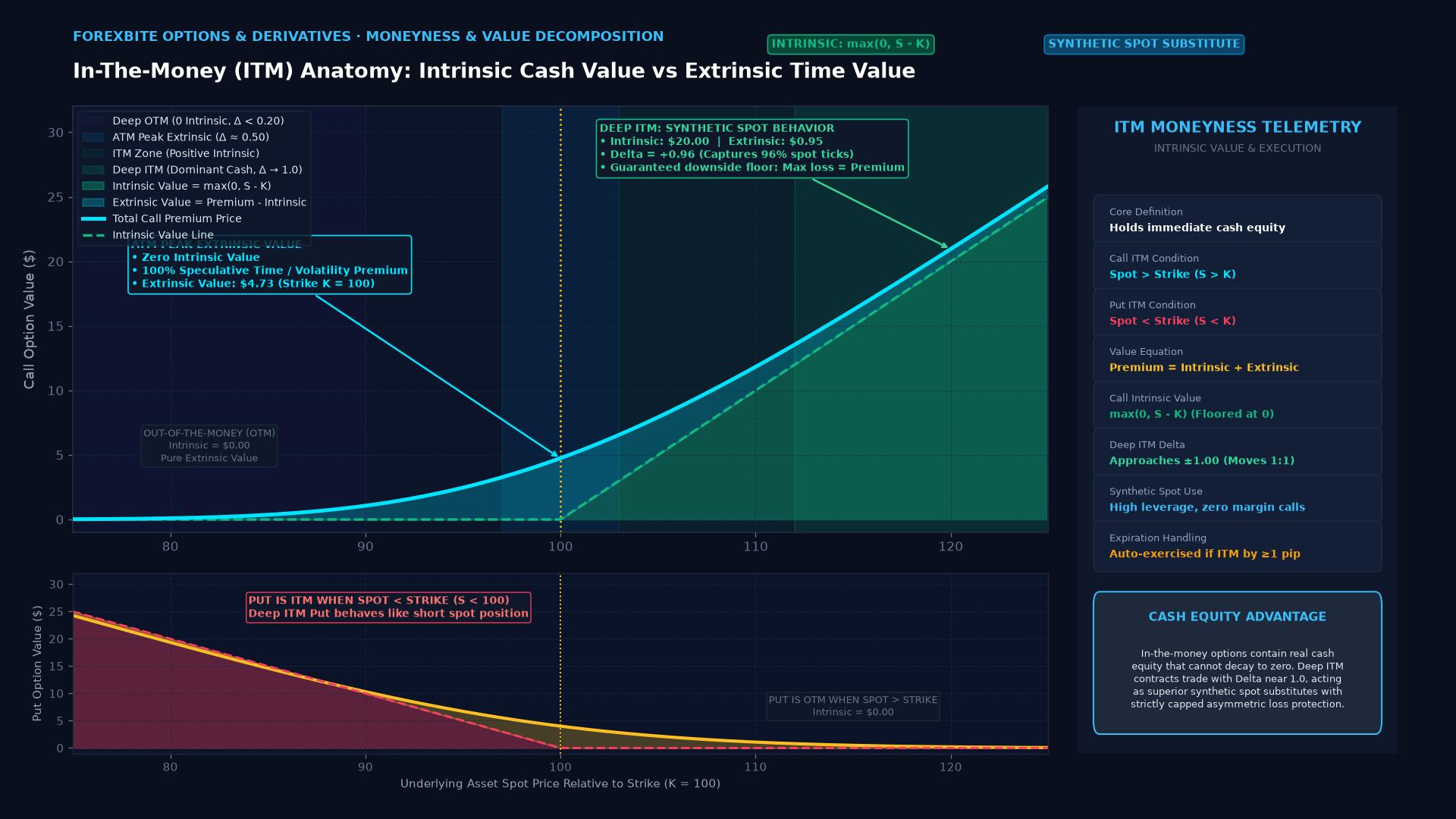
Intrinsic Value vs. Extrinsic (Time) Value
The total market price (premium) of an in-the-money option consists of two distinct components:
$$\text{Option Premium} = \text{Intrinsic Value} + \text{Extrinsic (Time) Value}$$
1. Intrinsic Value
Intrinsic value represents the tangible, immediate cash equity embedded in the contract:
- Call Intrinsic Value: $\max(0, S - K)$
- Put Intrinsic Value: $\max(0, K - S)$
If EUR/USD spot is trading at 1.0920, a call option with a strike price of 1.0800 possesses 120 pips ($0.0120$) of intrinsic value. Intrinsic value can never fall below zero.
2. Extrinsic Value (Time Value & Implied Volatility)
Extrinsic value represents the premium investors pay above intrinsic value for the probability that favorable price movements and remaining time to expiration will expand profits further. As an option travels deeper in-the-money, extrinsic value steadily declines as a percentage of total contract price, and the option trades virtually tick-for-tick with intrinsic value.
The Greeks Profile of ITM Options
Understanding how Option Greeks behave on in-the-money contracts is essential for managing portfolio sensitivity:
- Delta ($\Delta$): For deep ITM options, Delta approaches +1.00 on call options and -1.00 on put options. This indicates that for every 1-pip movement in the spot exchange rate, the option premium moves by approximately 1 pip.
- Gamma ($\Gamma$): Gamma is near-zero for deep ITM options. Because the option is already firmly profitable and the probability of expiring in-the-money approaches 100%, small spot moves do not significantly alter Delta.
- Theta ($\Theta$): Deep ITM options experience substantially less percentage-based time decay than at-the-money options because their value consists primarily of cash intrinsic value rather than speculative time value.
Moneyness Comparison Table
| Metric | In-the-Money (ITM) | At-the-Money (ATM) | Out-of-the-Money (OTM) |
|---|---|---|---|
| Call Condition | Spot > Strike ($S > K$) | Spot = Strike ($S = K$) | Spot < Strike ($S < K$) |
| Put Condition | Spot < Strike ($S < K$) | Spot = Strike ($S = K$) | Spot > Strike ($S > K$) |
| Intrinsic Value | Always Positive (> 0) | Exactly Zero (0) | Exactly Zero (0) |
| Extrinsic Value | Low to Moderate | Maximum | Exclusively Extrinsic (100%) |
| Delta Range | 0.50 to 1.00 (Calls) / -0.50 to -1.00 (Puts) | ~0.50 (Calls) / ~-0.50 (Puts) | 0.00 to 0.50 (Calls) / 0.00 to -0.50 (Puts) |
| Premium Cost | Expensive (cash equity) | Moderate | Cheap (pure lottery/insurance) |
Practical Trading Strategy: Deep ITM Options as a Synthetic Spot Substitute
Institutional currency desks and sophisticated retail traders frequently utilize deep in-the-money options as a structural alternative to holding leveraged spot positions.
Why Trade Deep ITM Options Over Spot?
- High Delta Efficiency: A deep ITM call with a Delta of 0.90 replicates 90% of spot currency gains.
- Capped Asymmetric Risk: If a sudden black-swan event collapses the currency by 1,000 pips overnight, a spot forex trader using leverage faces catastrophic liquidation or negative account balances. In contrast, the buyer of a deep ITM call option can never lose more than the initial premium paid, providing an absolute, guaranteed catastrophic risk stop.
- No Margin Calls: Unlike spot or futures contracts, long option positions are not subject to margin calls or forced stop-loss hunting during temporary liquidity flash crashes.
Key Takeaways
- An in-the-money (ITM) option possesses intrinsic value because its strike price is advantageous relative to the spot market.
- A call option is ITM when spot price exceeds strike; a put option is ITM when spot price is below strike.
- Total option premium equals intrinsic cash value plus extrinsic time value.
- Deep ITM options feature Deltas approaching 1.00, mimicking spot price movements tick-for-tick with minimal time decay.
- Trading deep ITM options allows market participants to capture spot market trends with strictly capped downside risk.
Frequently Asked Questions
Does an in-the-money option guarantee a profitable trade?
No. An option can expire in-the-money and still result in a net loss. If a trader buys an ITM call for a total premium of $150 pips, and at expiration the contract is in-the-money by only 80 pips, the trader loses 70 pips on the trade because the intrinsic value failed to exceed the total upfront purchase premium.
What happens to an in-the-money currency option at expiration?
Most institutional and exchange-traded options (such as CME currency options) have automatic exercise provisions. If an option is in-the-money by at least 1 tick at expiration, the clearinghouse automatically exercises the contract, delivering the underlying cash settlement or futures position into the trader’s account.
Why are in-the-money options more expensive than out-of-the-money options?
ITM options cost more because they contain real, immediate intrinsic value that can be realized through exercise, whereas OTM options consist entirely of speculative time value that may expire completely worthless.
Ready to trade forex?
Open a free demo account with a regulated broker. Practice with virtual funds before risking real money.