Booked
The administrative and legal recording of a completed financial transaction on the balance sheet and accounting ledger of a specific institutional legal entity or branch, which frequently differs from the geographical location where the trade was physically negotiated or executed.
What Does “Booked” Mean in Global Finance?
In institutional banking and capital markets, booked refers to the official legal and accounting act of entering a finalized financial transaction onto the balance sheet and ledger of a specific corporate entity, subsidiary, or regional branch.
In modern cross-border financial operations, there is a fundamental separation between:
- Where a trade is executed: The physical location or server where the trader or algorithm negotiated the transaction (e.g., a dealing desk in London or an electronic server in New York).
- Where a trade is booked: The legal corporate entity that holds the ultimate contractual rights, obligations, capital reserves, and tax liabilities associated with the trade (e.g., a banking subsidiary in Frankfurt, Dublin, Singapore, or the Cayman Islands).
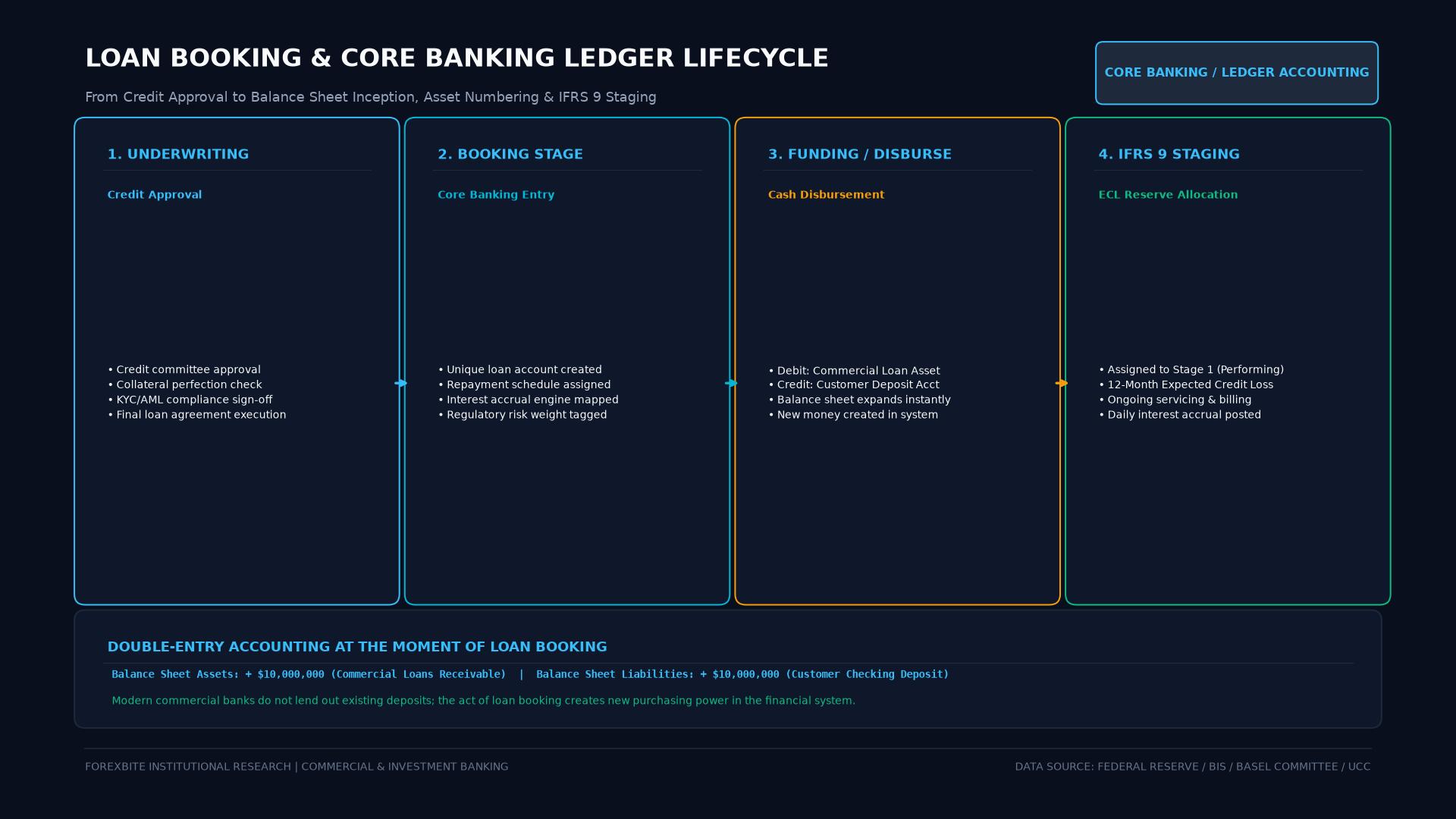 Figure: Banking operational trade pipeline: front-office execution, middle-office validation, general ledger T-account booking, and regulatory settlement.
Strategic Drivers of Global Booking Hubs
Multinational financial conglomerates (such as Goldman Sachs, JPMorgan Chase, HSBC, and Barclays) operate sophisticated global booking models to optimize multiple operational dimensions:
1. Regulatory Capital and Balance Sheet Optimization
Under international Basel III capital accords, banks must hold regulatory capital reserves against Risk-Weighted Assets (RWA). By booking trades in jurisdictions that permit comprehensive bilateral master netting agreements (under ISDA documentation), institutions dramatically lower their net counterparty credit risk, reducing the mandatory capital reserves they must lock away.
2. Post-Brexit Licensing and Market Access
Following the UK’s departure from the European Union, London-based dealing desks lost “passporting rights” to directly service EU clients. In response, global investment banks established major booking hubs in Paris, Frankfurt, Dublin, and Amsterdam. London traders can physically structure the deal, but the trade is formally booked into the EU subsidiary to maintain full European regulatory compliance.
3. Corporate Tax Efficiency and Transfer Pricing
Multinational institutions establish booking entities in favorable corporate tax jurisdictions (such as Ireland, Luxembourg, or Singapore). The trading desks that generate the revenue charge internal intercompany fees (transfer pricing) to the booking hub under OECD guidelines, optimizing the group’s global effective tax rate.
Operational Lifecycle: How a Trade is Booked
The path from verbal or electronic execution to finalized balance sheet booking follows a structured protocol:
- Trade Execution: A voice broker in London agrees to sell €50,000,000 to a Swiss private bank at 1.0850.
- Trade Capture & Tagging: The front-office trade capture system stamps the transaction with standard metadata, including the executing desk ID, trader ID, time stamp, and the designated legal booking entity (LEI - Legal Entity Identifier).
- Trade Affirmation & Confirmation: Electronic confirmation platforms (such as DTCC, MarkitWire, or SWIFT) match the trade parameters bilaterally between both counterparty institutions.
- Internal Mirror (Back-to-Back) Booking:
If the trading desk operates under a different legal entity than the booking hub, an automated internal back-to-back mirror trade is generated:
- The London entity passes the market risk directly to the Frankfurt booking entity.
- The Frankfurt balance sheet assumes the external credit and market risk, while the London desk receives an internal commission allocation.
Comparative Matrix: Key Institutional Transaction Locations
| Transaction Dimension | Definition | Typical Example | Regulatory Impact |
|---|---|---|---|
| Execution Location | Where the trade order was physically entered or matched | London trading desk or NY4 Equinix Data Center | Governed by local exchange/conduct rules (FCA / CFTC) |
| Booking Location | The legal entity balance sheet holding the asset/liability | Dublin, Frankfurt, or Delaware corporate subsidiary | Dictates capital adequacy, insolvency law, and taxes |
| Clearing Location | The clearinghouse guaranteeing counterparty settlement | LCH (London) or CME Clearing (Chicago) | Governed by central counterparty margin rules |
| Custody Location | The custodian bank holding physical or book-entry securities | Euroclear (Brussels) or DTC (New York) | Governed by securities depository and segregation laws |
Regulatory Scrutiny and Compliance Challenges
Because cross-border booking can be used to obfuscate risk or artificially shift taxable income, regulatory bodies enforce strict governance:
- The “Empty Shell” Prohibition (Substance Requirements): Regulatory authorities (such as the European Central Bank and the U.S. Federal Reserve) strictly forbid banks from operating “brass-plate” booking entities that lack local executive management, compliance staff, and autonomous risk-monitoring systems.
- Resolution and Recovery Planning (Living Wills): Regulators require global systemically important banks (G-SIBs) to maintain transparent booking documentation. In the event of bankruptcy, liquidators must be able to trace which legal entity owns every booked derivative contract to prevent systemic contagion.
Key Takeaways
- “Booked” refers to the formal legal and accounting registration of a trade on a specific corporate balance sheet.
- In global investment banking, the booking entity often resides in a different country than the executing trader or electronic trading desk.
- Global booking hubs are selected to optimize regulatory capital requirements under Basel III, maintain regional market licensing (such as post-Brexit EU access), and manage corporate tax exposure.
- Automated internal back-to-back mirror trades allow dealing desks to centralize market risk into regional capital hubs.
- International regulators enforce strict substance requirements to ensure booking entities maintain genuine physical operations and independent risk controls.
Frequently Asked Questions
Can a retail forex trader choose where their account is booked?
Indirectly, yes. Major global retail brokerages operate multiple regulated subsidiaries (e.g., one regulated by the UK FCA, another by the Australian ASIC, and an offshore entity in Seychelles or Bahamas). When opening an account, the client signs terms of service with a specific entity, dictating where their funds and trades are legally booked and which regulatory protections apply.
What is the difference between “cleared” and “booked”?
“Booked” refers to the internal legal and accounting record of a trade on an institution’s balance sheet. “Cleared” refers to the external settlement process—typically managed by a central counterparty (CCP) or clearinghouse—where payments and collateral are legally netted and exchanged between buyers and sellers.
Why did Brexit force global banks to change their booking models?
Prior to Brexit, international banks used London as a unified booking hub for all European transactions. When the UK lost EU passporting rights, banks were required by the European Central Bank to establish and capitalize authorized EU subsidiaries (e.g., in Frankfurt, Paris, or Dublin) to legally book transactions conducted with EU-domiciled clients.
What is an “internal mirror trade”?
An internal mirror trade is an automated, synthetic transaction executed between two subsidiaries of the same banking group. It transfers the market risk of a trade executed by a trader in one subsidiary to the balance sheet of the authorized legal booking entity in another subsidiary.
Ready to trade forex?
Open a free demo account with a regulated broker. Practice with virtual funds before risking real money.