Book
In institutional finance, a book is the comprehensive portfolio and ledger of open positions, pending orders, and financial instruments managed by a trader, desk, or institution. In electronic market microstructure, it also designates the Central Limit Order Book (CLOB) displaying resting bids and offers.
What is a Trading Book?
In global banking and capital markets, the term book carries two vital operational definitions:
- Portfolio / Inventory Ledger: The complete inventory of open positions, currency exposures, derivative contracts, and cash holdings managed by an individual trader, dealing desk, or financial institution. When a currency dealer says they are “running a book,” they are actively managing the risk, financing costs, and profit-and-loss (P&L) of that portfolio.
- Central Limit Order Book (CLOB): In electronic market microstructure, the “order book” refers to the continuous real-time ledger maintained by an exchange matching engine or ECN, displaying all resting limit orders organized by price tier and queue priority.
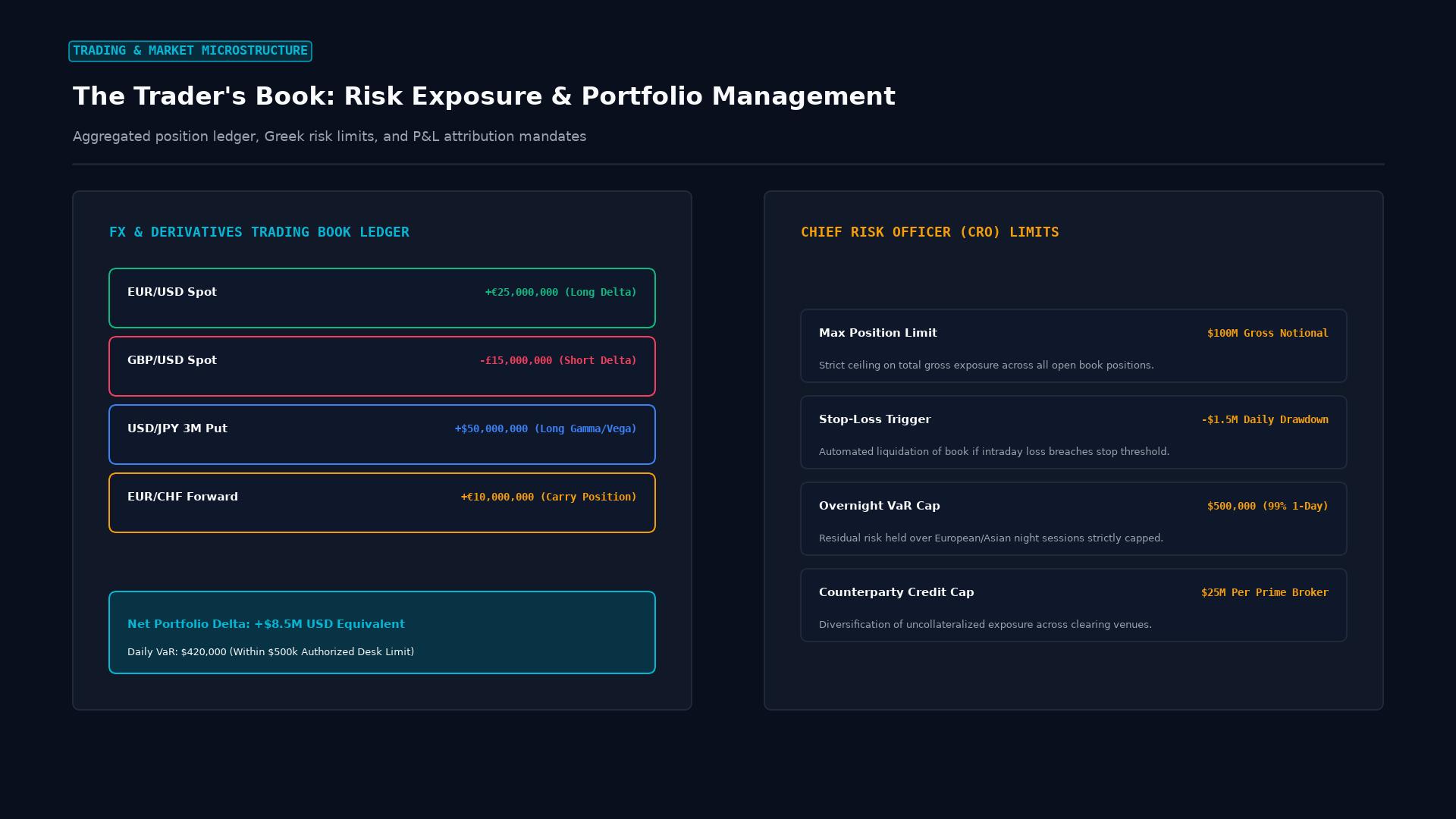 Figure: Institutional trading book architecture: aggregated multi-asset positions, net portfolio delta, daily VaR limits, and risk officer mandate controls.
Trading Book vs. Banking Book (Basel III Regulatory Framework)
Under international banking regulations established by the Basel Committee on Banking Supervision (Basel III / Fundamental Review of the Trading Book - FRTB), commercial and investment banks must strictly segregate their balance sheet assets into two distinct books:
1. The Trading Book
- Mandate: Holds assets and derivatives intended for short-term trading, market making, arbitrage, or direct client hedging.
- Accounting Standard: Governed by Mark-to-Market (MTM) accounting; assets are revalued daily to reflect current secondary market prices.
- Capital Treatment: Subject to stringent market risk capital requirements based on Expected Shortfall (ES) and Value at Risk (VaR) calculations.
2. The Banking Book
- Mandate: Holds core commercial banking assets intended to be held to maturity—such as consumer mortgages, long-term corporate loans, and customer deposit liabilities.
- Accounting Standard: Governed by accrual accounting (historical cost minus credit impairment allowances), insulating the bank’s income statement from daily price swings.
- Capital Treatment: Evaluated primarily on credit risk, counterparty default probabilities, and interest rate risk in the banking book (IRRBB).
Anatomical Components of an Institutional FX Trading Book
An institutional foreign exchange spot trader managing a major currency book continuously monitors a suite of live telemetry metrics:
- Net Open Position (NOP): The aggregate net directional exposure of the desk. For example, if a dealer is long €150 million and short €110 million against the U.S. Dollar, the book carries a net long NOP of +€40 million.
- Intraday and Realized P&L: Real-time tracking of cash gains locked in by completed trades versus fluctuating paper profits on active inventory.
- Value at Risk (VaR): The statistical estimate of maximum expected dollar loss over a 1-day horizon at a 99% confidence interval.
- Financing Swaps and Rollover: The overnight carry yield accrued or debited when holding currency balances across the 5:00 PM EST market rollover.
Step-by-Step Dealing Desk Case Study: Running a $100M EUR/USD Book
A senior spot market maker at a global Tier 1 investment bank manages the EUR/USD book during the volatile London morning session:
Initial Book State
- Allocated Risk Ceiling: Maximum NOP of $\pm $100,000,000$.
- Starting Position: Flat ($0 NOP).
Session Flow and Inventory Balancing
- Client Ticket 1 (Hedge Fund): Buys €40,000,000 from the dealer at the ask price of 1.08505.
- Dealer’s Book Impact: The dealer is now short €40,000,000 at 1.08505 (Net delta: -$43.4M USD).
- Client Ticket 2 (Corporate Importer): Buys €30,000,000 from the dealer at the ask price of 1.08515.
- Dealer’s Book Impact: The dealer’s short expands to -€70,000,000 at an average short price of 1.08509.
- Inventory Skew & Internal Hedging:
Because the dealer is nearing their risk ceiling and EUR/USD is exhibiting upward momentum, the trader skews their prices:
- The dealer raises their quoted bid to 1.08512 to attract aggressive selling from other market participants.
- Concurrently, the dealer routes a buy order for €30,000,000 into an electronic interbank ECN (EBS) at 1.08510 to flatten risk.
- Final Book Squaring: By midday, the dealer repurchases the entire short position at a weighted average price of 1.08495, returning the book to flat ($0 NOP) while capturing a 1.4 pip spread profit on €70 million ($98,000).
Comparative Matrix: Types of Books in Institutional Trading
| Book Classification | Managing Entity | Primary Operating Objective | Risk Horizon | Regulatory Classification |
|---|---|---|---|---|
| Market Maker Book | Sell-Side Investment Bank | Harvest bid-ask spread; maintain continuous two-way prices | Intraday to overnight | Trading Book (FRTB) |
| Proprietary Book | Hedge Fund / Prop Firm | Directional alpha generation, macro trend capture | Days to months | Trading Book / Private Capital |
| Flow Book | Commercial FX Desk | Facilitate corporate client currency conversions | Minutes to hours | Trading Book |
| Banking Book | Commercial Lending Desk | Collect long-term loan interest; manage deposit spreads | Years to decades | Banking Book (Accrual) |
| Central Limit Order Book | Exchange / Matching Engine | Transparent algorithmic order matching (FIFO) | Milliseconds | Exchange Telemetry |
Strategic Significance: “Squaring the Book”
At the end of a trading session or ahead of high-risk macroeconomic events (such as a U.S. Non-Farm Payrolls release or a Federal Reserve rate decision), desk heads frequently issue an order to “square the book”:
- Flattening Inventory: Traders aggressively close open positions or purchase offsetting index derivatives to bring net directional delta to zero.
- Protecting Capital: Squaring the book eliminates the risk of gap openings, overnight liquidity freezes, or catastrophic slippage, ensuring that the firm enters the next session with a clean balance sheet.
Key Takeaways
- In finance, a “book” represents either a trader’s portfolio of positions and risk exposures or an electronic central limit order book (CLOB).
- Under Basel III regulations, banks strictly separate mark-to-market Trading Books from accrual-based Banking Books.
- Foreign exchange market makers run books by continuously balancing long and short client flows while managing their Net Open Position (NOP).
- “Squaring the book” involves closing or hedging all directional exposure to eliminate overnight market risk.
- Order flow indicators and Level 2 depth tools allow market participants to analyze the resting limit order book to anticipate support and resistance liquidity.
Frequently Asked Questions
What does “running a flat book” mean?
“Running a flat book” means a trader or desk has zero net open market positions. All long positions are either closed out or perfectly offset by short hedges, leaving the portfolio with zero directional market risk.
What is the difference between a trader’s book and an order book?
A trader’s book is the internal portfolio of active investments, assets, and liabilities owned by that trader. An order book (Depth of Market) is the public electronic list of resting buy and sell limit orders waiting to be executed on an exchange.
What does “off-the-book” trading mean?
“Off-the-book” trading refers to over-the-counter (OTC) bilateral transactions negotiated privately between two institutions (such as voice-brokered block trades) rather than executed directly through a centralized public order book.
What is the “Fundamental Review of the Trading Book” (FRTB)?
FRTB is a comprehensive set of capital standards introduced by the Basel Committee designed to standardize market risk modeling, prevent regulatory arbitrage between trading and banking books, and ensure banks hold sufficient capital reserves against sudden market crashes.
Ready to trade forex?
Open a free demo account with a regulated broker. Practice with virtual funds before risking real money.