Foreign Exchange (Forex)
Foreign exchange (forex or FX) is the global market for trading currencies. It is the largest financial market in the world by daily volume — $7.5 trillion per day — operating 24 hours a day, five days a week across financial centers in London, New York, Tokyo, Sydney, and Hong Kong. Every international business transaction, cross-border investment, and tourism activity involves forex at some level.
The Market That Never Sleeps
Forex is not a place. There’s no building, no central exchange, no trading floor. It’s a decentralized, over-the-counter (OTC) network of banks, brokers, institutional investors, corporations, central banks, and retail traders, all connected electronically, continuously quoting prices and executing transactions across time zones.
When a Japanese manufacturer buys copper from Chile, they exchange yen for Chilean pesos — that’s forex. When a European fund manager buys US Treasury bonds, they first buy dollars — that’s forex. When a tourist at London Heathrow exchanges pounds for euros — that’s forex too, at the retail end of the same global market.
The retail traders who make up the community of this website represent a small but growing fraction of total forex volume. Most volume comes from institutions: banks trading on behalf of corporate clients, hedge funds speculating on currency movements, central banks managing reserves, and automated trading systems executing strategies at microsecond speed.
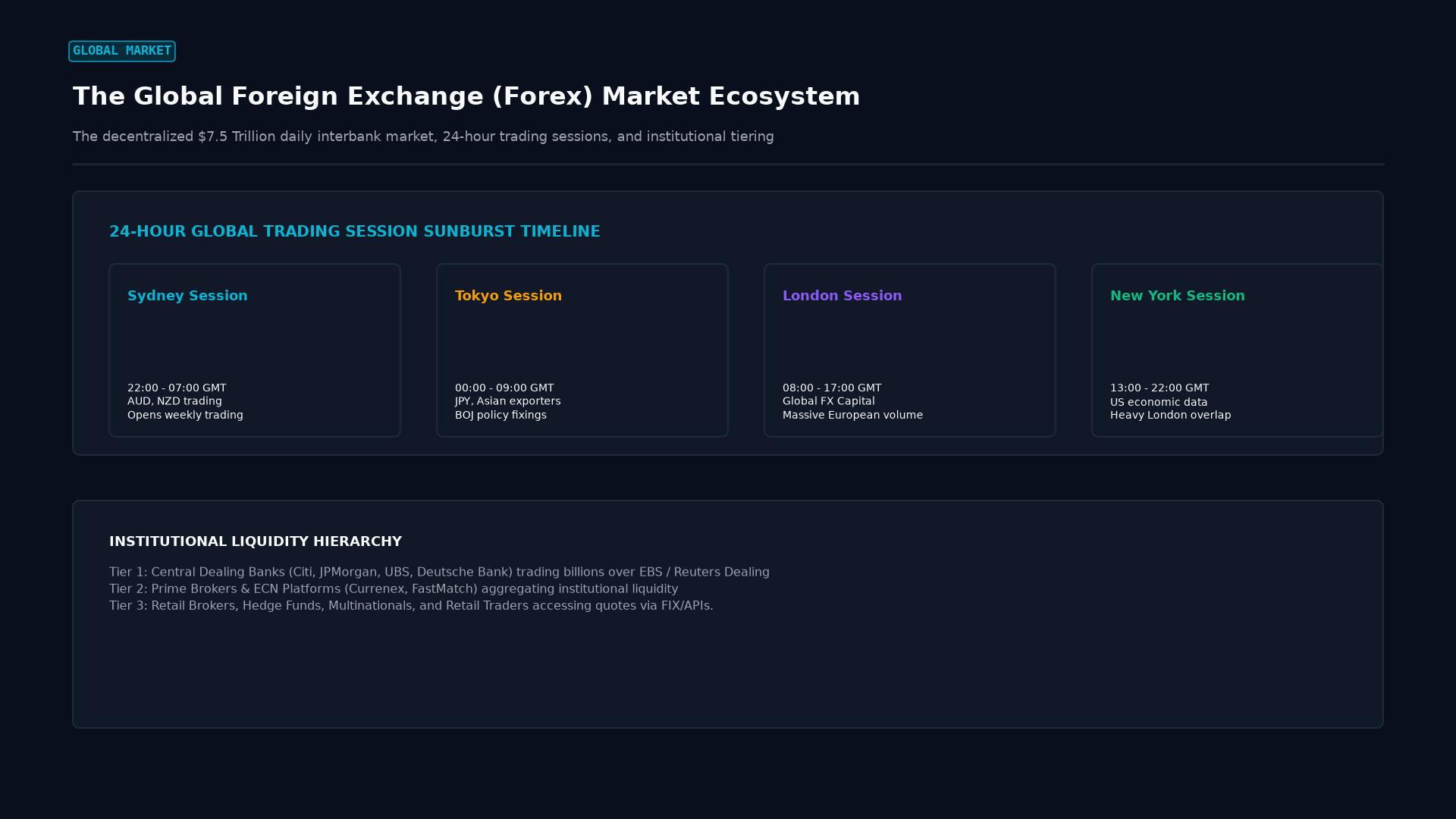 Figure: 24-hour global OTC network: continuous trading sunburst timeline from Sydney and Tokyo to London and New York, processing $7.5 Trillion daily.
How the Forex Market Is Structured
The forex market operates in tiers:
Tier 1: Interbank market The inner ring. The largest banks — JPMorgan Chase, Deutsche Bank, Citigroup, HSBC, UBS — trade directly with each other and with central banks. They quote prices in enormous size: $10 million, $50 million, or more in a single transaction. The interbank market establishes the “true” or reference rate for currency pairs.
Tier 2: ECN/STP brokers and prime brokers Connect institutional and larger retail participants to the interbank market. Electronic Communication Networks (ECNs) aggregate prices from multiple interbank liquidity providers and offer competitive, often near-interbank quotes to their clients.
Tier 3: Retail market makers The standard retail broker model. The broker takes the other side of trades (acting as market maker), managing its own risk through aggregation and interbank hedging. Most retail traders operate at this tier.
What Is Traded in Forex
Currency pairs — the simultaneous purchase of one currency and sale of another. The traded unit is a currency pair expressed as a rate: how many units of the second (quote) currency equal one unit of the first (base) currency.
The major currency pairs account for the majority of global volume:
- EUR/USD — ~28% of daily volume
- USD/JPY — ~13%
- GBP/USD — ~11%
- AUD/USD, USD/CAD, USD/CHF, NZD/USD — remaining majors
No dividends, no corporate reports, no earnings surprises in the traditional sense. Currency values are driven by macroeconomics: interest rates, inflation, growth, employment, central bank policy, and geopolitical events.
Why Retail Traders Access Forex
Three structural features make forex attractive for retail participation:
24-hour trading: Unlike stock exchanges with fixed opening hours, forex trades continuously from Sunday evening (Sydney open) to Friday evening (New York close). Traders in any time zone can find liquid sessions.
Leverage: Retail brokers offer leverage ranging from 30:1 (regulated EU/UK) to 500:1 (offshore). This allows retail traders to participate meaningfully with modest capital. It also amplifies risk proportionally.
Low transaction costs: Major pairs trade with spreads as low as 0.1 pip on competitive ECN accounts — a cost structure that’s difficult to match in stock or futures markets at retail scale.
The Forex Market’s Key Participants and Their Motivations
Understanding who else is in the market explains a great deal about why price moves the way it does:
Central banks: Manage reserves, implement monetary policy, and occasionally intervene directly to influence exchange rates.
Commercial banks: Execute corporate client transactions, manage proprietary FX positions, and provide market-making services.
Multinational corporations: Hedge currency exposure from cross-border operations. They’re price-takers, not price-makers.
Institutional investors (hedge funds, pension funds): Speculate on currency movements or hedge international investment portfolios.
Retail traders: The most price-sensitive participants with the least information advantage. Typically the last to act on news.
Key Takeaways
- Forex is a $7.5 trillion/day decentralized OTC market operating 24/5 globally
- The market operates in tiers: interbank → ECN/prime brokerage → retail market makers
- Only currency pairs are traded — always simultaneously buying one currency and selling another
- Major pairs (EUR/USD, USD/JPY, GBP/USD) account for over 50% of all trading volume
- Retail traders access the market through brokers who provide leverage, platforms, and execution
FAQ
Is forex trading the same as currency exchange at airports? Same underlying concept — exchanging one currency for another — but completely different mechanics and costs. Airport exchanges charge spreads of 3-5% or more and don’t use leverage. Retail forex trading involves spreads of 0.01-2% on major pairs, leverage, and sophisticated order types. The rates at airport kiosks bear no relationship to the competitive prices available through a forex broker.
Can retail traders genuinely compete in the forex market? Yes, but not by having better information than institutional participants. The retail advantage is flexibility: you can trade in very small sizes, hold no mandatory exposure, and trade at any hour. The institutional disadvantage is size — a hedge fund can’t buy $500 million of EUR/USD without moving the market; a retail trader can. Retail trading edge comes from disciplined execution of a specific strategy, not from information superiority.
Ready to trade forex?
Open a free demo account with a regulated broker. Practice with virtual funds before risking real money.