Broken Dates / Period
A non-standard maturity period in foreign exchange forward contracts and money market deposits that does not align with standard market tenors (such as one month, three months, or one year), requiring specialized pricing via linear or cubic spline interpolation of forward swap points.
What are Broken Dates in Forex Trading?
In the institutional foreign exchange and money markets, broken dates (commonly referred to as odd dates or a broken period) describe any settlement or maturity date that does not correspond to a standard, standardized market tenor.
In regular interbank forward trading, liquidity is concentrated in fixed, universally recognized maturities known as standard tenors:
- Short tenors: Overnight (O/N), Tomorrow-Next (T/N), Spot-Next (S/N).
- Weekly and monthly tenors: 1 Week (1W), 2 Weeks (2W), 1 Month (1M), 2 Months (2M), 3 Months (3M), 6 Months (6M), and 12 Months (1Y).
However, real-world international trade does not operate on rigid calendar months. A corporate exporter may receive a shipment payment in exactly 43 days, or an airline may need to settle a jet fuel contract on a specific Thursday in 78 days. A forward contract structured to mature on that exact non-standard date is a broken date transaction.
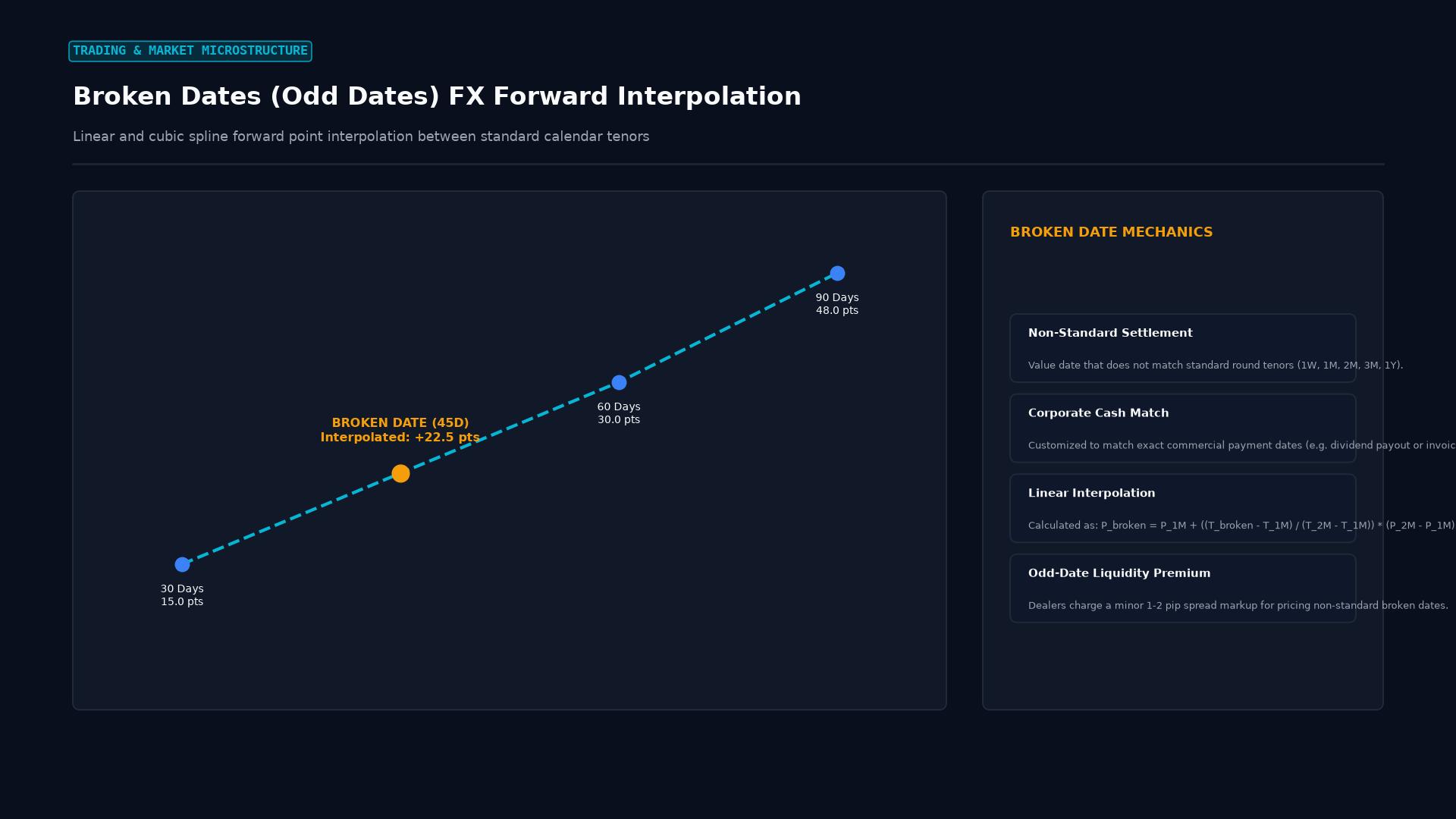 Figure: Pricing non-standard forward value dates: mathematical interpolation of forward points between standard calendar benchmark tenors to match corporate cash flows.
Mathematical Pricing: Linear Interpolation of Swap Points
Because interbank dealing screens (such as Bloomberg FXGO or Refinitiv Dealing) continuously stream forward swap points only for standard tenors, dealers calculate the forward points for a broken date using linear interpolation:
$$\text{Points}_{\text{broken}} = \text{Points}1 + \left( \frac{D{\text{broken}} - D_1}{D_2 - D_1} \right) \times (\text{Points}_2 - \text{Points}_1)$$
Where:
- $\text{Points}_1$ = Forward swap points for the nearest preceding standard tenor.
- $\text{Points}_2$ = Forward swap points for the nearest succeeding standard tenor.
- $D_{\text{broken}}$ = Total calendar days to the broken value date.
- $D_1, D_2$ = Total calendar days to standard tenors 1 and 2, respectively.
Step-by-Step Dealing Example: Pricing a 45-Day Broken Date on EUR/USD
A corporate client calls an FX desk requesting an outright forward quote to sell Euros for U.S. Dollars in exactly 45 days.
Prevailing Interbank Market Quotes
- Spot EUR/USD:
1.08500 / 1.08520 - 1-Month Standard Tenor (30 Days): $+20.0\text{ pips}$ ($+0.00200$)
- 2-Month Standard Tenor (60 Days): $+44.0\text{ pips}$ ($+0.00440$)
Step 1: Interpolate the Forward Swap Points
$$D_{\text{broken}} = 45\text{ days}, \quad D_1 = 30\text{ days}, \quad D_2 = 60\text{ days}$$
$$\text{Points}{45} = 20.0 + \left( \frac{45 - 30}{60 - 30} \right) \times (44.0 - 20.0)$$ $$\text{Points}{45} = 20.0 + \left( \frac{15}{30} \right) \times 24.0 = 20.0 + 12.0 = +32.0\text{ pips}$$
Step 2: Calculate the Outright Forward Rate
Applying the interpolated $+32.0$ pips ($+0.00320$) to the spot bid: $$\text{Forward Outright Bid} = 1.08500 + 0.00320 = 1.08820$$
The dealer quotes the corporate client a 45-day broken forward bid of 1.08820, allowing the corporate treasurer to lock in the exact cash flow matching their invoice.
When Linear Interpolation Fails: The “Event Twist”
While linear interpolation is effective under calm market conditions, it breaks down completely when a major monetary policy meeting falls between the two standard tenors:
- Suppose the 1-month tenor (Day 30) sits before an upcoming Federal Reserve FOMC interest rate decision, while the 2-month tenor (Day 60) sits after the decision.
- If the market prices an 85% probability of a 50 bps rate hike at that meeting, the forward curve does not follow a straight linear slope. Instead, it features a sharp, abrupt kink (a “step-function”) on the day of the central bank announcement.
- In such environments, quantitative dealers replace simple linear interpolation with interest rate curve bootstrapping or cubic spline modeling to account for the exact timing of expected rate shifts.
Comparative Matrix: Standard Tenors vs. Broken Dates
| Feature | Standard Interbank Tenor | Broken Date (Odd Date) | Spot Transaction | Forward Window Option |
|---|---|---|---|---|
| Maturity Alignment | Fixed market milestones (1M, 3M, 6M) | Custom calendar date (e.g., 41 days) | Standard $T+2$ Value Date | Flexible settlement window |
| Interbank Liquidity | Deep, tight spreads, streaming quotes | Bespoke pricing, manual or algorithmic | Deepest liquidity in global finance | Wider bid-ask dealer spreads |
| Pricing Method | Direct live market quoting | Interpolation between tenors | Pure supply and demand matching | Complex option volatility pricing |
| Primary User | Financial institutions, funds, banks | Corporate commercial hedgers | All financial market participants | Corporations with uncertain cash flows |
| Secondary Market Exit | Easy to offset or novate | Slightly wider spread to unwind | Closed instantly | Custom bilateral termination |
Strategic Significance for Corporate Treasurers
- Eliminating Cash Drag: Prior to widespread broken date trading, corporations were forced to buy standard 1-month or 2-month contracts and then use overnight or tom-next swaps to roll the settlement date forward day-by-day to match their real payment date. This generated continuous operational friction and transaction costs.
- Precision Balance Sheet Netting: Tailoring forward dates precisely to underlying invoice collection dates prevents unwanted overdraft charges or idle cash balances in foreign bank accounts.
Key Takeaways
- Broken dates (odd dates) are forward or money market maturities that do not conform to standardized tenors like 1 month, 3 months, or 1 year.
- They allow multinational corporations to align foreign exchange hedges precisely with commercial delivery and invoice payment dates.
- Dealers compute broken date forward swap points using linear interpolation between the two nearest standard tenors.
- When central bank meetings or policy rate changes fall between tenors, dealers must use non-linear yield curve bootstrapping to price the contract accurately.
- While slightly less liquid than standard tenors, electronic trading platforms now price broken dates automatically in milliseconds.
Frequently Asked Questions
Is there an extra fee or penalty for trading a broken date?
Dealers generally do not charge explicit fees for broken dates, but the bid-ask spread on the forward points may be slightly wider (e.g., a fraction of a pip) than on standard benchmark tenors to compensate the bank for managing odd-maturity liquidity.
What is an “immature broken date”?
An immature broken date refers to an odd-date forward whose maturity is shorter than the shortest standard monthly tenor (for example, a contract maturing in 11 days, falling between the 1-week and 2-week standard tenors).
Can a broken date forward contract be closed before maturity?
Yes. Just like a standard forward, an institution can close or unwind a broken date forward before expiration by executing an offsetting forward trade for the identical value date or by rolling the contract through an FX swap.
What is the difference between a broken date forward and a flexible forward option?
A broken date forward locks in an exact, binding settlement date (e.g., October 14th). A flexible forward option (or forward window) allows the client to draw down or settle foreign exchange at any point within an agreed time window (e.g., between October 1st and October 31st).
Ready to trade forex?
Open a free demo account with a regulated broker. Practice with virtual funds before risking real money.