CDBS
A specialized financial acronym referring to the Committee of Direction on Banking Statistics, established by the Reserve Bank of India to standardize regulatory reporting, credit registries, and monetary data architectures.
What Does CDBS Stand For in Finance?
In banking architecture and regulatory supervision, the acronym CDBS primarily stands for the Committee of Direction on Banking Statistics. Established by the Reserve Bank of India (RBI) in October 1972, this high-level statutory steering body was created to design, standardize, and oversee the institutional data-collection infrastructure governing commercial banks.
Following the nationalization of fourteen major commercial banks in India in 1969, central bank authorities recognized that traditional accounting reports were inadequate to monitor socioeconomic credit allocation. The CDBS designed the landmark Basic Statistical Returns (BSR) system, transforming crude bank ledger balances into granular, multidimensional economic datasets.
In modern financial operations, CDBS also occasionally serves as a secondary abbreviation for Comprehensive Database System or Commercial Debt Buyout Scheme, but its defining institutional identity remains anchored in regulatory banking statistics and supervisory data architecture.
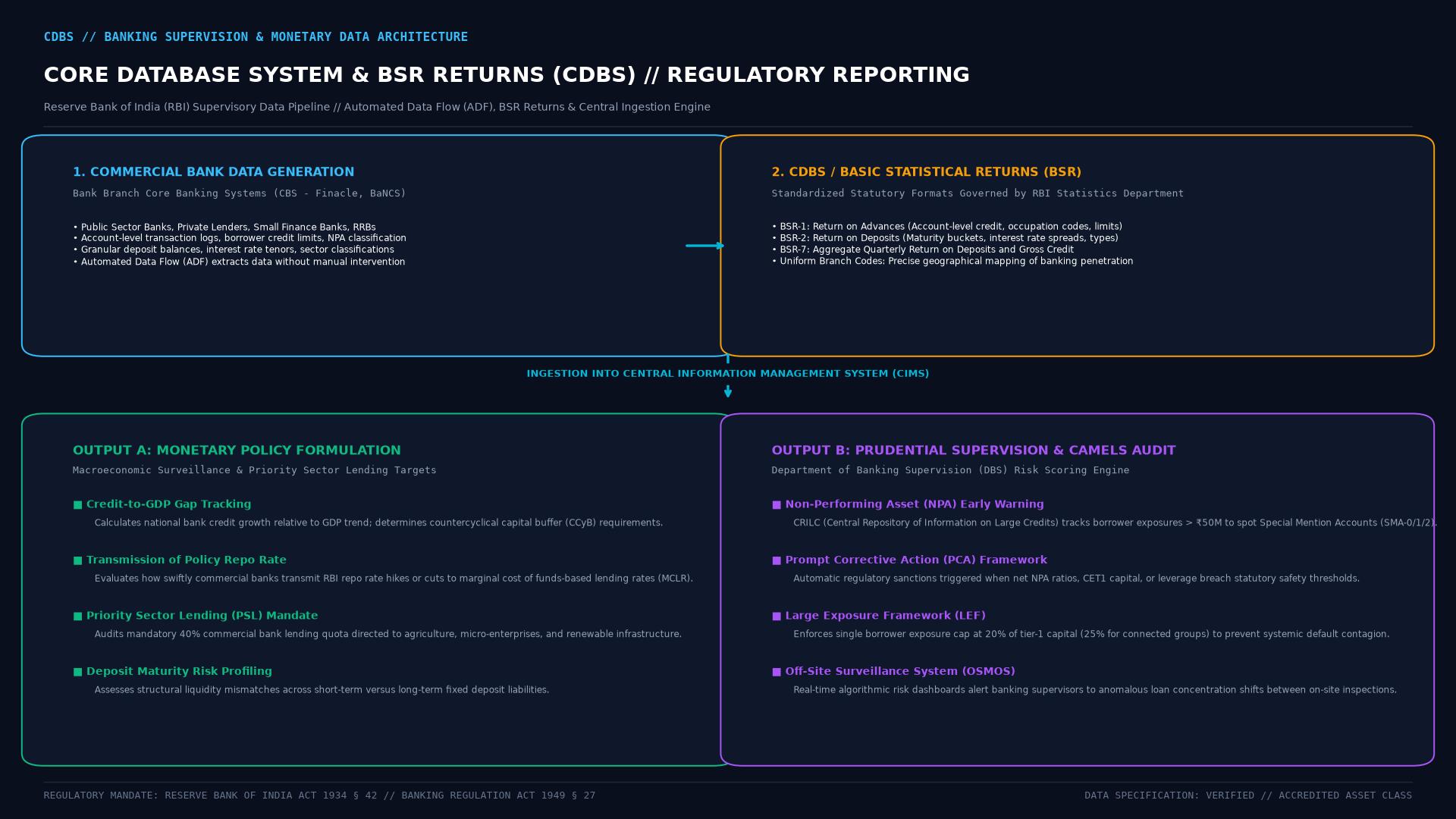 Figure: The Reserve Bank of India (RBI) supervisory data pipeline detailing Core Banking System (CBS) automated data extraction, Basic Statistical Returns (BSR-1/2), and central CIMS monetary surveillance.
Historical Origins: Post-Nationalization Banking Needs
The creation of the CDBS in 1972 addressed a profound structural disconnect between central bank policy and branch-level commercial activity. Before the late 1960s, commercial bank credit in developing economies was concentrated in large industrial conglomerates and urban mercantile houses. The agricultural sector, small-scale enterprises, and rural artisans received negligible formal credit.
When the state nationalized commercial lenders to democratize credit access, the RBI required an operational monitoring mechanism:
- Granular Loan Purpose Identification: Determining whether disbursed funds reached genuine agricultural producers or were siphoned into speculative commodity hoarding.
- Standardized Spatial Tracking: Creating uniform branch identification codes (Uniform Code Part I and Part II) to map credit penetration across underbanked administrative districts.
- Interest Rate Distribution Analysis: Evaluating loan books across distinct interest rate brackets to identify usurious practices and calculate effective borrowing costs across regions.
Under the guidance of the CDBS, the central bank retired cumbersome ad-hoc survey schedules and rolled out the unified BSR reporting architecture across the entire scheduled commercial banking network.
Mechanical Architecture of the Basic Statistical Returns (BSR)
The core operational contribution of the CDBS is the BSR reporting framework, structured around distinct periodic returns:
+------------------------------------+------------------------------------+
| Return Schedule                    | Institutional Data Specification   |
+------------------------------------+------------------------------------+
| BSR-1A: Large Credit Accounts      | Account-level return covering      |
|                                    | credit limits above designated     |
|                                    | thresholds. Captures borrower type,|
|                                    | activity code, interest rate, asset|
|                                    | classification, and district code. |
|                                    |                                    |
| BSR-1B: Small Credit Accounts      | Consolidated reporting for small   |
|                                    | borrower accounts, aggregated by   |
|                                    | occupation, social category, and   |
|                                    | priority sector classifications.   |
|                                    |                                    |
| BSR-2: Deposit Distribution        | Captures deposit liabilities by    |
|                                    | type (current, savings, term),     |
|                                    | interest rate brackets, residual   |
|                                    | maturity, and depositor profile.   |
+------------------------------------+------------------------------------+
The Spatial and Sectoral Allocation Code (NIC)
The CDBS integrated the National Industrial Classification (NIC) codes into the BSR architecture. Every commercial loan account is tagged with an exact occupational code. This design enables the central bank to determine:
$$\text{Sectoral Credit Exposure Ratio} = \frac{\sum \text{Credit to Sector } j}{\text{Total Gross Bank Credit}} \times 100$$
If aggregate credit flowing into commercial real estate rises unsustainably while credit to manufacturing stalls, monetary authorities can adjust regulatory risk weights on BSR-coded categories to enforce credit rationing.
Evolution into Modern Supervisory Platforms: From BSR to CIMS
With the advent of computerization, digital core banking systems (CBS), and real-time transaction clearing, manual reporting designed by the original CDBS transformed:
- Automated Data Flow (ADF): The RBI mandated direct, straight-through processing where regulatory returns are generated straight from a bank database without human manual intervention, preventing branch-level data tampering.
- Central Repository of Information on Large Credits (CRILC): While BSR captured annual and half-yearly trends, CRILC was established to monitor large exposures (aggregate fund-based and non-fund-based exposure of 50 million rupees and above) on a weekly and monthly cadence to detect early signs of non-performing loans (NPAs).
- Centralised Information Management System (CIMS): Launched to replace legacy data warehouses, CIMS functions as a high-performance big data repository that ingests structured BSR returns alongside unstructured financial filings, using advanced analytics to run macro stress tests.
Despite these technological evolutions, the foundational classification taxonomies, borrower status hierarchies, and geographical codifications engineered by the CDBS continue to serve as the structural backbone of regulatory banking datasets.
Economic and Policy Utility
The statistical models maintained under CDBS standards provide crucial inputs for multiple economic policy functions:
1. Priority Sector Lending (PSL) Enforcement
Regulatory guidelines mandate that commercial domestic banks allocate 40% of their Adjusted Net Bank Credit (ANBC) to designated priority sectors (agriculture, micro and small enterprises, affordable housing, education, export credit). BSR statistics verify whether lenders hit these mandatory targets or must face regulatory penalties, such as purchasing low-yielding Rural Infrastructure Development Fund (RIDF) deposits.
2. Monitoring the Credit-to-Deposit (CD) Ratio
CDBS filings capture branch-level deposit mobilization versus credit deployment across urban, semi-urban, and rural areas:
$$\text{Rural CD Ratio} = \frac{\text{Credit Disbursed in Rural Branches}}{\text{Deposits Mobilized in Rural Branches}} \times 100$$
This prevents metropolitan banks from acting as financial suction pumps, absorbing rural deposits to fund urban corporate conglomerates without recirculating liquidity back into rural agrarian economies.
Frequently Asked Questions
What is the difference between CDBS reporting and regular bank balance sheets?
A published commercial bank balance sheet provides an aggregated institutional snapshot under statutory accounting rules, displaying gross totals for loans, deposits, and capital. CDBS-designed returns (such as BSR-1 and BSR-2) capture micro-level, account-by-account parameters, including the borrower exact occupation, regional location, loan term, collateral classification, and nominal interest rate.
Does the CDBS framework apply to foreign commercial banks operating in India?
Yes. All scheduled commercial banks operating within the jurisdiction, including foreign bank branches, must submit standardized statistical returns formatted according to CDBS guidelines. Foreign banks must also comply with priority sector lending and sectoral credit reporting mandates.
How does the CDBS classification prevent non-performing loan concealment?
Under CDBS reporting guidelines, banks must record the precise asset classification status (Standard, Sub-standard, Doubtful, Loss) alongside borrower tax identifiers (PAN). When multiple banks submit data to the central repository, automated cross-validation flags instances where a corporate debtor has defaulted at Bank A but is being reported as performing at Bank B.
Ready to trade forex?
Open a free demo account with a regulated broker. Practice with virtual funds before risking real money.