Monetary Policy
Monetary policy refers to the decisions made by a central bank to control the supply of money and the level of interest rates in an economy. It is the primary tool for managing inflation, supporting employment, and stabilizing economic growth. For forex traders, monetary policy decisions are the most powerful driver of currency movements — anticipated changes in policy direction routinely cause 100-300 pip moves in major currency pairs.
What Monetary Policy Does
Every modern economy has a central bank with the authority and mandate to manage monetary conditions. The Federal Reserve, European Central Bank, Bank of England, Bank of Japan, and their peers use a toolkit of policy tools to influence the cost and availability of money — which in turn affects borrowing, spending, investment, inflation, and ultimately, the exchange rate.
Monetary policy doesn’t operate in isolation. It interacts with fiscal policy (government spending and taxation), but central banks in most countries are deliberately independent from political influence to prevent short-term electoral considerations from distorting long-run price stability goals.
Expansionary vs. Contractionary Monetary Policy
All monetary policy decisions can be categorized on one axis:
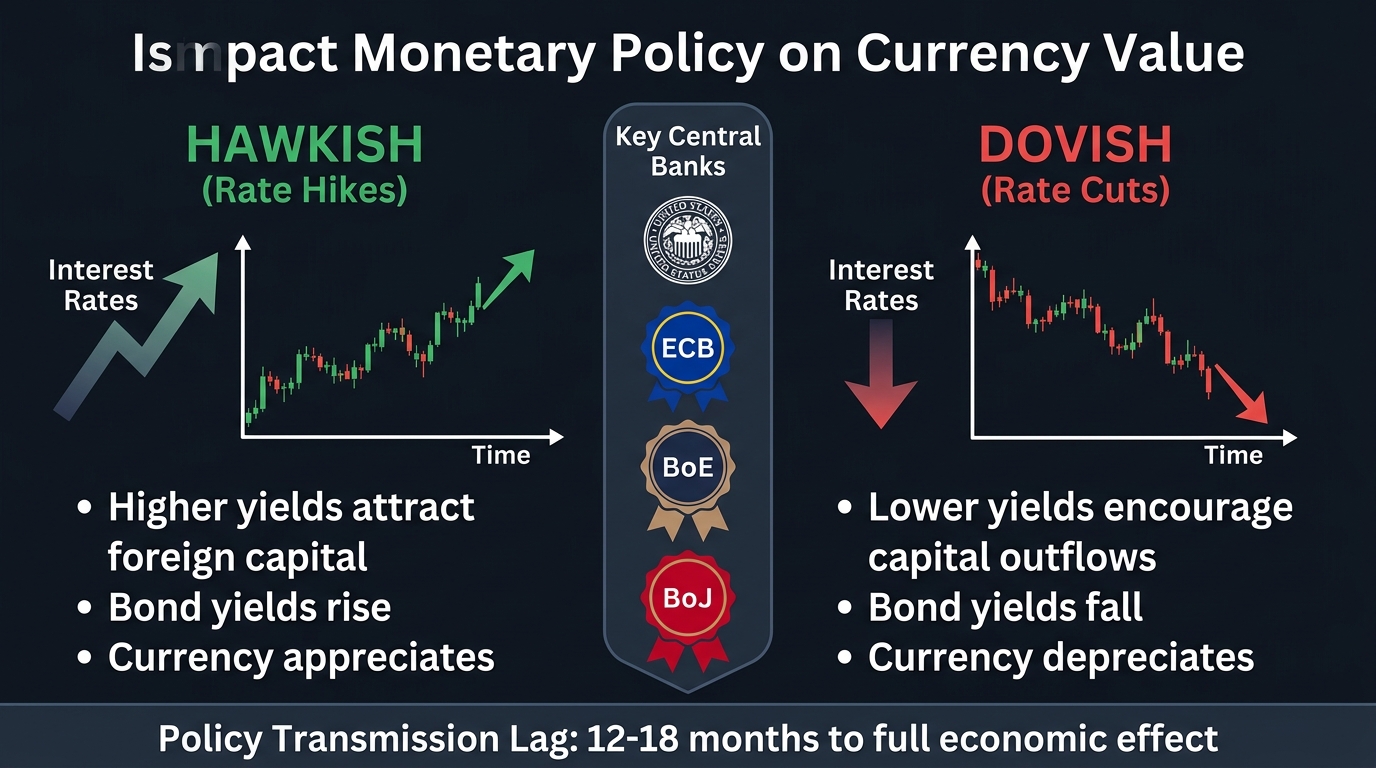
Expansionary (Dovish) monetary policy: The central bank lowers rates, increases money supply, or engages in quantitative easing to stimulate a sluggish economy. Borrowing becomes cheaper, businesses invest more, consumers spend more. The trade-off: inflation risk increases as more money chases the same amount of goods.
Forex impact: expansionary policy weakens the currency. Lower rates reduce the yield advantage of holding that currency’s assets, causing capital to flow elsewhere.
Contractionary (Hawkish) monetary policy: The central bank raises rates, reduces money supply, or engages in quantitative tightening to cool an overheating economy and bring inflation under control. Borrowing becomes more expensive, slowing demand.
Forex impact: contractionary policy strengthens the currency. Higher rates attract yield-seeking capital from abroad.
The Policy Toolkit
Interest rate adjustments: The primary tool. Central banks set a benchmark rate at which commercial banks can borrow from them. This rate propagates through the entire financial system — affecting mortgage rates, business loan rates, savings account yields, and bond yields.
Open market operations: The central bank buys or sells government securities in the open market to inject or drain liquidity. The daily mechanism through which the policy rate target is maintained.
Quantitative easing/tightening: When conventional rate tools are insufficient (rates at zero), asset purchases (QE) inject additional money directly. QT reverses this.
Reserve requirements: The minimum fraction of deposits that banks must hold in reserve. Rarely changed in modern practice but remains a theoretical tool.
Forward guidance: Communication about the future path of policy. In the modern era, central bank communication is itself a policy tool. A credible commitment to future rate hikes moves markets almost as effectively as the hike itself — managing expectations is half the battle.
The Policy Transmission Mechanism
Monetary policy changes don’t instantly affect prices and economic activity. They work through several transmission channels:
Interest rate channel: Higher rates increase the cost of borrowing, reducing business investment and consumer spending → lower demand → lower inflation.
Exchange rate channel: Higher rates attract capital inflows → currency appreciates → imports become cheaper → reduces inflationary pressure from imported goods.
Asset price channel: Higher rates reduce the present value of future cash flows → stock and property prices fall → negative wealth effect reduces consumer spending.
Credit channel: Higher rates tighten bank lending standards and increase loan default rates → credit availability shrinks → business investment contracts.
The full effect of a rate hike typically takes 12-18 months to fully flow through the economy. Central banks must therefore make decisions based on where they expect the economy to be in a year or more, not where it is today.
Monetary Policy and Currency Pair Dynamics
The most important concept for forex traders: relative monetary policy drives currency pairs, not absolute policy.
EUR/USD is not driven by ECB policy alone or Fed policy alone — it’s driven by the difference in their policy stances. When the Fed was hiking aggressively in 2022 while the ECB was behind the curve, the policy divergence drove EUR/USD from 1.1500 to parity. When both started cutting in 2024, the rate of divergence determined direction.
Monitoring both central banks in any given currency pair — their current rates, their forward guidance language, and how market pricing of future rates is evolving — is the essential foundation of fundamental forex analysis.
Key Takeaways
- Monetary policy controls money supply and interest rates to manage inflation, employment, and growth
- Expansionary policy (rate cuts, QE) weakens a currency; contractionary policy (rate hikes, QT) strengthens it
- Forward guidance — what central banks communicate about future policy — is as market-moving as actual decisions
- Policy transmission takes 12-18 months to fully affect the economy; central banks make forward-looking decisions
- Relative monetary policy between two countries drives currency pairs — not either country’s policy in isolation
FAQ
How do I follow monetary policy changes for trading? Track: (1) the economic calendar for scheduled central bank meetings and press conferences; (2) speeches and interviews by central bank officials between meetings; (3) market pricing of future rate changes in fed funds futures, OIS swaps, or equivalent instruments; and (4) major economic data releases that influence central bank decisions. Bloomberg and Reuters provide comprehensive coverage of all these inputs.
Can central banks control inflation perfectly? No. Central banks influence inflation through the transmission mechanisms above, but the relationship is imprecise and the lags are long. External shocks (supply chain disruptions, energy price spikes) create inflation that monetary policy can’t directly address — it can only manage demand-side response. The 2021-2023 inflation episode demonstrated the limits of central bank control when supply-side factors are the primary driver.
Ready to trade forex?
Open a free demo account with a regulated broker. Practice with virtual funds before risking real money.