Cleared Funds
Financial capital and bank deposits that have completed the entire interbank clearing, verification, and settlement cycle, making them irrevocably available to the account holder for immediate trading operations, margin collateral, or cash withdrawal.
What are Cleared Funds?
In banking, treasury operations, and brokerage accounting, cleared funds (often designated as settled funds or good funds) represent money that has fully traversed the interbank payment and clearing network, reaching definitive settlement finality.
When a client deposits money into a bank or brokerage account via a paper check, automated clearing house (ACH) transfer, or electronic wire, the funds do not become instantly irrevocable. Until the receiving financial institution physically receives and verifies the central bank reserve transfer from the sending bank, the deposit is merely “pending” or “provisional.”
Once the transaction is authenticated, matched, and permanently credited to the receiving bank’s account at the central bank, the funds transition into cleared funds. Only cleared funds provide unconditional, legally protected purchasing power that can be withdrawn or deployed as regulatory trading margin.
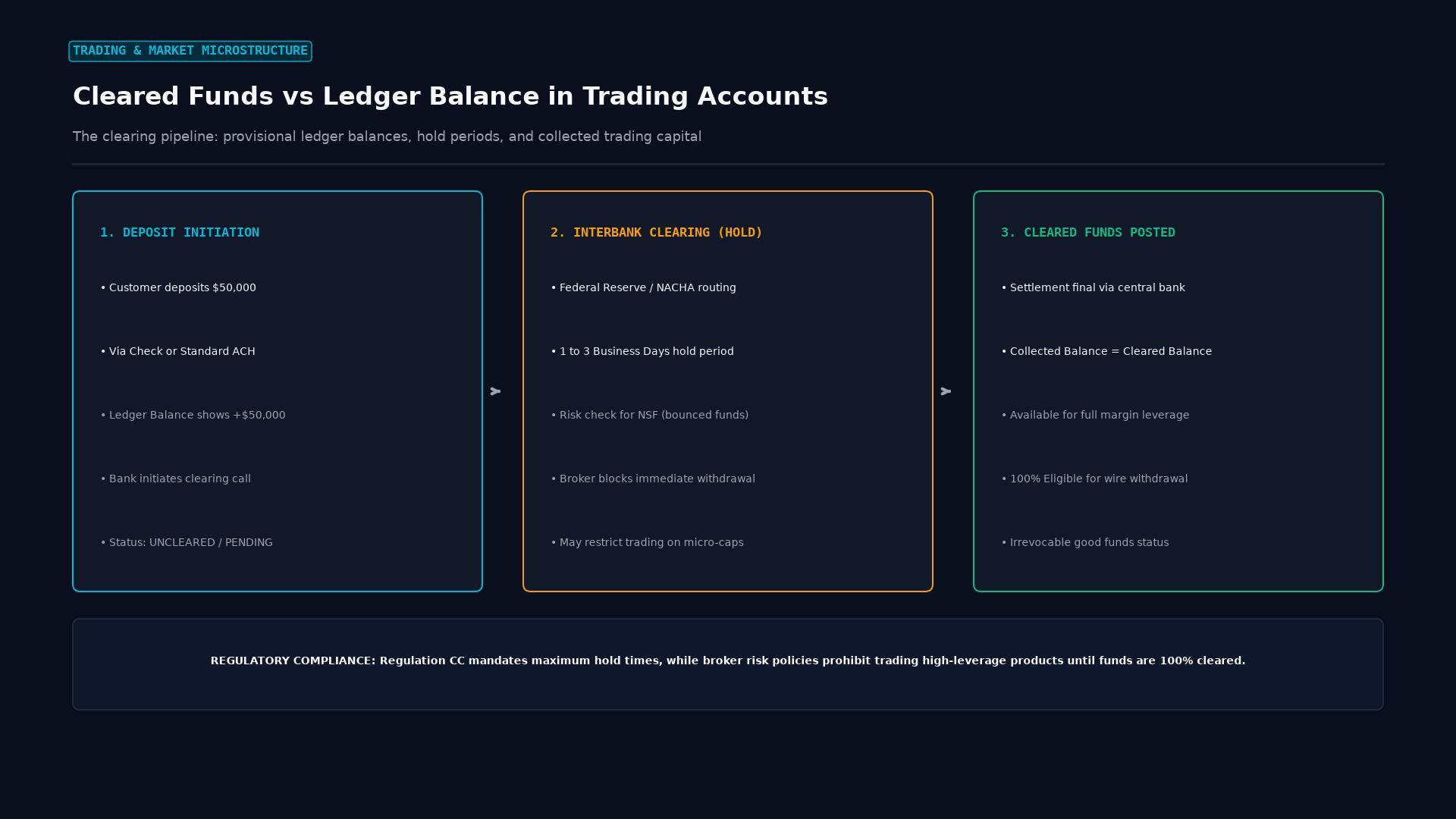 Figure: The depository clearing cycle: transitioning provisional ledger deposits through interbank hold periods into fully collected, withdrawable cleared trading funds.
The Critical Distinction: Ledger Balance vs. Available Cleared Funds
Retail investors and corporate accountants frequently confuse two standard ledger metrics displayed on banking and trading portals:
1. Ledger Balance (Book Balance)
The total gross figure recorded on the account statement, including all pending deposits, uncleared checks, and in-transit electronic transfers. If you deposit a $10,000 paper check, your ledger balance immediately reflects an increase of $10,000. However, you cannot legally spend or withdraw that money until the check clears.
2. Available Balance (Cleared Funds)
The exact dollar amount of liquid capital that has cleared all banking holding periods and is immediately accessible for transfer, withdrawal, or trading:
$$\text{Available Cleared Funds} = \text{Ledger Balance} - \text{Pending Deposits} - \text{Margin Collateral Holds}$$
If an account holder attempts to wire money exceeding their cleared funds balance, the transaction will be rejected or trigger punitive bank overdraft penalties.
Cleared Funds in Leveraged Foreign Exchange Trading
In institutional and retail forex trading, strict international regulations (enforced by the CFTC in the U.S., the FCA in the UK, and ESMA in Europe) govern cleared funds:
- Mandatory Initial Margin Verification: Brokers are legally prohibited from extending leverage against uncleared funds. An investor cannot open a 10-lot position on EUR/USD until their deposit has attained cleared status, protecting the broker from counterparty default if an uncollected wire is rejected.
- Mitigating Chargeback and Reversal Fraud: When traders deposit funds via credit cards or electronic debit mechanisms, brokers often implement a mandatory clearing holding period (e.g., 5 to 14 business days) before allowing trading profits to be withdrawn. This prevents fraudsters from depositing funds, executing high-risk gambles, and initiating credit card chargebacks if their trades lose.
- Anti-Money Laundering (AML) Settlement Rules: Regulated brokerages enforce the “Return to Origin” rule: withdrawals can only be wired to the exact bank account from which the original cleared funds arrived, verifying that the depositor and beneficiary are identical legal entities.
Settlement Windows Across Global Payment Rails
The time required for an initiated deposit to transform into cleared funds depends on the underlying payment architecture:
| Payment Rail | Geographic Reach | Typical Clearing Horizon | Irrevocability / Finality | Primary Commercial Use |
|---|---|---|---|---|
| Fedwire (United States) | Domestic U.S. | Instantaneous (Minutes) | Absolute Finality | Institutional block transfers, sovereign bonds |
| CHAPS (United Kingdom) | Domestic UK | Same-Day (Hours) | Absolute Finality | High-value commercial property & FX settlement |
| TARGET2 (Eurozone) | Pan-European | Real-Time (Minutes) | Absolute Finality | Interbank wholesale Euro liquidity |
| ACH (NACHA Network) | Domestic U.S. | 1 to 3 Business Days | Reversible for 60 Days | Payroll, consumer bills, retail deposits |
| SWIFT MT103 (Cross-Border) | Global Interbank | 1 to 3 Business Days | High (Once matched) | Cross-border commercial & broker funding |
| Paper Check | Domestic | 2 to 5 Business Days | High (Can bounce) | Traditional retail & legacy commercial trade |
Step-by-Step Scenario: The Hazard of Trading on Uncleared Capital
To understand why financial clearing safeguards exist, consider what occurs when clearing controls fail:
- A speculative trader deposits a $50,000 corporate check into an unregulated offshore broker.
- The broker prematurely credits the trader’s account with $50,000 in trading equity before the check clears.
- The trader opens maximum leverage on GBP/USD ahead of an interest rate decision.
- The market crashes against the trader; the position is stopped out, wiping out the $50,000 equity.
- Two days later, the originating bank returns the check stamped “Insufficient Funds” (NSF).
- The Result: The broker suffered a catastrophic $50,000 unhedged loss because they allowed trading against uncleared phantom capital.
Key Takeaways
- Cleared funds represent settled bank deposits that have reached definitive, irrevocable settlement finality.
- Unlike ledger balances (which show pending deposits), cleared funds reflect capital that carries zero credit or clawback risk.
- Regulated forex and derivatives brokers require cleared funds before activating purchasing power or extending margin leverage.
- Real-Time Gross Settlement (RTGS) networks like Fedwire, CHAPS, and TARGET2 provide immediate cleared funds finality.
- Strict AML regulations dictate that withdrawn profits must flow back to the originating cleared funds source.
Frequently Asked Questions
Why does my broker show my deposit in my balance, but I cannot withdraw it yet?
Your broker has provided you with “provisional ledger credit” so you can prepare your trading setup, but the underlying banking wire or credit card processing has not yet achieved definitive settlement finality. Until the clearing cycle completes, the funds are not yet cleared funds eligible for withdrawal.
Can cleared funds ever be recalled by the sending bank?
Under standard banking law (such as the Uniform Commercial Code in the U.S. and English banking common law), once a high-value wire transfer settles on an RTGS network like Fedwire or CHAPS, it is legally final and cannot be reversed or recalled without a formal court order or verified mutual fraud investigation.
What is the fastest method to deposit cleared funds into a trading account?
Domestic Real-Time Gross Settlement (RTGS) wire transfers (such as Fedwire in the U.S., CHAPS in the UK, or SEPA Instant in Europe) provide the fastest cleared funds, typically settling in under two hours with full legal finality.
What does “uncollected funds” mean?
“Uncollected funds” is the banking term for money deposited into an account that is currently working through the interbank clearing pipeline. The bank has not yet collected the cash from the payer’s financial institution, meaning the funds are not yet cleared.
Ready to trade forex?
Open a free demo account with a regulated broker. Practice with virtual funds before risking real money.