Cash on Deposit
The total liquid, settled monetary funds held within a bank account, brokerage ledger, or custodial depository that are immediately accessible for trade execution, margin collateral requirements, or cash withdrawal.
What is Cash on Deposit?
In banking, wealth management, and brokerage operations, cash on deposit refers to the total volume of settled, liquid currency held in a client’s account at a depository institution or regulated broker. Unlike illiquid assets (such as real estate or private equity) or fluctuating securities (such as stocks and open derivative contracts), cash on deposit represents cleared, finalized legal tender that carries zero market price volatility.
In foreign exchange and margin trading, cash on deposit serves as the foundational financial baseline for an investor’s trading account. It forms the permanent Account Balance, dictating the maximum purchasing power and margin leverage a broker will extend to the trader to open new currency positions.
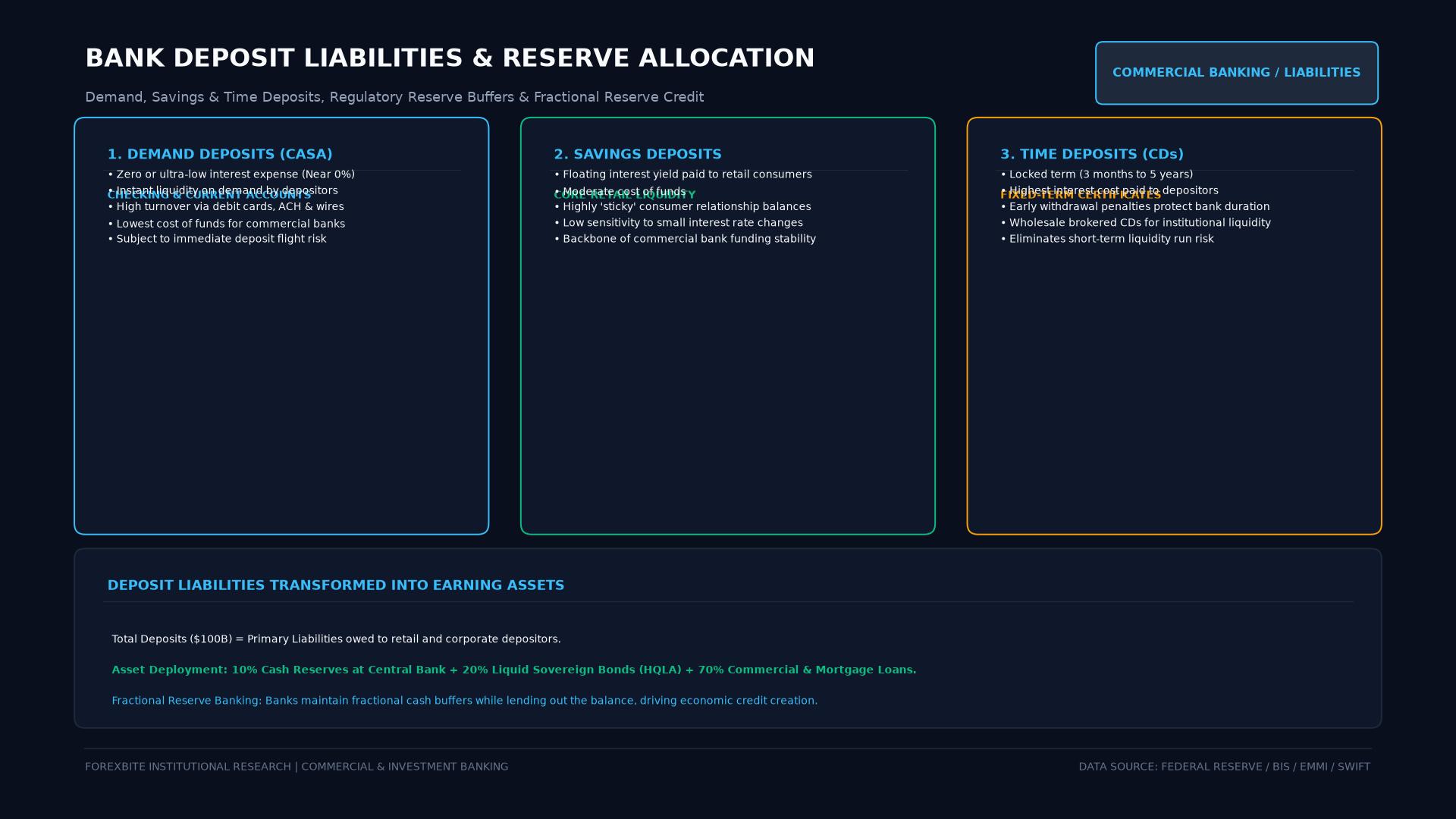 Figure: Bank accounting treatment: depositor asset vs commercial bank liability, statutory reserve netting (CRR/SLR), and High-Quality Liquid Asset (HQLA) classification.
Cash on Deposit vs. Balance, Equity, and Margin
To manage risk effectively, traders and risk managers must distinguish between four closely related account ledger metrics:
1. Cash on Deposit (Account Balance)
The exact amount of settled cash in the account. This figure changes only when:
- New funds are deposited or withdrawn.
- An open trade is closed, realizing a permanent profit or loss.
- Rollover financing swaps or broker commissions are debited or credited. It remains completely static while positions are open, regardless of market volatility.
2. Account Equity
The real-time liquidation value of the trading account if all open positions were instantaneously closed at prevailing bid/ask prices:
$$\text{Account Equity} = \text{Cash on Deposit (Balance)} \pm \text{Unrealized P&L}$$
3. Used Margin
The portion of cash on deposit set aside and frozen by the broker as a security collateral bond to support active leveraged positions.
4. Free Margin
The remaining unencumbered capital available either to open additional positions or to withdraw back to a commercial bank account:
$$\text{Free Margin} = \text{Account Equity} - \text{Used Margin}$$
Step-by-Step Ledger Walkthrough: Cash Dynamics in Live Trading
Consider a currency trader depositing capital and executing trades on a leveraged trading platform:
| Event Timeline | Action Taken | Cash on Deposit (Balance) | Used Margin (Collateral) | Floating P&L | Account Equity | Free Margin (Accessible) |
|---|---|---|---|---|---|---|
| Day 1: Initial Deposit | Wires $10,000 cash | $10,000.00 | $0.00 | $0.00 | $10,000.00 | $10,000.00 |
| Day 2: Trade Entry | Buys 2 Lots EUR/USD (1:100 leverage) | $10,000.00 | $2,000.00 | $0.00 | $10,000.00 | $8,000.00 |
| Day 3: Market Rallies | EUR/USD gains +50 pips | $10,000.00 | $2,000.00 | +$1,000.00 | $11,000.00 | $9,000.00 |
| Day 4: Position Closed | Trader hits “Close” at +50 pips | $11,000.00 | $0.00 (Released) | $0.00 | $11,000.00 | $11,000.00 |
| Day 5: Cash Withdrawal | Wires $3,000 to personal bank | $8,000.00 | $0.00 | $0.00 | $8,000.00 | $8,000.00 |
Notice that on Day 3, despite the trade showing a $1,000 profit, the Cash on Deposit remained exactly $10,000. The profit became cash on deposit only on Day 4 when the trade was officially closed and settled.
Institutional Custody: Segregated Accounts and Safety of Funds
When an investor places cash on deposit with a regulated financial broker, the legal architecture governing those funds dictates counterparty safety:
1. Segregated Client Accounts (Statutory Protection)
Under strict regulatory regimes (such as the UK Financial Conduct Authority - FCA, the Australian ASIC, and the European CySEC), brokers are legally mandated to hold client cash on deposit in segregated trust accounts at Tier 1 commercial banks, completely isolated from the broker’s own corporate operating funds. If the brokerage firm becomes insolvent, creditors cannot seize client deposits.
2. Commingled / Unsegregated Accounts (Offshore Hazards)
Unregulated or lightly regulated offshore brokers often commingle client deposits with their internal operational capital, using client cash to fund company marketing, payroll, or proprietary trading. In an insolvency event, clients become unsecured creditors and risk losing 100% of their cash on deposit.
3. Government Deposit Insurance Backstops
In major banking jurisdictions, cash deposits enjoy statutory government insurance schemes:
- United States: FDIC insurance protects bank deposits up to $250,000 per depositor.
- United Kingdom: The Financial Services Compensation Scheme (FSCS) protects eligible deposits up to £85,000.
- European Union: National deposit guarantee schemes protect up to €100,000.
Comparative Matrix: Account Capital Metrics
| Financial Metric | What It Measures | Volatility Exposure | Withdrawal Eligibility | Primary Function |
|---|---|---|---|---|
| Cash on Deposit | Settled, cleared cash balance | Zero (Static cash) | 100% (Subject to free margin) | Base account purchasing power |
| Account Equity | Real-time liquidation value | High (Ticks continuously) | Limited by used margin | Solvency and margin call monitoring |
| Used Margin | Collateral frozen by broker | Fixed per lot size | Ineligible (Locked as bond) | Underwriting leveraged positions |
| Floating P&L | Paper profit or loss on open trades | High (Market-dependent) | Ineligible until trade closed | Intraday performance tracking |
Key Takeaways
- Cash on deposit represents the settled, liquid funds held in a bank or brokerage account.
- In trading accounts, cash on deposit constitutes the Account Balance, changing only when trades close, fees are debited, or deposits/withdrawals settle.
- Account Equity reflects cash on deposit plus or minus real-time unrealized profits and losses on open positions.
- Tier 1 regulatory frameworks mandate that brokerages hold client cash on deposit in segregated bank accounts to protect against broker insolvency.
- Unencumbered cash on deposit (Free Margin) is immediately accessible for opening new positions or wiring back to a commercial bank.
Frequently Asked Questions
Can my cash on deposit become negative?
In modern retail trading under regulated jurisdictions (such as the UK, EU, and Australia), brokers enforce mandatory Negative Balance Protection. If a flash crash causes a trade to close below zero equity, the broker must absorb the loss and reset the client’s cash on deposit back to zero. In unregulated offshore markets or institutional prime brokerage agreements, clients can be legally pursued to repay negative balances.
Do brokers pay interest on cash on deposit?
Yes. Many regulated brokers offer institutional cash yield sweep accounts, paying annualized interest (often linked to central bank policy rates like SOFR or Euribor) on uninvested, idle cash on deposit held in the account.
How long does it take for a bank wire to reflect as cash on deposit?
International SWIFT wire transfers typically take 1 to 3 business days to clear interbank compliance checks and reflect as settled cash on deposit. Domestic electronic transfers (such as Fedwire, SEPA, or CHAPS) usually settle within minutes to a few hours.
What is the difference between “cleared funds” and “cash on deposit”?
“Cleared funds” refers to money that has completed all interbank settlement checks and has permanently arrived at the depository. Once funds are officially cleared, they are classified as active “cash on deposit” available for trading and withdrawal.
Ready to trade forex?
Open a free demo account with a regulated broker. Practice with virtual funds before risking real money.