Clearing House Automated Payment System (CHAPS)
The United Kingdom's high-value, same-day electronic wholesale payment network operated by the Bank of England, functioning as a Real-Time Gross Settlement (RTGS) system for interbank liquidity, foreign exchange settlement, and large commercial transactions.
What is CHAPS?
The Clearing House Automated Payment System (CHAPS) is the United Kingdom’s premier high-value, electronic payment network. Owned and operated directly by the Bank of England, CHAPS serves as the financial circulatory system for the British Pound (Sterling), processing hundreds of billions of pounds daily with guaranteed, same-day settlement finality.
Established in 1984 by the major UK clearing banks and integrated into the Bank of England’s Real-Time Gross Settlement infrastructure in 1996, CHAPS is engineered specifically for transactions where speed, certainty, and settlement finality are critical. While it accounts for less than 1% of total UK payment volumes by transaction count, it settles roughly 90% of all UK payments by total monetary value.
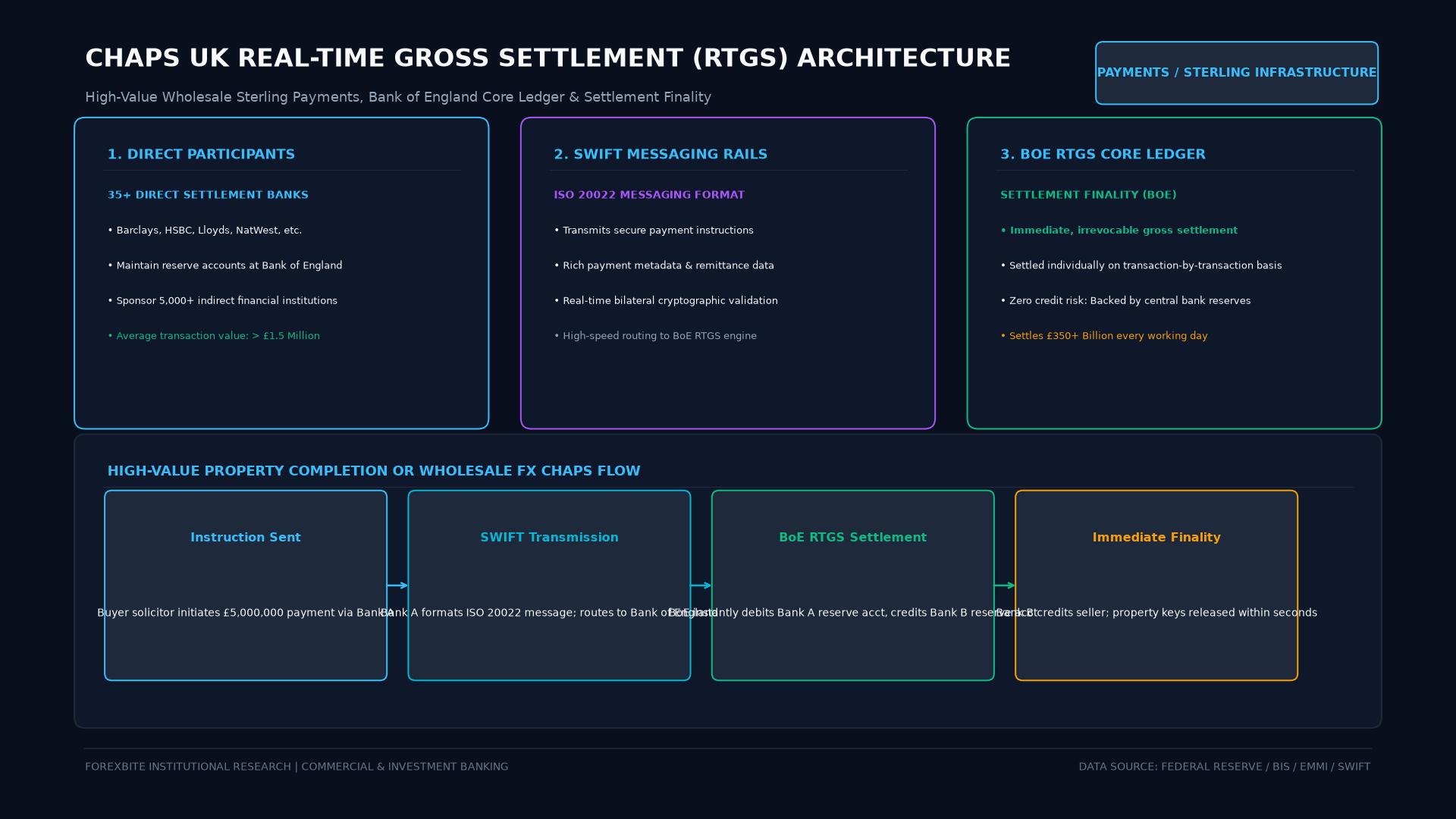 Figure: Bank of England Real-Time Gross Settlement (RTGS) architecture: settlement bank reserve transfers, messaging, and finality for wholesale UK transactions.
The Real-Time Gross Settlement (RTGS) Mechanism
CHAPS operates under the gold standard of sovereign payment architecture: Real-Time Gross Settlement (RTGS):
- Real-Time Processing: Transactions are not held in a batch to be processed at the end of the day. Each payment is queued, authenticated, and settled individually on a continuous, rolling basis throughout the operating day (from 6:00 AM to 6:00 PM UK time).
- Gross Settlement: Every single transfer is settled on a gross, one-to-one basis. If Bank A owes Bank B £100 million and Bank B owes Bank A £80 million, CHAPS does not net the difference; both full gross sums are settled independently across central bank reserves.
- Immediate Legal Finality: The moment the Bank of England debits the sending bank’s reserve ledger and credits the receiving bank, the payment is legally complete, irrevocable, and immune to insolvency clawback.
Primary Institutional Use Cases for CHAPS
CHAPS is the mandatory settlement conduit for high-stakes capital flows:
- Wholesale Foreign Exchange (The Sterling Leg): When multi-billion pound foreign exchange spot, forward, and swap transactions are executed in London—the foreign exchange capital of the world—the Sterling leg of the transaction is settled via CHAPS into Continuous Linked Settlement (CLS) accounts.
- Interbank Money Market Liquidity: Commercial banks use CHAPS to execute overnight unsecured lending, repo operations, and central bank reserve adjustments to manage daily liquidity ratios under Basel III.
- Corporate Treasury Sweeping & M&A: Multinational corporations use CHAPS to execute multi-million pound cross-border treasury sweeps, dividend disbursements, and corporate merger and acquisition settlements.
- Commercial Real Estate Conveyancing: In the UK property market, legal conveyancers rely exclusively on CHAPS on completion day to wire house purchase funds, ensuring the seller receives guaranteed cleared funds before handing over the property keys.
The UK Payment Landscape: CHAPS vs. Bacs vs. Faster Payments
The United Kingdom operates three distinct electronic payment rails, each tailored to specific economic requirements:
| Payment Rail | Primary Function | Typical Transfer Value | Settlement Speed | Cost per Transaction |
|---|---|---|---|---|
| CHAPS | High-value, wholesale, corporate & FX | Unlimited (Average $> £2\text{ million}$) | Same-day (Minutes) | High (£15 to £30 bank fee) |
| Faster Payments | Retail, consumer, and small business | Capped (Up to £1,000,000) | Instantaneous (Seconds, 24/7) | Free or minimal |
| Bacs Payment | Routine bulk payroll and direct debits | Standard retail/commercial | Three Business Days | Fractions of a penny |
Direct Participants vs. Indirect Participants
Access to the CHAPS core network is stratified by creditworthiness and systemic importance:
- Direct Participants (Settlement Banks): Elite financial institutions (including Barclays, HSBC, Lloyds, NatWest, Santander UK, and major international investment banks) maintain direct settlement accounts with the Bank of England and connect directly to the CHAPS core.
- Indirect Participants: Smaller commercial banks, building societies, foreign brokerages, and fintechs access the CHAPS system by routing their payments through a sponsoring Direct Participant bank.
Modernization: The Transition to ISO 20022
In June 2023, the Bank of England executed a historic technical overhaul of CHAPS by migrating to the ISO 20022 messaging standard.
Under ISO 20022, CHAPS payment instructions contain exponentially richer, structured financial data—including explicit Legal Entity Identifiers (LEIs), end-to-end transaction tracking codes, and detailed commercial remittance metadata. This upgrade eliminates friction in cross-border anti-money laundering (AML) screening, reduces payment rejections, and harmonizes UK wholesale settlement with European (TARGET2) and American (Fedwire) payment networks.
Key Takeaways
- CHAPS is the UK’s high-value, wholesale payment network operated directly by the Bank of England.
- It functions as a Real-Time Gross Settlement (RTGS) system, ensuring immediate legal finality and zero settlement risk.
- CHAPS settles the vast majority of UK financial payments by monetary value, including the Sterling leg of global foreign exchange transactions.
- Unlike retail Faster Payments, CHAPS has no maximum transaction ceiling and is designed for multi-million pound corporate, property, and interbank transfers.
- The adoption of the ISO 20022 standard aligns CHAPS with international high-value payment rails.
Frequently Asked Questions
Can an individual retail banking customer send a CHAPS payment?
Yes. Retail bank customers frequently utilize CHAPS when transferring large sums that exceed daily Faster Payments limits—such as buying a home, purchasing an expensive vehicle, or transferring large investment balances between brokerages.
What is the operating window for CHAPS?
CHAPS operates on all UK business days. The system opens for participant banks at 6:00 AM UK time and closes at 6:00 PM UK time for customer payments (extending to 6:20 PM for interbank transfers). Payments submitted after the afternoon cut-off are queued for processing the following business morning.
What happens if a sending bank fails while a CHAPS payment is in flight?
Because CHAPS settles in real-time across central bank reserves on a gross basis, once the Bank of England ledger updates, the transfer is final. If the sending bank collapses a millisecond later, the receiving bank and beneficiary legally keep the cleared funds.
What is the equivalent of CHAPS in the United States and Europe?
In the United States, the sovereign equivalent of CHAPS is Fedwire, operated by the Federal Reserve. In the Eurozone, the equivalent system is T2 (formerly TARGET2), operated by the Eurosystem.
Ready to trade forex?
Open a free demo account with a regulated broker. Practice with virtual funds before risking real money.