Spot Transaction
A foreign exchange agreement between two counterparties to buy one currency against another at an agreed rate for prompt settlement, which internationally standardizes on two business days after trade execution (T+2), or next business day (T+1) for specific currency pairs.
What is a Spot Transaction?
A spot transaction is the most common and foundational trade type in the global foreign exchange market, representing the direct exchange of one national currency for another at the current prevailing market rate.
While the word “spot” implies instantaneous on-the-spot execution, it is an international financial misnomer to assume physical cash changes hands immediately. In institutional foreign exchange practice, a spot transaction is an agreement finalized on the Trade Date ($T$) whose formal payment and delivery takes place on the Spot Value Date ($T+2$)—exactly two business days later.
This standardized two-day settlement window provides global banks and corporate treasuries with the necessary operational window to execute automated anti-money laundering validations, process cross-border electronic funds transfers across non-overlapping international time zones, and net bilateral obligations.
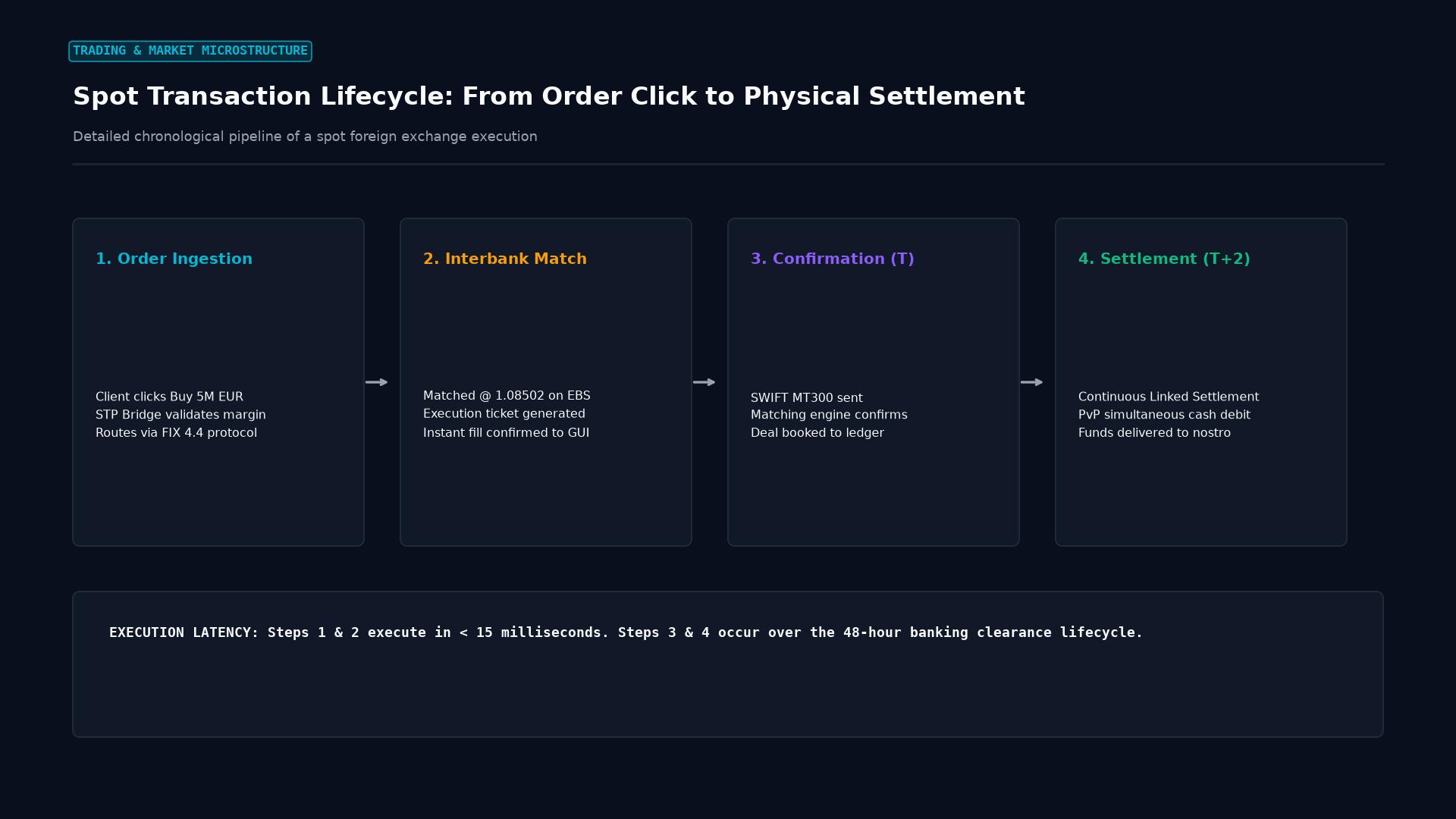 Figure: Chronological spot trade pipeline: sub-millisecond STP routing, interbank matching, SWIFT confirmation, and CLS cash settlement.
Global Settlement Conventions: The T+2 vs. T+1 Rule
The universal international convention for spot foreign exchange settlement is $T+2$. However, distinct geographical and banking exceptions exist across global markets:
1. Standard Spot Pairs ($T+2$)
Applies to the overwhelming majority of global foreign exchange transactions, including all major currency pairs involving non-adjacent trading zones:
- EUR/USD, GBP/USD, USD/JPY, AUD/USD, NZD/USD, USD/CHF.
- If a spot trade is executed on Monday, it settles on Wednesday. If executed on Thursday, it settles on the following Monday (excluding bank holidays).
2. North American & Selected Emerging Pairs ($T+1$)
Settles on the next business day ($T+1$) due to shared time zones, integrated banking clearing infrastructure, or local central bank rules:
- USD/CAD (United States and Canadian banking hours are identical).
- USD/MXN (Mexican Peso).
- USD/TRY (Turkish Lira).
- USD/PHP (Philippine Peso).
3. Non-Spot Same-Day Conventions
If a market participant requires immediate, same-day delivery, they must explicitly negotiate a non-standard value date:
- Value Today ($T+0$ / Cash Today): Settlement finalized before the local central bank wire cut-off on the same calendar day.
- Value Tomorrow ($T+1$ / Tom): Settlement executed on the immediate next business day.
Eliminating Herstatt Risk: The CLS Settlement Engine
Historically, spot transactions carried catastrophic systemic counterparty risk known as settlement risk or Herstatt risk (named after the collapse of German Bankhaus Herstatt in 1974, which accepted Deutsche Marks from international counterparties but collapsed before wiring U.S. Dollars due to time zone differences).
Today, spot transactions between major institutions are settled through Continuous Linked Settlement (CLS) Bank:
- Payment-versus-Payment (PvP): CLS ensures that neither currency leg of a spot transaction is paid out until the counterparty’s leg is verified and received simultaneously in a central escrow settlement system.
- If one party fails to deliver, the transaction is canceled, completely eliminating principal credit risk across 18 major global currencies.
Step-by-Step Lifecycle of an Institutional Spot Trade
- Price Request & Quotation: A corporate treasury queries its liquidity provider for a two-way spot price on GBP/USD. The bank quotes 1.27200 / 1.27208.
- Deal Execution: The corporate client accepts the offer, buying £5,000,000 at 1.27208 on Tuesday at 2:00 PM GMT.
- Trade Capture & Electronic Confirmation: The trade details are automatically transmitted via SWIFT MT300 electronic messaging, matching transaction size, rate, and counterparty settlement instructions.
- Multilateral Netting: CLS Bank nets the gross trade against the bank’s other daily transactions to minimize gross cash wire volume.
- Final Settlement: On Thursday ($T+2$), the corporation’s account is credited with £5,000,000 and debited for $6,360,400 USD.
Retail Spot Forex: The Rolling Spot Mechanism
Retail traders operating on platforms like MetaTrader or cTrader rarely take physical delivery of currency. Instead, retail brokers utilize a rolling spot contract:
- Positions that remain open at 5:00 PM EST are automatically rolled over into the next business day’s value date via an automated overnight swap transaction (Tom-Next swap).
- The trader either pays or receives an interest rate differential (rollover swap fee), allowing them to hold leveraged directional exposure indefinitely without ever wiring physical banknotes.
Comparative Matrix: Spot Transactions vs. Derivative Contracts
| Dimension | Spot Transaction | Forward Outright | Currency Futures | Currency Option |
|---|---|---|---|---|
| Settlement Date | Prompt ($T+2$ or $T+1$) | Fixed custom future date | Standardized quarterly date | Expiration or exercise date |
| Pricing Formula | Pure spot supply/demand | Spot $\pm$ Forward points | Spot $\pm$ Cost of carry | Black-Scholes volatility model |
| Capital Outlay | 100% of notional upon settlement | Zero upfront; settled at expiry | Initial performance margin bond | Upfront option premium paid |
| Contract Nature | Immediate ownership exchange | Binding future commitment | Exchange-traded standardized | Right without obligation |
| Primary Arena | Interbank OTC market | Interbank OTC / Corporate | Regulated exchange (CME) | OTC bank desk / Exchange |
Key Takeaways
- A spot transaction is a binding agreement to buy or sell a currency at the current market rate for prompt settlement.
- Standard foreign exchange spot trades settle on a $T+2$ convention (two business days after trade date), with USD/CAD settling on $T+1$.
- Settlement risk (Herstatt risk) is neutralized through the Payment-versus-Payment (PvP) clearing architecture of CLS Bank.
- In retail forex, brokers roll open spot positions forward daily at 5:00 PM EST via rollover swaps, avoiding physical delivery.
- Spot exchange rates serve as the baseline pricing reference for the entire multi-trillion dollar derivatives landscape.
Frequently Asked Questions
What happens if a public holiday falls within the T+2 settlement window?
If a bank holiday occurs in either of the two currency jurisdictions between the trade date and the scheduled value date, the settlement date is pushed forward to the next mutual business day where commercial banking systems in both countries are open.
Can an institutional investor settle a spot transaction on the same day?
Yes. Known as a “Value Today” or “Cash” transaction, the trade can settle on $T+0$ if negotiated early in the trading session before local central bank gross settlement clearing windows close.
Why doesn’t spot FX settle instantly like cryptocurrency?
Wholesale fiat foreign exchange moves through sovereign central bank payment systems (like Fedwire in the U.S. or TARGET2 in Europe). These systems require rigorous compliance checks, liquidity netting, and foreign exchange reporting, which historically and operationally require structured clearing windows.
What is the minimum trade size for an interbank spot transaction?
In the professional interbank market (on platforms like EBS or Refinitiv Matching), standard spot trade sizes typically start at $1,000,000 notional (10 standard lots) and frequently trade in blocks of $5 million to $50 million.
Ready to trade forex?
Open a free demo account with a regulated broker. Practice with virtual funds before risking real money.