Clearing House Interbank Payment System (CHIPS)
The premier private-sector high-value U.S. Dollar clearing system operated by The Clearing House, settling over $1.8 trillion daily in international trade payments, interbank liquidity, and foreign exchange transactions through continuous real-time multilateral netting.
What is CHIPS?
The Clearing House Interbank Payment System (CHIPS) is the primary private-sector wholesale electronic funds transfer system for high-value U.S. Dollar transactions. Owned and operated by The Clearing House (a consortium of the world’s largest commercial banks), CHIPS serves as the central clearing engine for international dollar-denominated trade, global cross-border commerce, and foreign exchange settlement.
Established in 1970 to replace paper check clearing among Wall Street banks, CHIPS today settles more than $1.8 trillion across hundreds of thousands of transactions daily. Crucially, CHIPS handles approximately 95% of all cross-border U.S. Dollar payments, making it the indispensable operational bridge connecting foreign commercial banks with the United States domestic financial system.
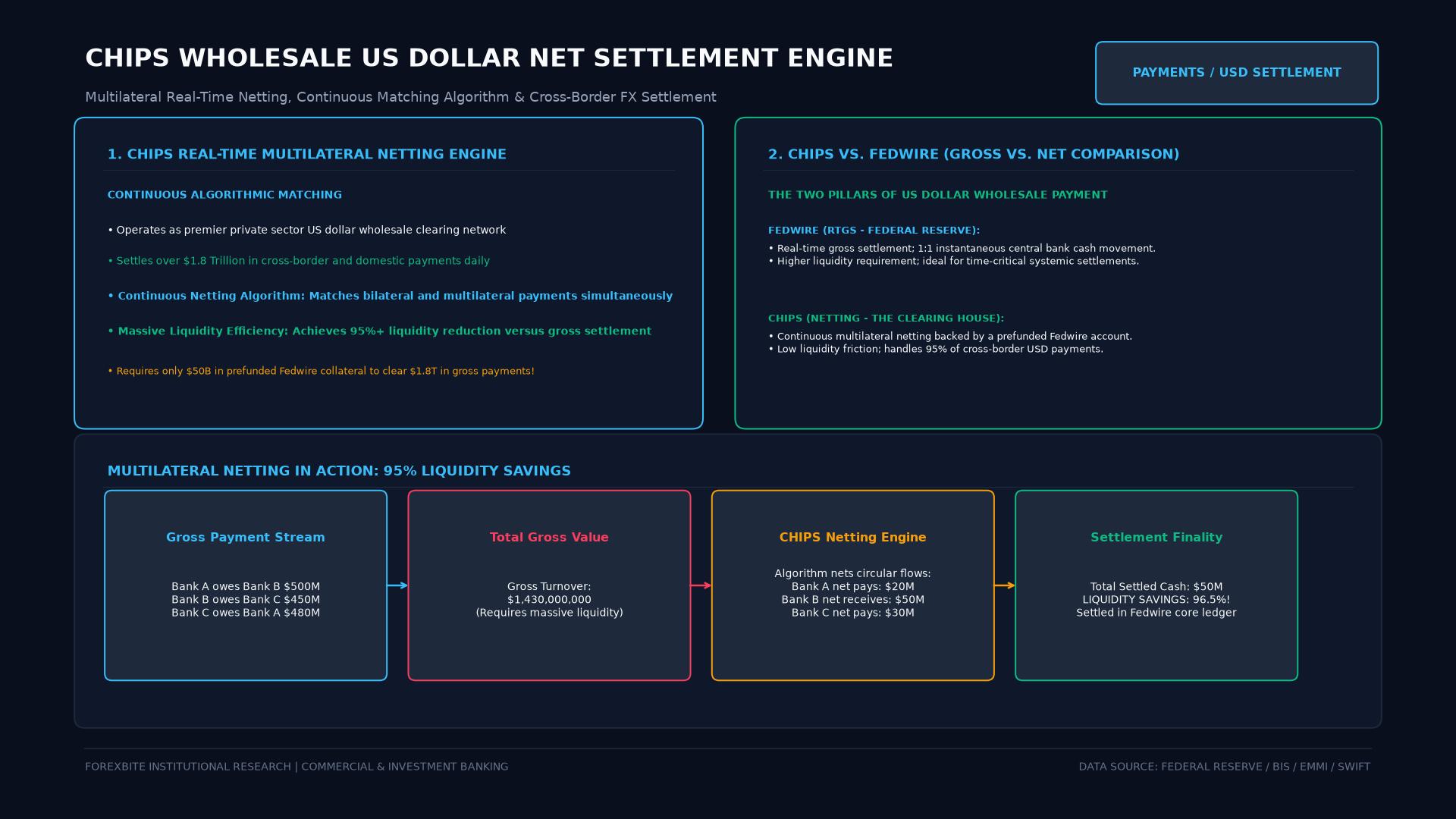 Figure: CHIPS continuous multilateral netting engine: combining liquidity savings algorithms with Fedwire final settlement across global participant banks.
Continuous Real-Time Multilateral Netting
The defining technical breakthrough of CHIPS is its proprietary real-time multilateral netting engine.
In a pure Real-Time Gross Settlement (RTGS) network like Fedwire, every transaction requires dollar-for-dollar cash reserves. If Bank A owes Bank B $100 million, Bank A must hold $100 million in cold cash at the Federal Reserve to release the wire, creating massive intraday liquidity strain.
CHIPS solves this via a hybrid netting mechanism:
- Pre-Funded Collateral Accounts: Each morning, participating banks deposit a small, pre-funded cash pool into a consolidated escrow account at the Federal Reserve Bank of New York.
- Algorithmic Queue Matching: Throughout the business day, CHIPS algorithms scan bilateral and multilateral payment queues continuously, matching offsetting payments across dozens of banks simultaneously.
- Liquidity Efficiency: By continuously netting payments, CHIPS operates with an astounding liquidity efficiency ratio exceeding 95%—meaning that $1.8 trillion in gross payments is cleared using less than $50 billion in active cash collateral.
- Immediate Finality: Payments that clear through the netting algorithm receive instant, irrevocable legal settlement finality under New York Uniform Commercial Code (UCC Article 4A).
CHIPS vs. Fedwire: The Dual Pillars of U.S. Dollar Settlement
The United States operates two distinct high-value payment rails that complement one another:
| Operational Feature | CHIPS (The Clearing House) | Fedwire Funds Service (Federal Reserve) |
|---|---|---|
| System Operator | Private bank consortium (The Clearing House) | U.S. Federal Reserve Banks (Sovereign) |
| Settlement Method | Continuous Real-Time Multilateral Netting | Real-Time Gross Settlement (RTGS) |
| Primary Domain | International Cross-Border / Foreign Exchange | Domestic Interbank / U.S. Treasury Settlement |
| Liquidity Usage | Extremely efficient (~5% cash required) | Gross capital required (100% cash needed) |
| Transaction Fees | Significantly cheaper per transaction | Higher per-wire central bank fee |
| Daily Turnover | ~$1.8 Trillion / Day | ~$4.0 Trillion / Day |
| Settlement Guarantee | Pre-funded collateral pool at NY Fed | Direct central bank reserve debit |
The Indispensable Role of CHIPS in Global Foreign Exchange
Because the U.S. Dollar is the world’s primary global reserve currency—participating in nearly 90% of all foreign exchange transactions—cross-border currency settlement depends directly on CHIPS:
- When an international bank in London, Tokyo, or Frankfurt executes a multi-million dollar spot or forward trade (such as EUR/USD or USD/JPY), the foreign currency leg settles through local national rails (like CHAPS or TARGET2).
- The U.S. Dollar leg is transmitted across the globe via SWIFT messaging (MT103 / MT202) and injected directly into CHIPS via a U.S. correspondent clearing bank.
- CHIPS nets the global dollar flow, drastically reducing interbank liquidity exposure between international financial centers.
Step-by-Step Payment Walkthrough: Cross-Border Trade Settlement
Consider a Japanese conglomerate buying industrial machinery from a German manufacturer, with the contract priced in $20,000,000 U.S. Dollars:
- Payment Initiation: The Japanese bank receives the instruction to wire $20,000,000 to the German manufacturer’s bank.
- Correspondent Routing: Neither bank is based in the U.S., so the Japanese bank routes the wire to its U.S. correspondent bank (e.g., JPMorgan Chase), while the German bank designates its U.S. correspondent (e.g., Citibank).
- CHIPS Netting: JPMorgan enters the $20,000,000 payment into CHIPS. Simultaneously, Citibank enters an offsetting $18,000,000 payment to JPMorgan from a separate client.
- Instant Settlement: The CHIPS netting engine offsets the two obligations, transferring $2,000,000 from JPMorgan’s pre-funded ledger to Citibank’s ledger.
- Beneficiary Credit: Both underlying commercial clients receive their cleared funds within minutes.
Modernization: The ISO 20022 Migration
In April 2024, CHIPS successfully migrated its entire core infrastructure to the ISO 20022 messaging standard.
This transition expanded data capacity, enabling banks to embed richer supply chain invoice details, sanctions-screening data, and automated tax compliance tags into every wire. The upgrade harmonized CHIPS with global real-time payment networks, enhancing anti-money laundering (AML) detection while reducing payment processing exceptions.
Key Takeaways
- CHIPS is the premier private-sector high-value U.S. Dollar payment system, clearing over $1.8 trillion daily.
- It processes roughly 95% of all cross-border international U.S. Dollar wire transfers and foreign exchange settlements.
- CHIPS achieves extraordinary liquidity efficiency (>95%) by continuously netting payments in real time against a pre-funded Federal Reserve escrow pool.
- While Fedwire handles domestic gross settlement, CHIPS serves as the primary conduit for international global commerce.
- Full adoption of ISO 20022 standardizes CHIPS data formatting alongside global wholesale clearing houses.
Frequently Asked Questions
Can retail consumers send payments through CHIPS directly?
No. CHIPS is exclusively an institutional wholesale clearing system. Individual consumers and commercial businesses access CHIPS indirectly when their commercial banks route international wire transfers through authorized CHIPS participant banks.
How many institutions participate in CHIPS?
Approximately 40 to 50 elite global commercial banks are direct participants in CHIPS. However, thousands of smaller financial institutions, regional banks, and international brokerages connect to CHIPS indirectly as correspondent banking customers of the direct participants.
What happens if a participating bank fails to settle its net position at the end of the day?
CHIPS enforces an airtight pre-funded collateral framework. Every participant bank must deposit collateral at the Federal Reserve Bank of New York at the start of the day. If a bank encounters a liquidity crisis, its pre-funded collateral is automatically liquidated to guarantee 100% settlement finality for all other participants.
Is CHIPS regulated by the U.S. Government?
Yes. As a systemically important financial market utility (SIFMU) under Title VIII of the Dodd-Frank Act, CHIPS is subject to rigorous regulatory supervision by the Federal Reserve Board and the Office of the Comptroller of the Currency (OCC).
Ready to trade forex?
Open a free demo account with a regulated broker. Practice with virtual funds before risking real money.