Compound Option
A compound option is an exotic derivative contract whose underlying asset is another option rather than a cash instrument. It provides the holder with two strike prices and two expiration dates across four distinct structural permutations.
What Is a Compound Option?
A compound option (commonly referred to as an “option on an option” or split-fee option) is an exotic derivative instrument where the underlying asset is another standard vanilla or exotic option contract. Instead of conferring the right to buy or sell a currency, stock, or commodity directly, a compound option grants the holder the right to purchase or sell another underlying option at a predetermined price on or before a specified date.
Because compound options involve two sequential stages, they are defined by two distinct expiration dates ($T_1$ and $T_2$) and two strike prices ($K_1$ and $K_2$):
- $T_1$ and $K_1$: The expiration date and strike price of the mother (compound) option.
- $T_2$ and $K_2$: The expiration date and strike price of the daughter (underlying) option, where $T_1 < T_2$.
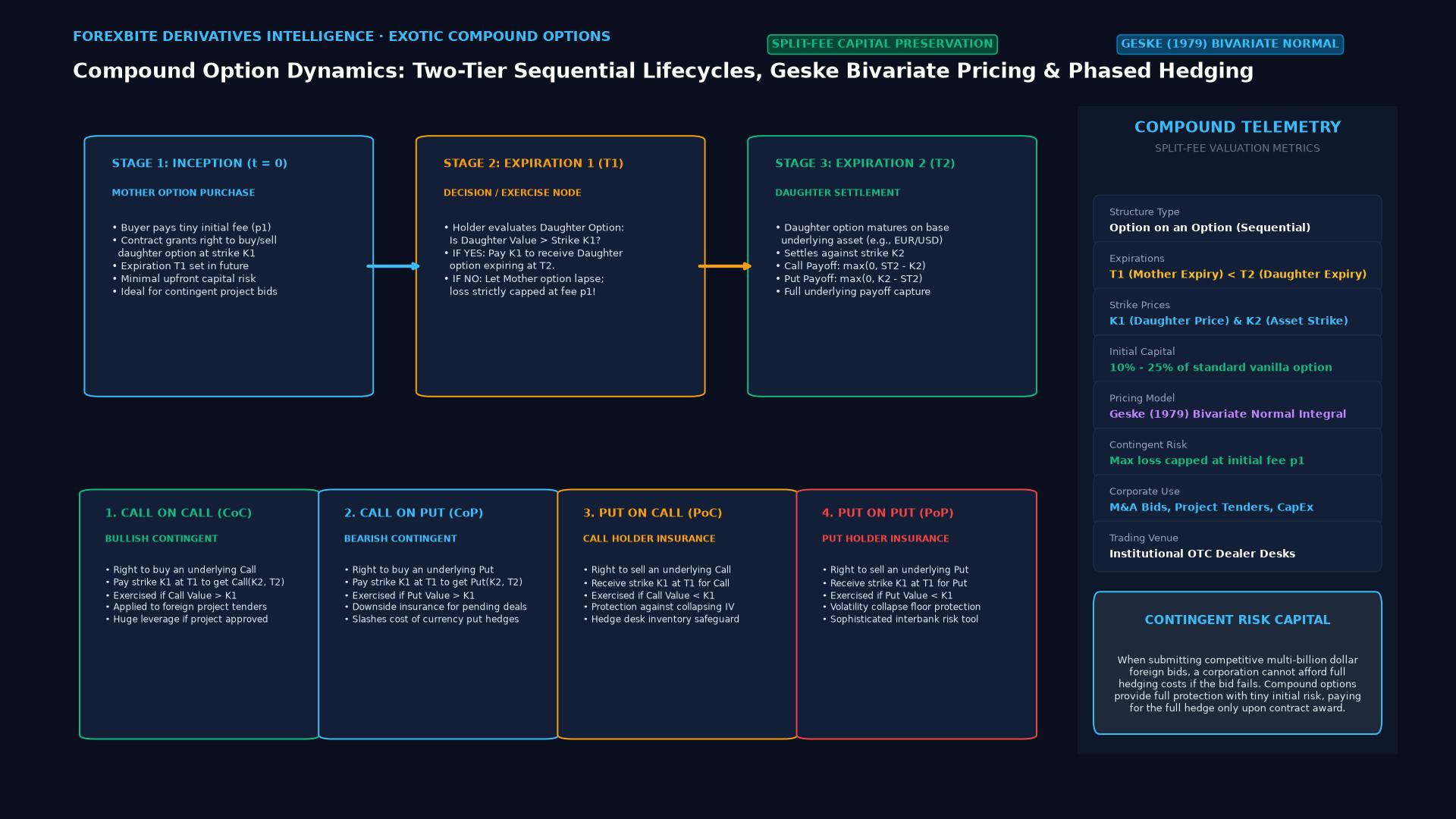 Figure: Compound option sequential lifecycle showing mother option purchase at t=0, exercise decision at T_1, and daughter option settlement at T_2.
Key Takeaways
- Four Permutations: Compound options exist in four variations: Call on a Call (CoC), Call on a Put (CoP), Put on a Call (PoC), and Put on a Put (PoP).
- Reduced Upfront Premium: Compound options require substantially less initial capital than buying a standard long-term vanilla option upfront, providing an economical tool for phased corporate hedging.
- The Geske Model (1979): The standard theoretical framework for pricing compound options was derived by Robert Geske, extending the Black-Scholes formula using bivariate normal distributions.
- Corporate M&A Utility: Multinationals frequently deploy compound options to hedge foreign currency risks associated with contingent project bids or cross-border acquisitions where the underlying transaction may not be finalized.
The Four Structural Types of Compound Options
Compound options allow corporate treasuries and institutional proprietary desks to tailor exact risk profiles:
| Acronym | Type | Right Granted at Expiration $T_1$ | Payoff Condition at $T_1$ | Ideal Market Application |
|---|---|---|---|---|
| CoC | Call on a Call | Right to buy an underlying call option at strike $K_1$ | Underlier Call Value $> K_1$ | Bullish expectation contingent on a project approval |
| CoP | Call on a Put | Right to buy an underlying put option at strike $K_1$ | Underlier Put Value $> K_1$ | Bearish downside protection contingent on future event |
| PoC | Put on a Call | Right to sell an underlying call option at strike $K_1$ | Underlier Call Value $< K_1$ | Protection against falling value of held long call positions |
| PoP | Put on a Put | Right to sell an underlying put option at strike $K_1$ | Underlier Put Value $< K_1$ | Synthetic floor protection against rising implied volatility collapse |
Valuation Mechanics: The Geske Analytical Pricing Model
In 1979, finance professor Robert Geske published the closed-form valuation formula for compound options on European underlyings. For a Call on a Call (CoC), the price $C_{\text{CoC}}$ is determined by:
$$C_{\text{CoC}} = S e^{-r_f T_2} M(a_1, b_1; \rho) - K_2 e^{-r_d T_2} M(a_2, b_2; \rho) - K_1 e^{-r_d T_1} N(a_2)$$
Where:
- $S$ = Spot exchange rate of the currency pair
- $K_1, K_2$ = First strike (premium payable at $T_1$) and second strike (underlying exchange rate at $T_2$)
- $T_1, T_2$ = Time to maturity of compound and underlying options ($T_1 < T_2$)
- $r_d, r_f$ = Domestic and foreign risk-free interest rates
- $M(x, y; \rho)$ = Bivariate cumulative normal distribution function with correlation parameter $\rho = \sqrt{T_1 / T_2}$
- $N(\cdot)$ = Standard cumulative normal distribution function
Intuition Behind the Pricing:
The holder pays an initial small fee for the first option. If the underlying currency performs favorably between Time 0 and $T_1$, the market value of the secondary option will exceed strike $K_1$. The holder then pays $K_1$ to receive the full underlying option expiring at $T_2$. If market conditions become unfavorable, the holder abandons the contract at $T_1$, losing only the modest initial premium.
Real-World Case Study: Hedging a Multinational Tender Offer
Imagine a Canadian aerospace manufacturer submitting a formal bid to supply €100,000,000 worth of equipment to an EU consortium.
The Corporate Challenge:
- Tender Decision Date: 3 months ($T_1$). The firm will only know if it wins the contract at $T_1$.
- Project Completion & Payment Date: 9 months ($T_2$). If the firm wins the contract, it will be paid €100,000,000 at $T_2$.
- Currency Exposure: If the Canadian Dollar appreciates sharply against the Euro between now and month 9, the revenue from the deal will collapse in Canadian dollar terms.
- The Dilemma: Buying a full 9-month EUR/CAD Put option costs €3,500,000 in upfront cash. If the firm loses the tender at month 3, this €3,500,000 premium is completely lost.
The Compound Option Solution:
The firm purchases a Call on a Put (CoP) on EUR/CAD:
- Initial Premium at $T_0$: The firm pays an initial premium of just €750,000.
- Mother Option Parameters: Expiration at 3 months ($T_1$) with strike $K_1 = €2,200,000$.
- Underlying Put Parameters: Expiration at 9 months ($T_2$) with strike $K_2 = 1.4500$ EUR/CAD.
Outcome Scenarios:
- Scenario A (Bid Rejected): At month 3, the consortium rejects the firm’s bid. The company lets the compound option expire worthless. Total hedging cost: €750,000 (saving €2,750,000 compared to a standard vanilla put).
- Scenario B (Bid Accepted): At month 3, the bid is accepted. The firm exercises its Call on a Put by paying the €2,200,000 strike fee ($K_1$) and immediately receives the 6-month EUR/CAD Put option protecting its €100,000,000 revenue at 1.4500.
Comparison: Compound Option vs. Chooser Option
Both compound options and chooser options belong to the exotic family, but they address fundamentally different financial risks:
| Operational Feature | Compound Option | Chooser Option (“As-You-Like-It”) |
|---|---|---|
| Core Functionality | Right to buy or sell another option contract | Right to choose whether a contract becomes a call or a put |
| Number of Strikes | Two distinct strikes ($K_1, K_2$) | Single underlying strike ($K$) |
| Payment Structure | Split-fee: Initial premium + optional exercise fee | Single upfront premium paid at initiation |
| Primary Use Case | Contingent business transactions (M&A, project bids) | High-volatility binary events (elections, court rulings) |
Frequently Asked Questions
Why are compound options also called “split-fee options”?
Because the total premium is split into two installments: an initial non-refundable payment to acquire the compound option, and a secondary contingent payment (the first strike $K_1$) payable only if the buyer elects to exercise into the underlying option at $T_1$.
Can compound options be traded on public exchanges?
No. Compound options are almost exclusively traded in Over-the-Counter (OTC) interbank derivatives markets. They are structured as bespoke contracts by investment bank foreign exchange desks to match specific corporate exposure dates.
How does implied volatility affect compound options?
Compound options exhibit exceptionally high vega leverage (sensitivity to volatility). Because the value of the underlying option is itself heavily dependent on implied volatility, an increase in volatility expands both the value of the secondary option and the probability that the compound option will be exercised at $T_1$.
Ready to trade forex?
Open a free demo account with a regulated broker. Practice with virtual funds before risking real money.