Chooser Option
An exotic options contract that grants the holder the contractual right to decide, on a predetermined choice date prior to expiration, whether the instrument will function as a standard vanilla call option or a vanilla put option at a specified strike price.
What is a Chooser Option?
A chooser option (widely designated in quantitative derivatives literature as an “As-You-Like-It” option) is an exotic path-independent derivative that provides the buyer with unprecedented directional flexibility.
When entering a conventional option, the trader must commit immediately to either a bullish bias (purchasing a call) or a bearish bias (purchasing a put). With a chooser option, the buyer pays an initial premium at inception ($t=0$) but defers the directional decision until a pre-agreed future date known as the choice date ($t_c$).
On the choice date, after observing market volatility, economic data releases, or geopolitical events, the holder formally elects whether the contract will become a standard European call option or a standard European put option for the remainder of its lifespan until final expiration ($T$).
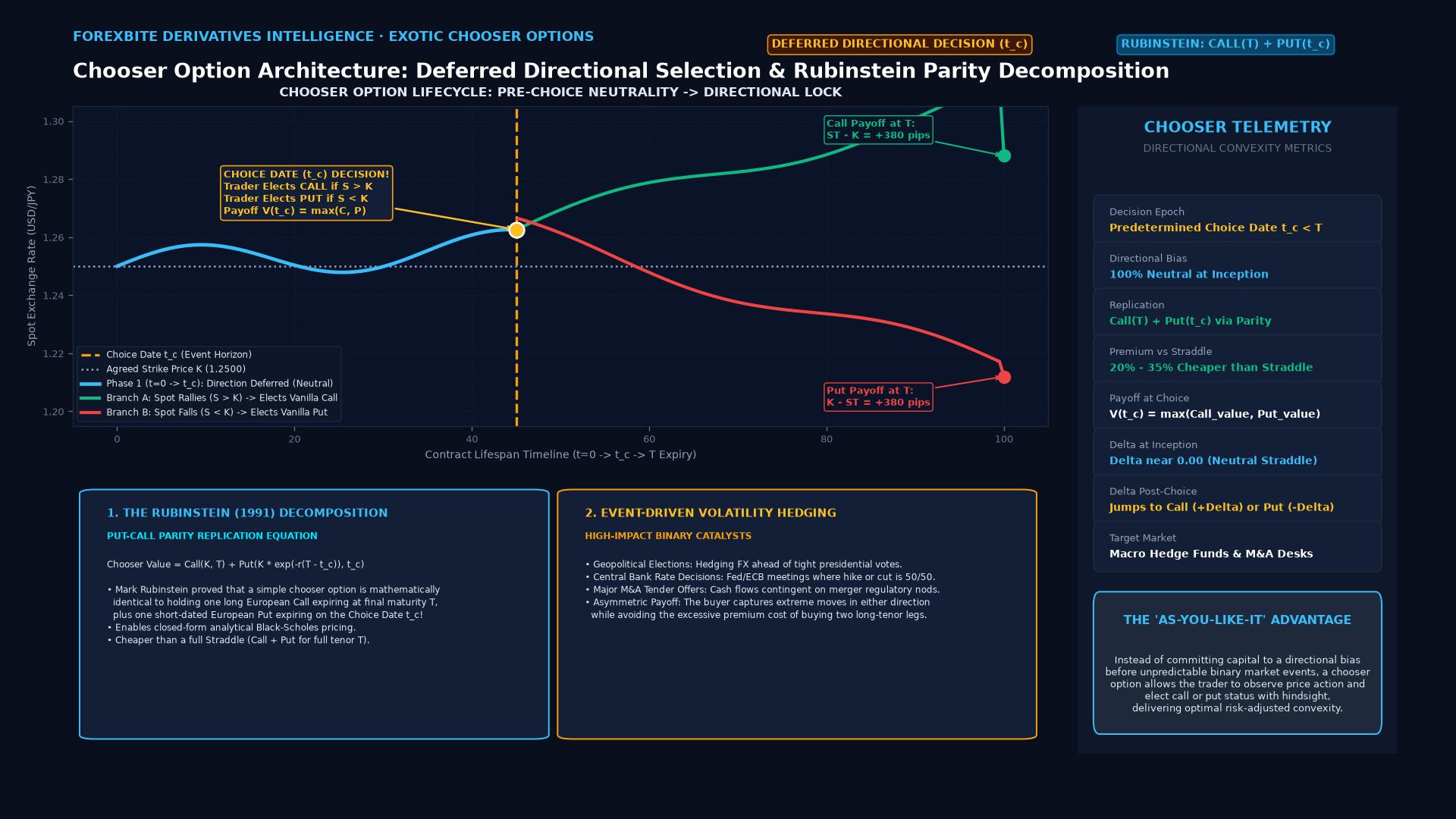 Figure: Chooser option lifecycle showing deferred directional decision at choice date t_c and Rubinstein put-call parity decomposition.
Mathematical Payoff and Valuation Mechanics
Formalized by financial economist Mark Rubinstein in 1991, the terminal valuation of a chooser option at the choice date $t_c$ is determined by selecting whichever vanilla option has greater market value:
$$V(t_c) = \max \Big( C\big(S(t_c), K, T - t_c\big), ; P\big(S(t_c), K, T - t_c\big) \Big)$$
Where:
- $S(t_c)$ = Spot price of the underlying currency at the choice date.
- $K$ = Agreed strike price.
- $T - t_c$ = Time remaining from choice date to final expiration.
- $C(\cdot), P(\cdot)$ = Standard Black-Scholes pricing values for European calls and puts.
The Put-Call Parity Decomposition
Through the law of Put-Call Parity, Rubinstein proved that a simple chooser option (where the call and put share the same strike $K$ and expiration $T$) can be replicated as: $$\text{Chooser Option} = \text{Vanilla Call}(K, T) + \text{Vanilla Put}(K e^{-r(T - t_c)}, t_c)$$
In financial terms, a chooser option is mathematically equivalent to:
- Purchasing one standard long-term European call option expiring at $T$.
- Simultaneously purchasing one short-term European put option expiring on the choice date $t_c$.
Why Chooser Options are Cheaper Than a Straddle
A trader anticipating an explosive, high-volatility event without knowing the direction often considers buying a straddle (buying both a call and a put simultaneously). However, a straddle requires paying for two complete options.
A chooser option is structurally cheaper than a straddle:
- In a straddle, you own both options for the entire duration, paying double premium.
- In a chooser option, you only own one option at a time. Prior to the choice date, you hold the optionality to pick; after the choice date, you hold only the selected leg.
- Because you surrender the unchosen leg on the choice date, dealers price chooser options at a substantial discount (typically 20% to 35% less) compared to purchasing a full long straddle.
Step-by-Step Currency Case Study: Hedging an Election on EUR/USD
Consider a global macro hedge fund analyzing EUR/USD, currently trading at 1.0800, 30 days ahead of a highly contentious national election. The fund knows the election will trigger a massive 300-pip trend, but political polling is split 50/50.
Contract Specifications
- Notional: $10,000,000
- Strike ($K$): 1.0800 (At-the-Money)
- Total Maturity ($T$): 6 Months (180 Days)
- Choice Date ($t_c$): Day 35 (5 days after the election results are ratified)
- Premium Paid: 180 pips ($180,000) vs. 270 pips ($270,000) for an outright 6-month straddle.
Decision Scenarios on Day 35 (Choice Date)
| Market Scenario on Day 35 | EUR/USD Spot Level | Value of 5-Month Call | Value of 5-Month Put | Fund’s Choice Decision | Payoff at Month 6 ($T$) |
|---|---|---|---|---|---|
| Pro-Growth Policy Win | 1.1150 (Rallied) | Worth 380 pips | Worth 15 pips | Elects CALL Option | Rides Euro trend higher; collects large call profit. |
| Severe Crisis / Tariff Shock | 1.0450 (Crashed) | Worth 10 pips | Worth 410 pips | Elects PUT Option | Rides Dollar rally; collects massive put profit. |
| Dead Flat Stagnation | 1.0800 (Unchanged) | Worth 120 pips | Worth 120 pips | Picks based on interest carry | Suffers loss limited to initial premium paid. |
In both high-volatility breakout scenarios, the fund captured the winning side of a multi-month trend without having to guess the political outcome in advance, while saving $90,000 compared to a straddle.
Simple Chooser vs. Complex Chooser
Financial engineers structure chooser options under two frameworks:
- Simple Chooser Option: The strike price ($K$) and final expiration date ($T$) are identical regardless of whether the buyer selects a call or a put.
- Complex Chooser Option: The contract specifies different strike prices and different expiration tenors for the call and put legs:
- Example: On the choice date, the buyer can choose between a 1.0900 Call expiring in 3 months or a 1.0700 Put expiring in 6 months.
- Complex choosers are highly customized OTC instruments priced using numerical bivariate normal distribution models.
Comparative Matrix: Exotic and Volatility Strategies
| Strategy | Directional Commitment at Entry | Downside Risk | Premium Cost | Flexibility Horizon |
|---|---|---|---|---|
| Chooser Option | Deferred (Decided on choice date) | Capped at premium paid | Moderate (Discount to straddle) | Dynamic decision at choice date |
| Long Straddle | Neutral (Owns both simultaneously) | Capped at double premium | High (Pays for two legs) | Both legs active to expiry |
| Long Strangle | Neutral (OTM Call + OTM Put) | Capped at combined premium | Moderate (Cheaper strikes) | Requires larger price explosion |
| Vanilla Option | Immediate (Must pick Call or Put) | Capped at single premium | Low to Moderate | Zero directional flexibility |
Key Takeaways
- A chooser option is an exotic derivative allowing the buyer to decide on a future choice date whether the contract becomes a call or a put.
- It provides maximum strategic flexibility ahead of binary market events such as elections, regulatory rulings, or central bank meetings.
- The contract is mathematically priced as a long-term call combined with a short-term put, making it significantly cheaper than a straddle.
- Maximum financial loss is strictly limited to the upfront premium paid upon inception.
- Complex choosers allow different strike prices and maturities depending on which side is elected.
Frequently Asked Questions
When is the choice date typically set?
The choice date is customizable in OTC contracts, but it is typically scheduled immediately after a known volatility catalyst—such as one to five days following a major central bank policy meeting, an OPEC summit, or a national election.
What happens if the buyer forgets to make a choice on the choice date?
Institutional ISDA contract confirmations include default automated execution clauses: if the buyer fails to submit a formal choice notice by the daily cut-off time (e.g., 3:00 PM EST), the contract automatically converts into whichever option (call or put) is most in-the-money at that exact moment.
Are chooser options traded on public retail exchanges?
No. Chooser options are over-the-counter (OTC) institutional derivatives structured and underwritten by Tier 1 investment banks for corporate treasuries, commodity trading houses, and macro hedge funds.
How does implied volatility affect a chooser option?
Because a chooser option embodies optionality on both the upside and downside prior to the choice date, it has high positive vega. A surge in market implied volatility increases the value of both potential choices, significantly boosting the contract’s secondary market value.
Ready to trade forex?
Open a free demo account with a regulated broker. Practice with virtual funds before risking real money.