Average Rate Option
An exotic options contract whose settlement payout is determined by comparing the strike price against the mathematical average of the underlying asset's spot exchange rate sampled over a designated observation schedule, rather than the spot price on the expiration date.
What is an Average Rate Option?
An average rate option (ARO)—universally known in quantitative derivatives literature as an Asian option—is an exotic option whose terminal payoff is governed by the mathematical average of the underlying asset’s price sampled across a predetermined observation period, rather than its single spot price at the exact moment of expiration.
First conceptualized by Bankers Trust derivatives traders in Tokyo in 1987 (giving rise to the geographical moniker “Asian option”), average rate options were engineered specifically to solve real-world corporate treasury dilemmas. Multinational corporations and commodity trade houses rarely buy or sell all their foreign exchange at a single instant; instead, they generate recurring daily, weekly, or monthly cash flows throughout the fiscal quarter. An average rate option mirrors this multi-period operational exposure perfectly.
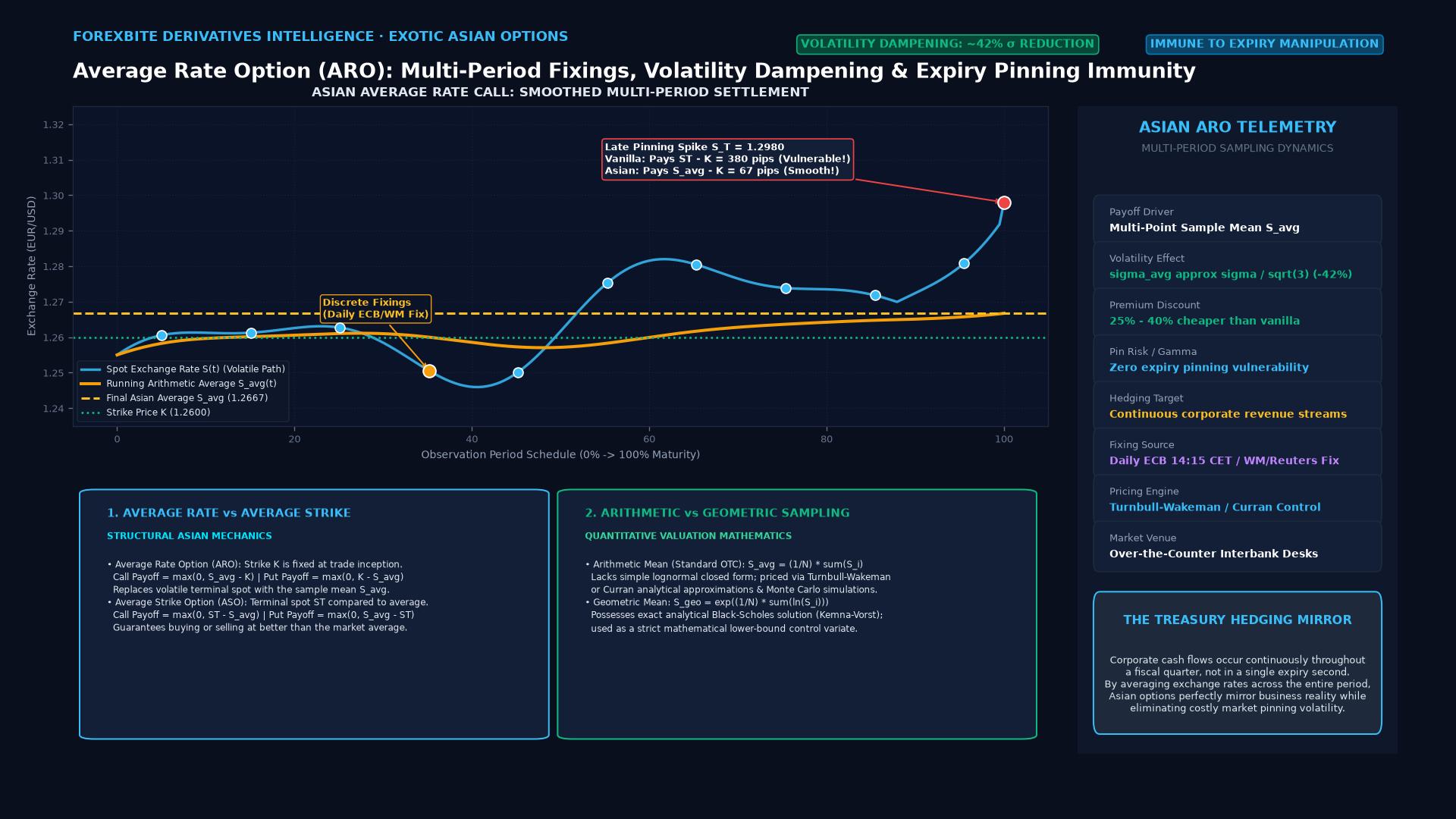 Figure: Average rate option (Asian option) mechanics demonstrating multi-period fixing schedules, volatility dampening, and immunity to late-tenor expiry pinning.
Mathematical Payoff Mechanics
Average rate options are structured as either calls or puts, utilizing either arithmetic or geometric sampling:
1. Arithmetic Averaging (Standard Market Practice)
The running sample average ($\bar{S}$) is calculated by recording the spot exchange rate at $N$ designated discrete observation dates (e.g., daily 2:00 PM ECB fixes, or weekly closes):
$$\bar{S} = \frac{1}{N} \sum_{i=1}^N S(t_i)$$
2. Payoff Formulas at Maturity
- Average Rate Call Option: $$\text{Payoff} = \max(0, \bar{S} - K)$$
- Average Rate Put Option: $$\text{Payoff} = \max(0, K - \bar{S})$$
Where:
- $\bar{S}$ = The arithmetic mean of the underlying exchange rate across all $N$ fixings.
- $K$ = The pre-agreed strike price.
(Note: In contrast to an Average Rate Option where the terminal spot is replaced by an average, an Average Strike Option compares the terminal spot $S_T$ against a floating strike determined by the average: $\max(0, S_T - \bar{S})$).
Why Asian Options are Cheaper: The Volatility Dampening Effect
From a pricing perspective, average rate options are significantly less expensive than standard European vanilla options. Under the Black-Scholes framework, option premiums scale directly with the volatility of the underlying asset.
Because the mathematical average of a stochastic time series is inherently smoother and exhibits lower variance than the instantaneous terminal price:
$$\text{Var}(\bar{S}) < \text{Var}(S_T)$$
For continuous daily observations over time $T$, the variance of an arithmetic average approaches approximately one-third of the variance of the underlying asset:
$$\sigma_{\text{average}} \approx \frac{\sigma}{\sqrt{3}} \approx 0.577 \times \sigma$$
Because implied volatility is drastically compressed, Asian option premiums are typically 15% to 40% cheaper than equivalent vanilla European options with the same strike and maturity.
Step-by-Step Corporate Hedging Case Study
Consider a European luxury goods exporter anticipating incoming U.S. Dollar cash receipts of $3,000,000 spread evenly across the next quarter ($1,000,000 collected at the end of each month).
- Current Spot Rate (EUR/USD): 1.0800
- Corporate Risk: A surging Euro (e.g., EUR/USD rallying to 1.1500) would severely reduce the Euro value of their dollar revenue upon repatriation.
Rather than buying an expensive vanilla European put option expiring on Day 90, the treasury purchases a 90-Day EUR/USD Average Rate Put Option (ARO):
- Strike ($K$): 1.0800
- Notional: $3,000,000
- Fixing Schedule: Daily closing rates sampled over 65 trading days ($N = 65$).
- Premium Paid: 90 pips ($27,000) vs. 150 pips ($45,000) for a vanilla European put (a 40% cash savings).
Outcome Scenarios at Expiry
| Market Scenario | Daily EUR/USD Dynamics | Average Rate ($\bar{S}$) | Final Spot ($S_T$) | Asian Put Payoff | Vanilla Put Payoff |
|---|---|---|---|---|---|
| A: Steady Euro Rally | Euro climbs steadily from 1.0800 to 1.1400. | 1.1100 | 1.1400 | Out of Money ($0) | Out of Money ($0) |
| B: Steady Euro Drop | Dollar strengthens, Euro slides from 1.0800 to 1.0200. | 1.0500 | 1.0200 | $1.0800 - 1.0500 = +300\text{ pips}$ ($90,000) | $1.0800 - 1.0200 = +600\text{ pips}$ ($180,000) |
| C: End-of-Quarter Spike | Rates average 1.0500, but flash rally to 1.0950 on Day 89. | 1.0520 | 1.0950 | +$84,000 (Protected!) | $0 (Expired Worthless!) |
In Scenario C, the vanilla European option expired completely worthless due to an isolated spike in the final 24 hours. The Average Rate Option, however, insulated the corporation from that terminal noise, delivering an $84,000 payout that matched the actual average rate at which the corporation repatriated its cash.
Comparative Matrix: Option Architectures
| Feature | Average Rate Option (Asian) | Vanilla European Option | Barrier Option (Knock-Out) | Lookback Option |
|---|---|---|---|---|
| Payoff Benchmark | Arithmetic or geometric average ($\bar{S}$) | Terminal spot price ($S_T$) | Terminal spot if barrier untouched | Maximum or minimum spot ($S_{\max}, S_{\min}$) |
| Option Cost | Substantially discounted (Low volatility) | Standard baseline premium | Heavily discounted (Knock-out risk) | Extremely expensive (Maximum payout) |
| Price Manipulation Risk | Virtually immune to end-of-term manipulation | Vulnerable to expiry pinning / ramp | Vulnerable to barrier hunting | Muted |
| Primary End User | Corporate hedgers, airlines, miners | Speculators, macro funds | Cost-sensitive corporate treasuries | Aggressive trend traders |
| Mathematical Complexity | Non-trivial (Approximation or Monte Carlo) | Exact analytical (Black-Scholes-Merton) | Closed-form analytical | Closed-form analytical |
Strategic Advantages of Average Rate Options
- Elimination of “Pin Risk” and Expiration Squeezes: Because market makers cannot manipulate an average calculated across 60 or 90 consecutive days, institutional desks cannot trigger artificial stop-outs or pin strikes at expiration.
- Accounting Alignment (IFRS 9 / ASC 815): Under international hedge accounting standards, derivative hedges must correlate closely with the underlying cash flow risk. For businesses recording continuous sales revenues, an Asian option provides near-perfect hedge effectiveness.
- Budgetary Efficiency: Saving 20% to 40% on option premium enables corporate treasuries to allocate capital toward productive capital expenditure rather than excess insurance overhead.
Key Takeaways
- An average rate option (Asian option) calculates its terminal payout against the average price of an asset over an observation period rather than the price at expiration.
- Because averaging dampens price volatility, Asian options are structurally 15% to 40% cheaper than vanilla European options.
- They are the premier hedging tool for corporate treasuries managing recurring revenues, continuous imports, or commodity supply chains.
- Arithmetic averaging is the standard commercial convention, typically evaluated using daily or weekly official fixings.
- Asian options provide robust structural protection against end-of-quarter market manipulation, liquidity voids, and temporary expiration spikes.
Frequently Asked Questions
Why are average rate options called “Asian options”?
They received the name in 1987 when derivatives traders David Spaughton and Mark Webber at Bankers Trust in Tokyo structured the first commercial contract based on average crude oil prices.
What is the difference between an Average Rate Option and an Average Strike Option?
In an Average Rate Option (ARO), the strike is fixed ($K$) and the spot is replaced by the average ($\bar{S}$). In an Average Strike Option (ASO), the terminal spot price ($S_T$) is compared against a floating strike determined by the historical average: $\max(0, S_T - \bar{S})$.
Why is pricing an arithmetic Asian option mathematically challenging?
While geometric averages follow a lognormal distribution that can be solved with exact closed-form formulas, the sum of lognormal variables (an arithmetic average) does not possess a simple closed-form probability distribution. Consequently, quants use moment-matching approximations (Turnbull-Wakeman, Curran) or Monte Carlo numerical simulations to price them.
Can retail forex traders trade Asian options?
While traditional retail brokerages focus on spot forex and vanilla CFDs, average rate options are widely traded through specialized multi-asset institutional brokers, OTC dealing banks, and commodity derivative exchanges.
Ready to trade forex?
Open a free demo account with a regulated broker. Practice with virtual funds before risking real money.