Contango
Contango is a market condition where the forward or futures price of an asset trades above its expected current spot price, creating an upward-sloping forward curve driven by storage, financing, and insurance carrying costs.
What Is Contango?
Contango is a market condition in derivatives and futures markets where the futures (forward) price of a commodity, currency, or financial instrument trades at a premium above its current spot price ($F_t > S_t$). When plotted across successive expiration dates, the term structure forms an upward-sloping forward curve.
Contango is the natural, equilibrium state for non-perishable storable assets in normal market environments. The premium reflected in distant contracts represents the Cost of Carry—the cumulative financial burden required to purchase the underlying physical asset today and store, finance, and insure it until future delivery. As a futures contract approaches its expiration date, contango systematically collapses toward the spot price through the process of basis convergence.
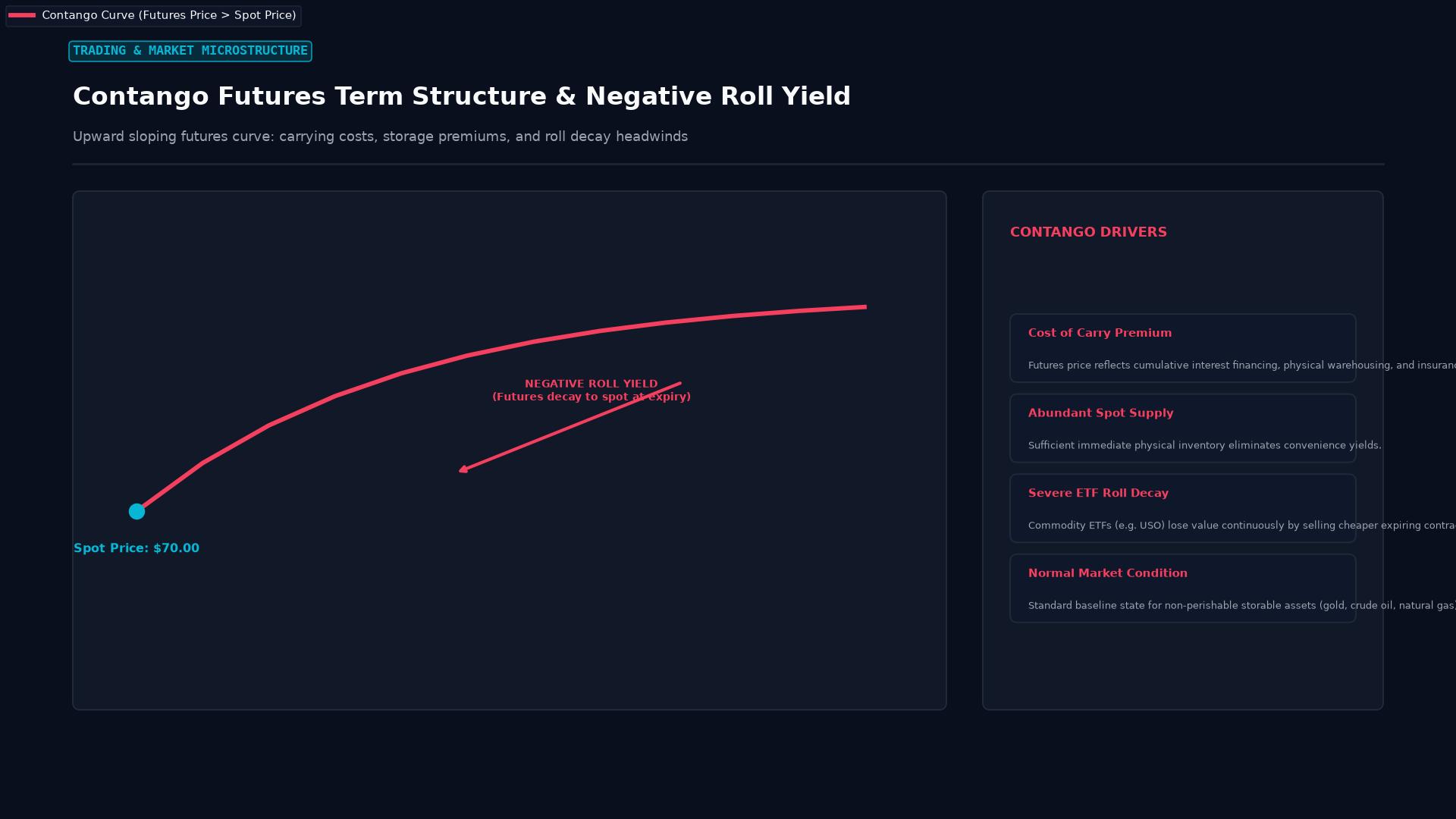 Figure: Upward sloping futures curve in contango: cost of carry premiums (financing, storage, insurance) driving futures prices above spot and imposing negative roll decay on long positions.
Key Takeaways
- Upward-Sloping Forward Curve: In a contango market, contracts with longer maturities trade at higher prices than near-term contracts ($F_{\text{distant}} > F_{\text{near}} > S_{\text{spot}}$).
- The Cost of Carry Mechanism: Contango reflects the cost of capital (interest rates), physical warehousing, transportation, and insurance required to carry physical inventory over time.
- Negative Roll Yield (“Roll Decay”): Investors holding long positions in commodity index funds or exchange-traded products (ETFs) lose capital over time in contango, as they must continuously sell expiring cheaper contracts and buy more expensive forward contracts.
- Cash-and-Carry Arbitrage Boundary: The upper limit of contango is strictly bound by arbitrage: if futures trade above full carrying costs, institutional arbitrageurs buy spot, sell futures, and pocket a riskless profit.
Mathematical Formulation: The Cost of Carry Model
Under standard financial asset pricing theory, the theoretical forward price $F(0, T)$ for an asset with spot price $S_0$ expiring at time $T$ is given by:
$$F(0, T) = S_0 e^{(r + u - y) T}$$
Where:
- $S_0$ = Current spot price
- $r$ = Risk-free financing rate (cost of borrowed capital)
- $u$ = Storage, warehousing, and insurance costs per unit per year
- $y$ = Convenience yield (the non-monetary benefit of holding physical inventory on hand)
- $T$ = Time to maturity in years
Conditions for Contango:
A market enters contango when net carrying costs exceed the convenience yield: $$(r + u) > y \implies F(0, T) > S_0$$
When inventory is abundant in commercial tanks and warehouses, the convenience yield $y$ drops toward zero, driving the futures price to trade at the “full cost of carry” premium over spot.
Negative Roll Yield: The Hidden Drag on Retail Commodity ETFs
Retail traders frequently purchase commodity exchange-traded funds (such as crude oil, natural gas, or agricultural funds) assuming long-term returns will mimic spot price gains. In a contango market, this strategy suffers severe performance erosion due to negative roll yield.
How Roll Decay Operates:
- A commodity fund does not take physical delivery of thousands of barrels of oil; it holds near-month futures.
- Two weeks before expiration, the fund must “roll” its exposure by selling the expiring near-month contract and buying the next consecutive month.
- In contango, the near contract might trade at $70.00, while the next month trades at $72.00.
- The fund sells at $70.00 and buys at $72.00, losing $2.00 per barrel on the roll.
- Over a full 12-month period, continuous negative roll decay can cause a fund’s share price to drop 20% to 40% even if the spot commodity price remains completely flat.
Monthly Roll Mechanics in Contango:
Month 1: Sell Near Contract at $70.00 ───► Buy Distant Contract at $72.00 (Pay $2.00 Roll Spread)
Month 2: Price converges down to $70 ───► Sell at $70.00 ───► Buy at $72.00 (Repeat Capital Drag)
Contango vs. Backwardation
The dynamics of derivatives pricing alternate between contango and backwardation depending on supply, demand, and interest rate environments:
| Market Parameter | Contango Market | Backwardation Market |
|---|---|---|
| Curve Shape | Upward sloping ($F > S$) | Downward sloping ($F < S$) |
| Physical Supply State | Abundant inventory, surplus supply, weak immediate demand | Immediate scarcity, supply chain disruptions, extreme spot demand |
| Convenience Yield | Low or negligible ($y \approx 0$) | Exceptionally high ($y > r + u$) |
| Roll Yield for Longs | Negative (Drag on performance) | Positive (Enhances long returns) |
| Typical Asset Classes | Gold, Silver, Natural gas (seasonal shoulder months) | Crude oil during geopolitical conflicts, short-crop agricultural crises |
Real-World Case Study: “Super Contango” in Crude Oil (April 2020)
The most extreme manifestation of contango in financial history occurred in the WTI crude oil futures market on April 20, 2020.
The Dynamics:
- Global Lockdowns: COVID-19 pandemic restrictions eliminated global fuel demand, causing worldwide storage hubs (such as Cushing, Oklahoma) to reach absolute physical capacity.
- The Delivery Obligation: Traders holding the May 2020 WTI contract faced mandatory physical delivery within 24 hours. Because every storage tank, pipeline, and tanker was fully booked, carrying costs ($u$) skyrocketed to infinity.
- The Collapse: With no available storage, speculators were forced to liquidate at any cost. The price of the May 2020 WTI contract plummeted into negative territory, settling at -$37.63 per barrel.
- The Contango Spread: While May oil settled at -$37.63, the June 2020 contract traded at +$20.43. The contango spread widened to an unprecedented $58.06 per barrel across a single month, demonstrating that when physical storage disappears, contango pricing can detach entirely from standard historical ranges.
Implications for Forex Traders
While contango is primarily discussed in commodities, its mathematical foundations govern foreign exchange forward pricing through Covered Interest Parity (CIP):
$$F = S \times \frac{1 + r_d \cdot (T / 360)}{1 + r_f \cdot (T / 360)}$$
- If the domestic currency interest rate ($r_d$) is higher than the foreign currency interest rate ($r_f$), the forward exchange rate trades at a premium over the spot rate (FX contango for the quote currency).
- Currency forward traders and institutional FX swap desks continuously monitor these forward curves to price cross-currency basis swaps and identify interest rate carry arbitrage opportunities.
Frequently Asked Questions
Can a stock or equity index trade in contango?
Yes. Major equity index futures (such as S&P 500 or E-mini futures) typically trade in contango relative to the cash index. Because the financing rate (interest rate) to carry the stock portfolio typically exceeds the dividend yield generated by the constituent companies ($r > q$), forward futures prices trade at a slight premium over spot.
How can traders profit from a contango market?
Institutional physical traders execute Cash-and-Carry Arbitrage: they borrow money at the risk-free rate, purchase physical inventory at the spot price, secure storage, and simultaneously sell distant futures at a premium. If the futures premium exceeds the cost of financing and storage, the trade locks in a 100% riskless annualized return.
What is “Super Contango”?
Super contango occurs during severe supply gluts when the price spread between near-term and long-term futures contracts widens so drastically that it covers even the most exorbitant storage costs (such as chartering Ultra Large Crude Carrier supertankers to serve as floating offshore storage).
Ready to trade forex?
Open a free demo account with a regulated broker. Practice with virtual funds before risking real money.