Basic Convergence
The financial market principle whereby the basis—the numerical price difference between a futures or forward contract and the underlying spot cash asset—progressively narrows over the contract's lifespan and converges to exactly zero at expiration.
What is Basic Convergence?
Basic convergence (universally termed basis convergence in quantitative finance) is the fundamental economic law dictating that as a futures or forward contract approaches its final expiration date, its price must inevitably converge to the current spot cash price of the underlying asset.
In derivatives markets, the basis is defined as the mathematical difference between the spot price and the futures price:
$$\text{Basis} = \text{Spot Price} - \text{Futures Price}$$
Throughout the life of a contract, the basis fluctuates due to shifting interest rates, financing costs, dividend expectations, and storage expenses (known collectively as the cost of carry). However, on the final delivery or settlement date, the time remaining until expiration drops to zero, extinguishing all carrying costs. Consequently, the basis collapses to zero, and the futures price equals the spot price:
$$\lim_{t \to T} (\text{Futures Price}_t - \text{Spot Price}_t) = 0$$
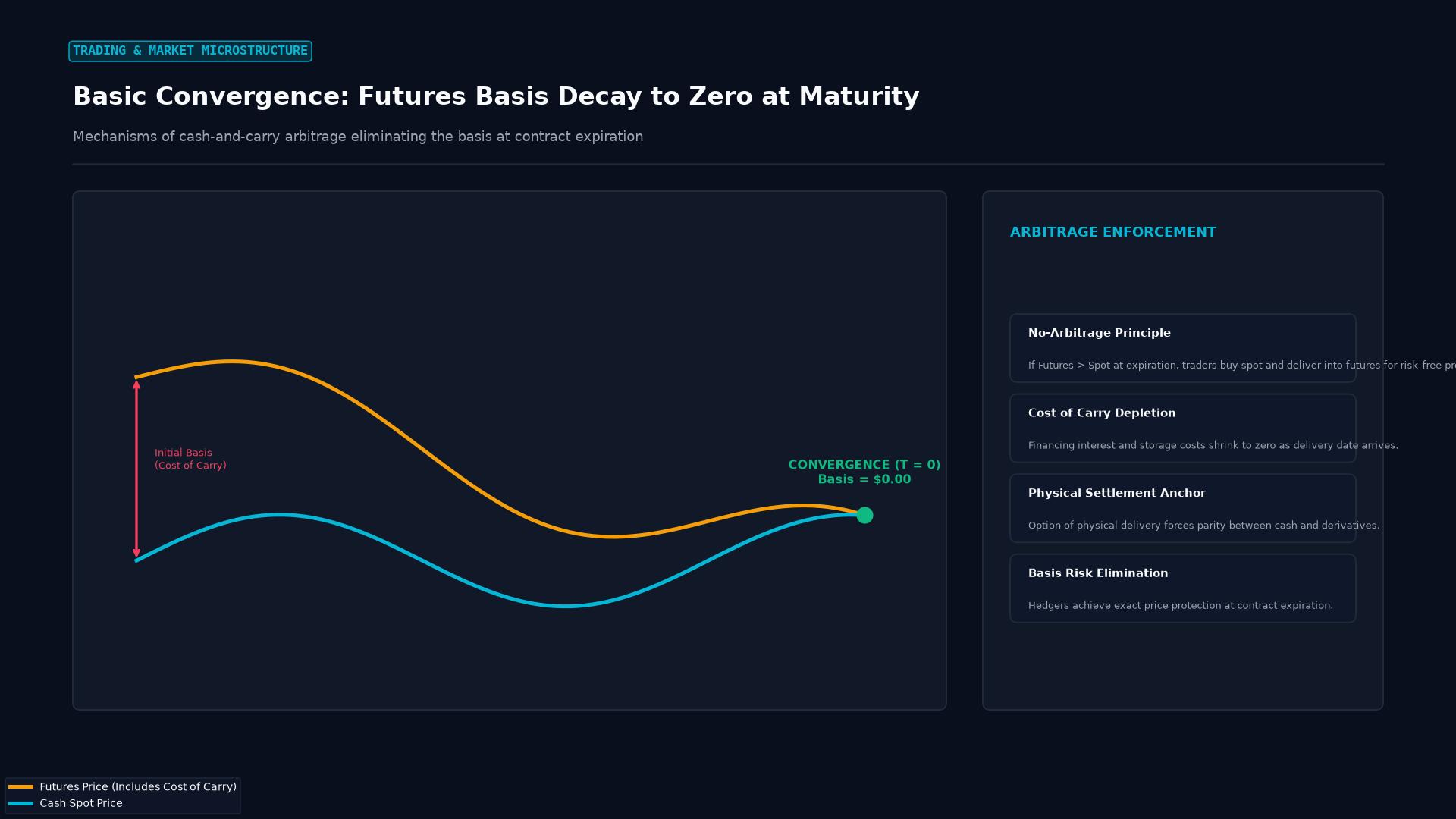 Figure: The convergence principle in futures markets: cost of carry decay driving the basis (Futures - Spot) to exactly zero at expiration via cash-and-carry arbitrage.
The Cost of Carry Model: The Engine Driving Convergence
To understand why convergence is mathematically and economically unavoidable, consider the classical Cost of Carry model:
$$F_t = S_t \times e^{(r - q)(T - t)}$$
Where:
- $F_t$ = Futures price at current time $t$.
- $S_t$ = Spot cash price at time $t$.
- $r$ = Risk-free financing interest rate.
- $q$ = Income yield (dividend yield for equities, foreign interest rate for currencies, convenience yield for commodities).
- $(T - t)$ = Time remaining until contract maturity date $T$.
As the calendar advances toward the expiration date, the time factor $(T - t)$ approaches zero:
$$e^{(r - q) \times 0} = e^0 = 1 \implies F_T = S_T$$
The gradual elimination of the time value of money and holding costs is the mathematical driver that pulls the futures price toward the spot price throughout the contract’s duration.
Convergence Across Market Regimes: Contango vs. Backwardation
The trajectory of basis convergence depends entirely on whether the market is structured in contango or backwardation:
1. Convergence in Contango (Carrying-Charge Market)
- Market State: Futures trade at a premium above the spot price ($F > S$, negative basis).
- Convergence Behavior: The futures price steadily declines toward the spot price as time decay erodes the financing and storage premium.
- Trader Impact: Long futures holders suffer negative roll yield (carry drag), while short futures holders capture positive roll yield.
2. Convergence in Backwardation (Inverted Market)
- Market State: Futures trade at a discount below the spot price ($F < S$, positive basis).
- Convergence Behavior: The futures price steadily appreciates toward the spot price as expiration approaches.
- Trader Impact: Long futures holders capture positive roll yield as the discounted contract rises to meet spot cash values.
The Arbitrage Mechanism Enforcing Convergence
Basic convergence is not merely a theoretical hope; it is strictly enforced by arbitrageurs. If a futures price fails to converge to the spot price on expiration day, institutional quantitative trading desks execute instantaneous, risk-free arbitrage that forces price parity:
Scenario A: Futures Price Exceeds Spot Price at Expiry ($F_T > S_T$)
- The arbitrageur buys the physical spot asset at $S_T$.
- The arbitrageur simultaneously sells the futures contract at $F_T$.
- The arbitrageur immediately makes physical delivery of the spot asset into the futures contract.
- Result: An immediate, risk-free profit equal to $F_T - S_T$. Heavy arbitrage selling of futures and buying of spot drives the two prices into perfect alignment.
Scenario B: Futures Price Falls Below Spot Price at Expiry ($F_T < S_T$)
- The arbitrageur short-sells the spot asset at $S_T$.
- The arbitrageur simultaneously buys the futures contract at $F_T$ and takes immediate delivery.
- The received asset covers the short spot position.
- Result: An immediate, risk-free profit equal to $S_T - F_T$.
Step-by-Step Currency Futures Example: CME EUR/USD
Consider a macro hedge fund managing a currency futures position on the Chicago Mercantile Exchange (CME):
| Timeline | Days to Expiry | Spot EUR/USD ($S$) | 3-Month Futures ($F$) | Basis ($S - F$) | Market State |
|---|---|---|---|---|---|
| Day 1 (Contract Launch) | 90 Days | 1.08000 | 1.08450 | -0.00450 (-45 pips) | Contango |
| Day 30 | 60 Days | 1.08200 | 1.08500 | -0.00300 (-30 pips) | Basis Narrows |
| Day 60 | 30 Days | 1.07900 | 1.08050 | -0.00150 (-15 pips) | Basis Narrows |
| Day 89 (Final Trading Day) | 1 Day | 1.08500 | 1.08505 | -0.00005 (-0.5 pips) | Near Zero |
| Day 90 (Settlement) | 0 Days | 1.08520 | 1.08520 | 0.00000 (0.0 pips) | Full Convergence |
Over 90 days, the initial 45-pip basis completely evaporated, ensuring that cash hedgers and derivative traders settled at identical valuations.
Comparative Matrix: Convergence across Asset Classes
| Asset Class | Underlying Spot Asset | Cost of Carry Components | Typical Market Shape | Convergence Enforcement Method |
|---|---|---|---|---|
| Currency Futures | Interbank Spot FX | Interest rate differentials | Contango or Backwardation | Cash settlement against fixing rate |
| Equity Index Futures | Stock Basket (e.g., S&P 500) | Risk-free rate minus dividend yield | Mild Contango | Cash settlement at official market close |
| Commodity Futures (Crude Oil) | Physical WTI / Brent barrels | Financing + Tank storage + Insurance | Fluctuates with inventory | Physical pipeline delivery at Cushing, OK |
| Agricultural Futures (Corn/Wheat) | Grain bushels | Silo storage + Spoilage risk | Seasonal Contango | Physical warehouse delivery certificates |
Strategic Significance for Commercial Hedgers: Basis Risk
While basis convergence guarantees that the basis will be zero on the final expiration date, it does not guarantee that the basis will be predictable prior to expiration. This uncertainty is known as basis risk:
- If an airline hedges jet fuel by purchasing crude oil futures expiring in December, but needs to liquidate the hedge in October, the basis between crude futures and spot jet fuel may widen unexpectedly, inflicting mark-to-market hedging drag.
- Commercial hedgers must monitor basis trends closely to avoid exiting hedges when basis distortion is unfavorable.
Key Takeaways
- Basic convergence is the financial principle dictating that the difference between a futures price and the spot cash price (the basis) narrows to zero at expiration.
- The time decay of carrying costs (financing interest, dividends, and storage expenses) drives the mathematical convergence.
- Cash-and-carry and reverse cash-and-carry arbitrageurs strictly enforce price parity on expiration day.
- In contango, futures converge downward toward spot; in backwardation, futures converge upward toward spot.
- While basis equals zero at settlement, unexpected basis fluctuations prior to expiration create basis risk for commercial hedgers.
Frequently Asked Questions
What happens if the futures price does not converge to the spot price on expiration day?
Market forces prevent this from happening. If a discrepancy exists, arbitrageurs simultaneously trade the spot asset and futures contract to lock in risk-free delivery profits, instantly eliminating the price gap.
What is the difference between “basis” and “spread” in futures trading?
The basis is the price difference between the cash spot market and a futures contract for the same asset ($\text{Spot} - \text{Futures}$). A spread typically refers to the price difference between two distinct futures contracts, such as two different expiration months (a calendar spread) or two related commodities.
Does basic convergence apply to cash-settled futures?
Yes. On cash-settled contracts (such as CME Eurodollar or crypto index futures), the exchange matching engine calculates the final settlement price using an official spot fixing average, automatically forcing the futures settlement price to equal spot cash.
Why do commodity futures sometimes experience violent basis dislocations before expiry?
Physical commodities face delivery logistics constraints. If physical storage tanks or pipeline delivery terminals are completely full (as occurred in the historic WTI negative oil event in April 2020), buyers cannot take delivery of physical barrels, causing nearby futures prices to collapse far below cash spot values until delivery settles.
Ready to trade forex?
Open a free demo account with a regulated broker. Practice with virtual funds before risking real money.